A Falling Star Fell

JimFox

Moderator
Staff member
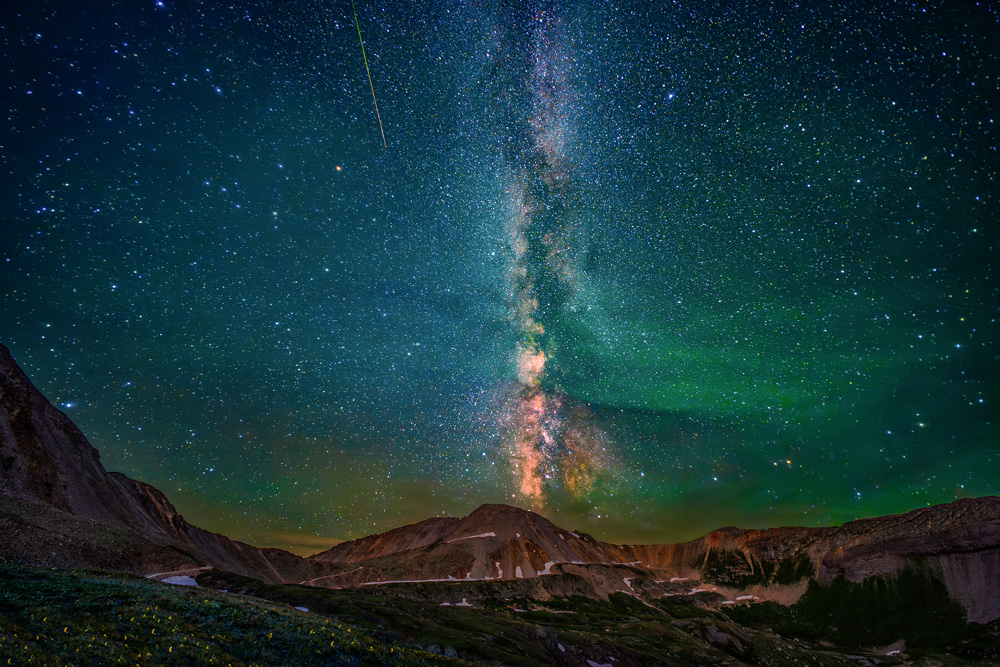
This is from 2 weeks ago in SW Colorado right below Black Bear Pass a 4x4 road. The Perseids meteor shower was just in it's early stages, so every so often there was a pretty spectacular meteor come crashing into the scene.

I shot this with my Laowa 10mm f2.8 Zero-D lens in a Manual version for the Nikon Z mount. With mirrorless, any Auto lenses are Focus by Wire which means the focusing ring doesn't actually connect directly to the focusing mechanism. So even if you tape the focus ring to maintain where the focus should be at night, when you turn off the camera or take the lens off, the focus is totally reset. So for me personally, I prefer manual focus lenses for my Night Time photgraphy.

Anyway, the Laowa holds up pretty good at f2.8, not perfect, but I would say for me that it's acceptable. And I love that at 10mm I am getting so much more of the Milky Way in the image without after to resort to multiple shots for a Pano image.

Along with the meteor, a few clouds started creeping in a bit and about that time the Airglow exploded with that green color in the sky.

I did blend in a twilight ground layer to get more detail in the ground.

Nikon Z6III (A really nice Milky Way Camera)
Laowa 10mm f2..8 Zero-D

25 secs
ISO 6400
f2.8

All comments are welcome,

Jim
_Z630286_dw.jpg
 

Michael13

Moderator
I shot this with my Laowa 10mm f2.8 Zero-D lens in a Manual version for the Nikon Z mount. With mirrorless, any Auto lenses are Focus by Wire which means the focusing ring doesn't actually connect directly to the focusing mechanism. So even if you tape the focus ring to maintain where the focus should be at night, when you turn off the camera or take the lens off, the focus is totally reset. So for me personally, I prefer manual focus lenses for my Night Time photgraphy.
I agree that manual focus lenses are much better for astro. When a lens has a hard stop at infinity, it's easy to set it once and know what you are getting. I would like to see more native manual focus lenses for the Z mount. If someone will make an all-manual 16mm F1.8 or 1.4 with low coma and vignetting, I will be all over it.

Having said that, Nikon does have a cool trick for astro built into the Nikon Z lenses. If you turn your camera off, then back on, it automatically focusses to infinity by default. It works with my Z 20mm f1.8 S lens.
 

JimFox

Moderator
Staff member
I agree that manual focus lenses are much better for astro. When a lens has a hard stop at infinity, it's easy to set it once and know what you are getting. I would like to see more native manual focus lenses for the Z mount. If someone will make an all-manual 16mm F1.8 or 1.4 with low coma and vignetting, I will be all over it.

Having said that, Nikon does have a cool trick for astro built into the Nikon Z lenses. If you turn your camera off, then back on, it automatically focusses to infinity by default. It works with my Z 20mm f1.8 S lens.
Thanks Michael.

I think it's been years since the hard stop at infinity on a manual lens got the DOF I needed to get the ground layer and the stars in focus. I usually have to back off a bit from infinity to get that. Like the Laowa 14mm I used for this, the focus was set just short of infinity. I just got a 7Artisans 14mm f2.8 that just came out. I wanted to test it to keep it as a backup lens in my kit. It's basically a better built Samyang. But when I tested it the other day, all the way to the hard stop on infinity, the ground was out of focus. So it had to be backed off to get my DOF I need.

The lens you want is a Viltrox 16mm f1.8. It's an AF lens, but it has a display on the lens that shows your focus distance. And it's super accurate and goes down to a 1/10th of a foot increments compared to the built in Focus Distance on the Nikon bodies themselves, that I haven't found accurate enough to rely on. So with the Viltrox I rotate the focus until it is between 19 to 30 feet, and my ground layer and stars are in perfect focus every time. It's a totally awesome lens, and I could not recommend it any higher.

That's an interesting trick, but it must only work on Nikon lenses? I had gotten a Meike 50mm f1.8 in the Z mount, and when it powers on, it actually initiates an AF all by itself. Which was horrible when I was using it to catch a comet last year. I would have the lens in focus, but if the camera powered down after 1 minute on it's own, when I touched it to get it to power back up, the Meike lens did the AF routine (Even though it was switched to Manual Focus), and now the sky was blurry. I don't have any fast Nikon lenses that I use at night to test what you are saying, that would be a cool feature to at least get the focus close to what would be needed.
 

Michael13

Moderator
Thanks Michael.

I think it's been years since the hard stop at infinity on a manual lens got the DOF I needed to get the ground layer and the stars in focus. I usually have to back off a bit from infinity to get that. Like the Laowa 14mm I used for this, the focus was set just short of infinity. I just got a 7Artisans 14mm f2.8 that just came out. I wanted to test it to keep it as a backup lens in my kit. It's basically a better built Samyang. But when I tested it the other day, all the way to the hard stop on infinity, the ground was out of focus. So it had to be backed off to get my DOF I need.

The lens you want is a Viltrox 16mm f1.8. It's an AF lens, but it has a display on the lens that shows your focus distance. And it's super accurate and goes down to a 1/10th of a foot increments compared to the built in Focus Distance on the Nikon bodies themselves, that I haven't found accurate enough to rely on. So with the Viltrox I rotate the focus until it is between 19 to 30 feet, and my ground layer and stars are in perfect focus every time. It's a totally awesome lens, and I could not recommend it any higher.

That's an interesting trick, but it must only work on Nikon lenses? I had gotten a Meike 50mm f1.8 in the Z mount, and when it powers on, it actually initiates an AF all by itself. Which was horrible when I was using it to catch a comet last year. I would have the lens in focus, but if the camera powered down after 1 minute on it's own, when I touched it to get it to power back up, the Meike lens did the AF routine (Even though it was switched to Manual Focus), and now the sky was blurry. I don't have any fast Nikon lenses that I use at night to test what you are saying, that would be a cool feature to at least get the focus close to what would be needed.
I am focusing too close to my foreground to be able to also get the stars in focus in a single frame. So one infinity frame for stars and another frame focused on whatever hoodoo is in front of me. This works for me. Right now 20mm is as wide as I go. Wider than that and the stars seem too distant to me, but I think I might try it at 16mm if a good MF lens comes along.
I should sell my tracker and other nightscape gear, I never use it anymore, I'm too sleepy to stay up for astronauts anymore! 😁
 

JimFox

Moderator
Staff member
I am focusing too close to my foreground to be able to also get the stars in focus in a single frame. So one infinity frame for stars and another frame focused on whatever hoodoo is in front of me. This works for me. Right now 20mm is as wide as I go. Wider than that and the stars seem too distant to me, but I think I might try it at 16mm if a good MF lens comes along.
I should sell my tracker and other nightscape gear, I never use it anymore, I'm too sleepy to stay up for astronauts anymore! 😁
20mm is good, though I never go that tight myself, but I like the way the MW frames up at 20mm. But I like never shoot it that tight, but I have thought about it a time or too. I did get a fast 24mm but only tried it once, I am hooked on 14mm and 16mm. I am really liking the 10mm too. I don't like that it's f2.8, but it's the price I have to pay.

Now I did crop one of the 10mm tighter to be about 24mm, I need to post it. So that's one way to shoot with the 14mm but get a tighter look.

I use Hyperfocal distance with mine because I am doing Timelapse's, so I have to get everything in focus in one image.
 
This is from 2 weeks ago in SW Colorado right below Black Bear Pass a 4x4 road. The Perseids meteor shower was just in it's early stages, so every so often there was a pretty spectacular meteor come crashing into the scene.

I shot this with my Laowa 10mm f2.8 Zero-D lens in a Manual version for the Nikon Z mount. With mirrorless, any Auto lenses are Focus by Wire which means the focusing ring doesn't actually connect directly to the focusing mechanism. So even if you tape the focus ring to maintain where the focus should be at night, when you turn off the camera or take the lens off, the focus is totally reset. So for me personally, I prefer manual focus lenses for my Night Time photgraphy.

Anyway, the Laowa holds up pretty good at f2.8, not perfect, but I would say for me that it's acceptable. And I love that at 10mm I am getting so much more of the Milky Way in the image without after to resort to multiple shots for a Pano image.

Along with the meteor, a few clouds started creeping in a bit and about that time the Airglow exploded with that green color in the sky.

I did blend in a twilight ground layer to get more detail in the ground.

Nikon Z6III (A really nice Milky Way Camera)
Laowa 10mm f2..8 Zero-D

25 secs
ISO 6400
f2.8

All comments are welcome,

Jim

View attachment 83668
Jim, this is beautifully captured. I have seen many meteor stars, more often the stars don't fly in the right direction though.

Oliver
 
Top Bottom