

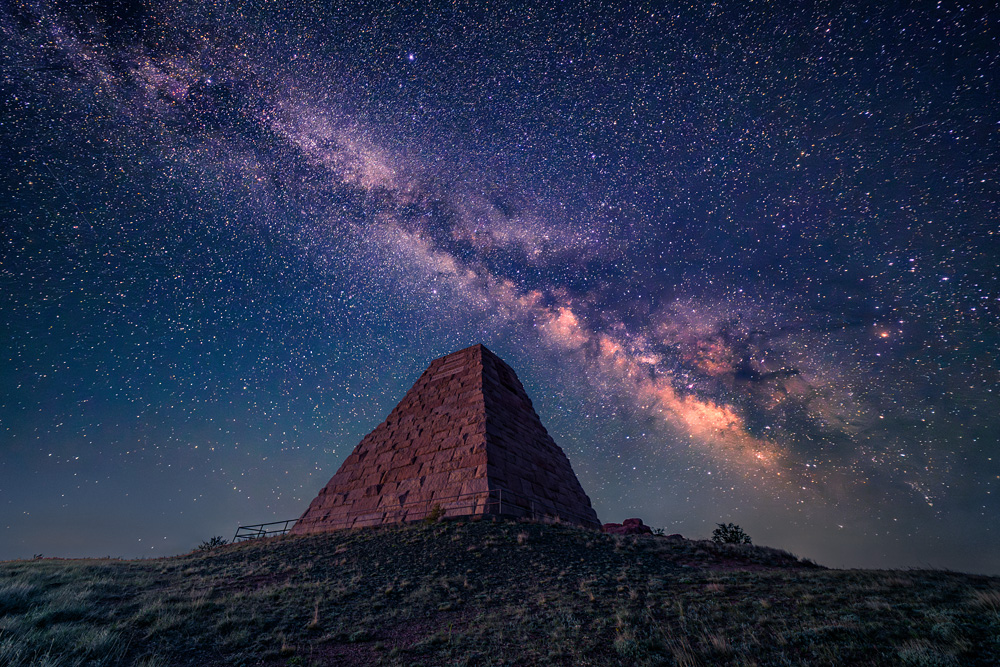
Here is my Milky Way from the Ames Memorial in Wyoming from 2 weeks ago. I had very small windows of time last new moon. I had lot's of family things in Colorado. I had planned to be back in California where there was clear skies for days at Death Valley, etc. But up in Colorado, that whole area was mainly clouded over going up into Wyoming, South Dakota, Nebraska. But 3 days before the New moon hit, it was Tuesday, and it was forecast to be clear. Now I prefer to capture the Milky Way at the new moon, or the 3 days after, not 3 days before as the moon rises inside the Milky Way and can wash it out.
But, it was a case of I had to take what I was given and after I picked up the grandkids from school, I dropped them off at my daughters and I then loaded my gear and drove up into Wyoming to Ames Memorial. I have captured Ames Memorial before, I have even done a video travel guide for it, but I haven't captured the Milky Way. Ames Memorial is off the I-80 between Cheyenne and Laramie. It is on the South side of the freeway, and a super cool place, Vedauwoo Recreation Area which has all of these cool rocks is to the North off the same exit. So as I was driving, I was mentally flipping coins should I go to Ames or Vedauwoo? In the end I went with Ames as I have not seen any Milky Way images from there, and I thought capturing the Milky Way over a pyramid in America was something a bit different.
This was captured on my Nikon Z8 with the Laowa 10mm Zero D f2.8 Manual Focus version. For those not realizing, with Mirrorless, one of the worst aspects of them to me, is the lack of a real actual Focus distance scale because they all are now Focus by Wire. There is no longer a mechanical connection between the focus ring and the focusing. So at night, I can't turn the lens to Manual from AF like you would with a DSLR and be able to turn the focus to a predetermined distance. So when I decided I wanted to get the 10mm Zero-D 2 years ago when it was released, I saw they made a manual focus version as well as the AF version for the Nikon Z mount. I bought the manual focus version as I wanted to be able to have a direct focus ring to focus mechanism connection. So there is no guess work as to getting it in focus. After a couple of trial runs, I know exactly where I want the focus to be to have both the ground and stars in focus, and I have it duct taped in that spot.
This is a f2.8 lens, so it's a bit slower then what I have spoiled myself with now. All of my regular night time lenses are f1.4 to f1.8. So buying a lens that's f2.8 made me a little squeamish. Even though 10 years ago f2.8 was a super fast lens, it's no longer the case. Fortunately, our post processing software cleans up noise now way better then it used to, so even though I shot this at ISO 5000, it still resulted in a pretty clean image.
The lens has a bit more vignetting then is sometimes the case on these fast Wide Angle lenses, but it cleans up pretty well. It's got some Coma in the corners at f2.8, but again not super bad, but if you look you can see it. Myself I am typically looking at the ground object and the Milky Way, so my eyes don't spend much time pixel peeping in the corners. Also since it's 10mm wide, it's easy to do a small crop and lose the corners if one chooses, that's what I did with this image.
Enough blabbering.
Nikon Z8
Laowa 10mm Zero-D f2.8
25 secs
f2.8
ISO 5000
All comments are welcome,
Jim
But, it was a case of I had to take what I was given and after I picked up the grandkids from school, I dropped them off at my daughters and I then loaded my gear and drove up into Wyoming to Ames Memorial. I have captured Ames Memorial before, I have even done a video travel guide for it, but I haven't captured the Milky Way. Ames Memorial is off the I-80 between Cheyenne and Laramie. It is on the South side of the freeway, and a super cool place, Vedauwoo Recreation Area which has all of these cool rocks is to the North off the same exit. So as I was driving, I was mentally flipping coins should I go to Ames or Vedauwoo? In the end I went with Ames as I have not seen any Milky Way images from there, and I thought capturing the Milky Way over a pyramid in America was something a bit different.
This was captured on my Nikon Z8 with the Laowa 10mm Zero D f2.8 Manual Focus version. For those not realizing, with Mirrorless, one of the worst aspects of them to me, is the lack of a real actual Focus distance scale because they all are now Focus by Wire. There is no longer a mechanical connection between the focus ring and the focusing. So at night, I can't turn the lens to Manual from AF like you would with a DSLR and be able to turn the focus to a predetermined distance. So when I decided I wanted to get the 10mm Zero-D 2 years ago when it was released, I saw they made a manual focus version as well as the AF version for the Nikon Z mount. I bought the manual focus version as I wanted to be able to have a direct focus ring to focus mechanism connection. So there is no guess work as to getting it in focus. After a couple of trial runs, I know exactly where I want the focus to be to have both the ground and stars in focus, and I have it duct taped in that spot.
This is a f2.8 lens, so it's a bit slower then what I have spoiled myself with now. All of my regular night time lenses are f1.4 to f1.8. So buying a lens that's f2.8 made me a little squeamish. Even though 10 years ago f2.8 was a super fast lens, it's no longer the case.
Fortunately, our post processing software cleans up noise now way better then it used to, so even though I shot this at ISO 5000, it still resulted in a pretty clean image.The lens has a bit more vignetting then is sometimes the case on these fast Wide Angle lenses, but it cleans up pretty well. It's got some Coma in the corners at f2.8, but again not super bad, but if you look you can see it. Myself I am typically looking at the ground object and the Milky Way, so my eyes don't spend much time pixel peeping in the corners. Also since it's 10mm wide, it's easy to do a small crop and lose the corners if one chooses, that's what I did with this image.
Enough blabbering.
Nikon Z8
Laowa 10mm Zero-D f2.8
25 secs
f2.8
ISO 5000
All comments are welcome,
Jim


