

(The purpose of this is to demonstrate to anyone who has a wider Narrowband OSC filter like the Optolong L-Enhance just how much of an improvement there will be to their subs if they go to a narrower Narrowband filter like the Antlia ALP-T filter.)
I just picked up the Antlia ALP-T 5nm Dual Band filter as a stronger light pollution filter then my current Optolong L-Enhance filter. First thing I wanted to do was test to see how much of an improvement the Antlia would provide for me.
The Antlia ALP-T is a Ha and OIII filter with both bands being 5nm
The Optolong L-Enhance has Ha at 10nm and OIII is 24nm.
So the Antlia is a big jump in terms of how narrow it's wavelengths are. In terms of a real comparison as to a comparison the Antlia ALP-T actually fits between the L-Extreme (7nm) and the L-Ultimate (3nm).
For those reading this that aren't Astrophotographers the biggest effect in terms of using it is the more narrow the the band pass, the darker and less light it will let in. So going from that 10nm/24nm combo I had in the L-Enhance to the 5nm of the ALP-T is going to really increase my exposure times. In fact my exposure for the Tadpoles Nebula was 180 seconds with the L-Enhance, I had to increase it to 600 seconds for the ALP-T for the same exposure. 600 seconds or 10 minute exposures are nothing to sneeze at. A lot of Astrophotographers won't do 10 minute exposures as it requires the astro rig to be set up almost perfectly in terms of balance, polar alignment and guiding. I am fortunate that my setup runs 10 minute exposures really well, so that's not an issue for me.
So here are the two images, processed exactly the same in Pixinsight, with the same exact default settings in Background Neutralization, Color Calibration, SCNR, ABE, DBE, BlurExterminator, NoiseXterminator and EZStretch. Both images have pretty similar integration times as well.
1. Optolong L-Enhance 180 sec exposures for a total of almost 7 hours
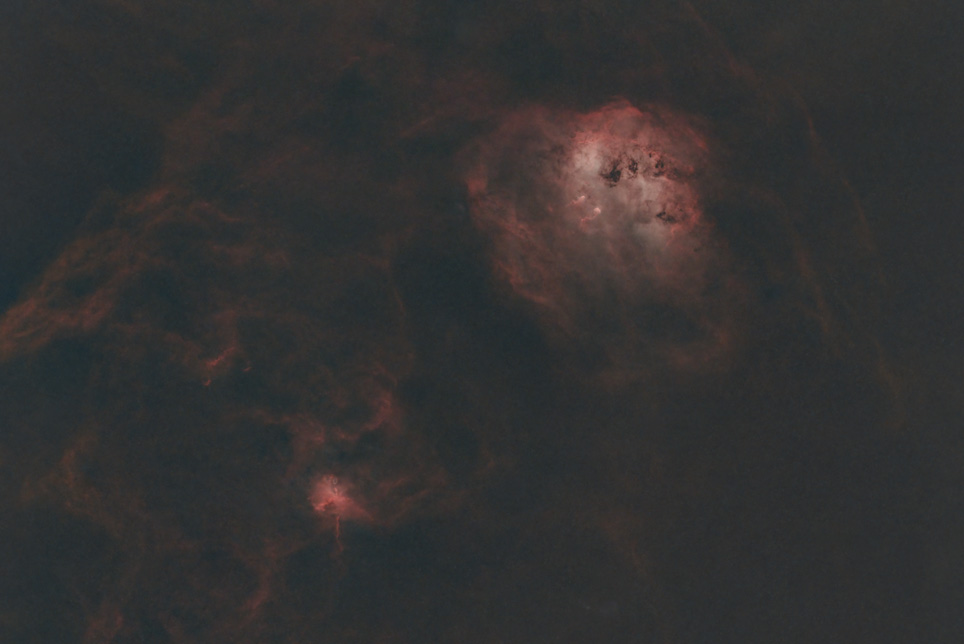
2. Antlia ALP-T with 600 sec exposures for a total of almost 7 hours

The biggest thing I noticed was a stronger Ha signal and a lot more contrast. Remember there is no extra stretching or processing. These both are basically as close to straight out of the camera as one can get so they essentially are still in a raw state. One other thing to note, and I haven't posted them, but the stars are much more controlled also by the Antlia ALP-T. I didn't see any flaring around the stars, but that's typically reserved for really bright stars anyway. So I need to test that still.
For anyone interested who is ready to take a jump up from the L-Pro or L-Enhance filters to a narrower filter, I hope showing what the Antlia ALP-T can do is helpful.
Jim
I just picked up the Antlia ALP-T 5nm Dual Band filter as a stronger light pollution filter then my current Optolong L-Enhance filter. First thing I wanted to do was test to see how much of an improvement the Antlia would provide for me.
The Antlia ALP-T is a Ha and OIII filter with both bands being 5nm
The Optolong L-Enhance has Ha at 10nm and OIII is 24nm.
So the Antlia is a big jump in terms of how narrow it's wavelengths are. In terms of a real comparison as to a comparison the Antlia ALP-T actually fits between the L-Extreme (7nm) and the L-Ultimate (3nm).
For those reading this that aren't Astrophotographers the biggest effect in terms of using it is the more narrow the the band pass, the darker and less light it will let in. So going from that 10nm/24nm combo I had in the L-Enhance to the 5nm of the ALP-T is going to really increase my exposure times. In fact my exposure for the Tadpoles Nebula was 180 seconds with the L-Enhance, I had to increase it to 600 seconds for the ALP-T for the same exposure. 600 seconds or 10 minute exposures are nothing to sneeze at. A lot of Astrophotographers won't do 10 minute exposures as it requires the astro rig to be set up almost perfectly in terms of balance, polar alignment and guiding. I am fortunate that my setup runs 10 minute exposures really well, so that's not an issue for me.
So here are the two images, processed exactly the same in Pixinsight, with the same exact default settings in Background Neutralization, Color Calibration, SCNR, ABE, DBE, BlurExterminator, NoiseXterminator and EZStretch. Both images have pretty similar integration times as well.
1. Optolong L-Enhance 180 sec exposures for a total of almost 7 hours
2. Antlia ALP-T with 600 sec exposures for a total of almost 7 hours
The biggest thing I noticed was a stronger Ha signal and a lot more contrast. Remember there is no extra stretching or processing. These both are basically as close to straight out of the camera as one can get so they essentially are still in a raw state. One other thing to note, and I haven't posted them, but the stars are much more controlled also by the Antlia ALP-T. I didn't see any flaring around the stars, but that's typically reserved for really bright stars anyway. So I need to test that still.
For anyone interested who is ready to take a jump up from the L-Pro or L-Enhance filters to a narrower filter, I hope showing what the Antlia ALP-T can do is helpful.
Jim
Last edited:


