

Bill Richards
Well-Known Member
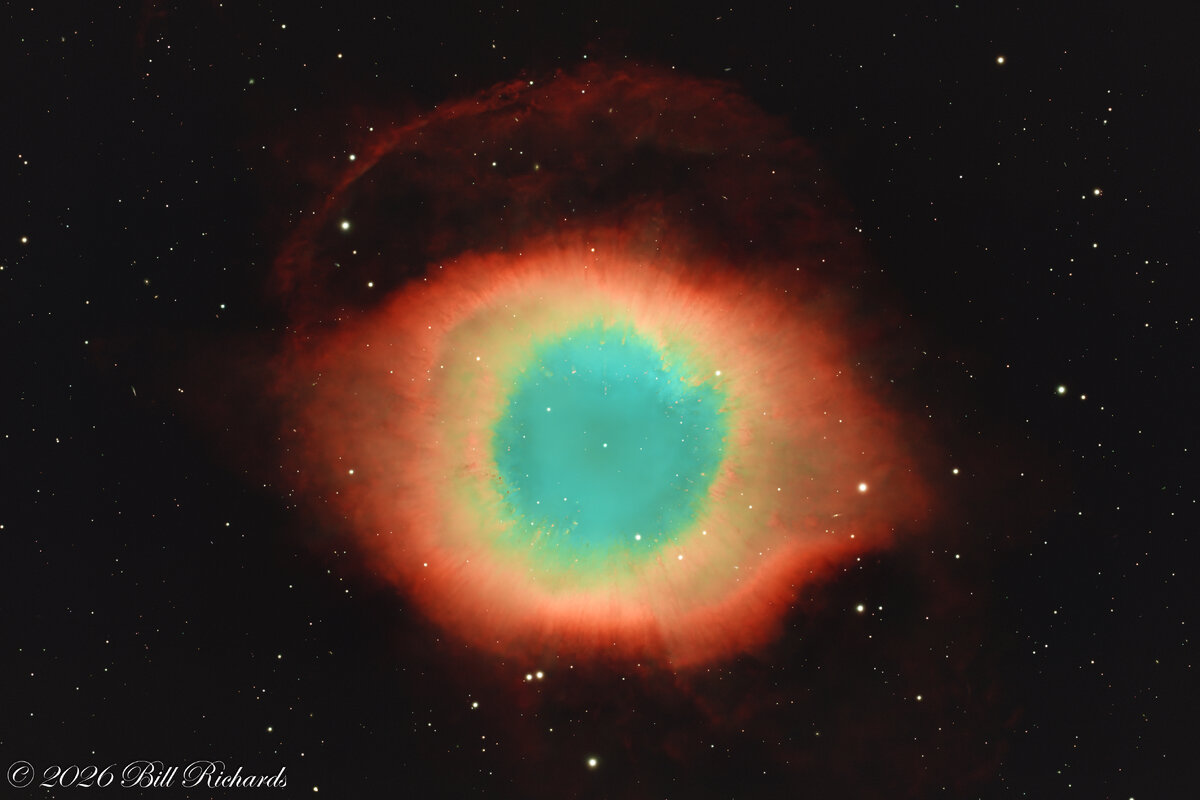
I posted a version of this two years ago but was able to gather more data on it last week and use improved processing techniques to obtain a much improved result. The Helix Nebula (NGC 7293), affectionately known as the "Eye of Sauron", is a colorful planetary nebula about 650 light-years away, formed by a star which shed its outer layers near the end of its life. The remnant central stellar core will eventually become a white dwarf. The observed glow of the central star is so energetic that it causes the expelled gases to brightly fluoresce. From Earth's perspective, those gases appear as a helix structure.
This is the result of over 12.5 hours of exposure time taken on 2023-09-15, 2024-09-27, 2024-10-04, and 2026-09-11.
Equipment and Software:
=======================
Mount: iOptron CEM40 w/iPolar and 10Micron GM1000HPS w/PoleMaster
Telescope: Celestron EdgeHD 8 w/0.7x focal reducer
Auto-Focuser: Rigel Systems nFOCUS
Imaging Camera: ASI2600MC-Pro and ASI2600MC-Duo
Filters: AstroHutech IDAS NBZ and Optolong L-Ultimate dual band
Guide Camera: ASI174MM-Mini on OAG
Imaging Software: NINA
Guiding Software: PHD2
Image Processing Software: PixInsight
Exposure Details:
=================
Camera Temperature -10C
Bias: 50
Gain: 100
39 x 240s & 120 x 300s
Plus 32x Darks, Flats, and Dark Flats
#HelixNebula #NGC7293 #amateurastrophotography #asi2600mc #asiweek #astronomy #astronomyphotography #astronomypicturesdaily #astrophotography #cosmos #deepsky #deepskyobject #longexposure #nasa #nebula #nightphotography #nightsky #outerspace #photography #science #skyandtelescopemag #space #spacephotography #stargazing #stars #telescope #universe
This is the result of over 12.5 hours of exposure time taken on 2023-09-15, 2024-09-27, 2024-10-04, and 2026-09-11.
Equipment and Software:
=======================
Mount: iOptron CEM40 w/iPolar and 10Micron GM1000HPS w/PoleMaster
Telescope: Celestron EdgeHD 8 w/0.7x focal reducer
Auto-Focuser: Rigel Systems nFOCUS
Imaging Camera: ASI2600MC-Pro and ASI2600MC-Duo
Filters: AstroHutech IDAS NBZ and Optolong L-Ultimate dual band
Guide Camera: ASI174MM-Mini on OAG
Imaging Software: NINA
Guiding Software: PHD2
Image Processing Software: PixInsight
Exposure Details:
=================
Camera Temperature -10C
Bias: 50
Gain: 100
39 x 240s & 120 x 300s
Plus 32x Darks, Flats, and Dark Flats
#HelixNebula #NGC7293 #amateurastrophotography #asi2600mc #asiweek #astronomy #astronomyphotography #astronomypicturesdaily #astrophotography #cosmos #deepsky #deepskyobject #longexposure #nasa #nebula #nightphotography #nightsky #outerspace #photography #science #skyandtelescopemag #space #spacephotography #stargazing #stars #telescope #universe


