

Tips and tricks to get great looking waterfalls.
There are several keys to good looking waterfall photographs. These pertain to conditions and techniques.
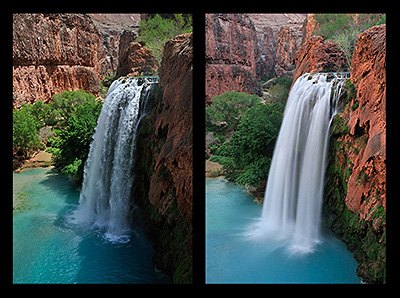
Photo on the left is a fast Shutter Speed, the Photo on the right is a slow Shutter Speed.
Conditions:
1. Overcast or even rainy days work best as they shade the water from sun hitting parts of the water and creating hot spots that can easily blown out.
2. Early morning or late evening are also great options if they cause the area around the waterfall to be in shade, which again helps provide uniform lighting.
Uniform lighting usually looks best with waterfalls, speckled lighting provides a confusing visual view for the viewer.
Technique:
1. For the water, usually 1/5th of a second Shutter Speed provides for nice silky water.
2. If your Shutter Speed is longer then 1 second, the movement of the water becomes lost and much of the water turns into what looks like blobs of milk and void of detail.
3. Sometimes you do want to freeze the water capturing every droplet of water spray and movement. Then typically you will want to have a Shutter Speed in the range of 1/200th to 1/400th depending on just how fast the water is flowing.
4. Be sure to use a Polarizer. It is crucial to block the reflections of light off of leaves and especially the water. But there will be times when the water has the ability to reflect color off of the sun in these cases you would back off on the Polarizer adjustment to allow the water to reflect the color.
Additional Consideration:
If it's a windy day and there are leaves or grasses moving, then there is an issue with shooting a slower shutter speed to capture that silky water look. The leaves and grasses will be moving in the scene, most often causing those areas to look out of focus, or just simply distracting.
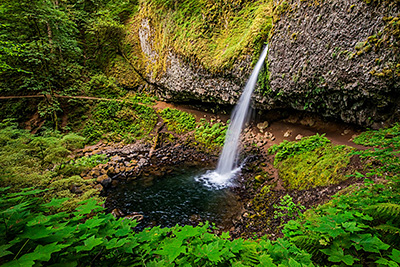
The following Photography had leaves that were blurry.
The solution is to take 2 images, the first for the water, and then a 2nd photo at a faster shutter speed to freeze the movement of the leaves and grasses. How fast the Shutter Speed needs to be will depend on just how hard the wind is blowing. But usually the range of 1/30th to 1/200th of a second will work. Since you won't want to change your Depth of Field, you won't want to change your Aperture (F stop), but instead you will raise your ISO up. There can be concern for increased noise with increasing the ISO, but since most often it won't be noticed as it will end up only affecting small area's.
Back at home when processing this image, you will use a layer mask to paint in the sharp leaves from the image at the faster Shutter Speed into the image with the slow Shutter Speed for the water.
The end result will be a very nice waterfall image!
There are several keys to good looking waterfall photographs. These pertain to conditions and techniques.
Photo on the left is a fast Shutter Speed, the Photo on the right is a slow Shutter Speed.
Conditions:
1. Overcast or even rainy days work best as they shade the water from sun hitting parts of the water and creating hot spots that can easily blown out.
2. Early morning or late evening are also great options if they cause the area around the waterfall to be in shade, which again helps provide uniform lighting.
Uniform lighting usually looks best with waterfalls, speckled lighting provides a confusing visual view for the viewer.
Technique:
1. For the water, usually 1/5th of a second Shutter Speed provides for nice silky water.
2. If your Shutter Speed is longer then 1 second, the movement of the water becomes lost and much of the water turns into what looks like blobs of milk and void of detail.
3. Sometimes you do want to freeze the water capturing every droplet of water spray and movement. Then typically you will want to have a Shutter Speed in the range of 1/200th to 1/400th depending on just how fast the water is flowing.
4. Be sure to use a Polarizer. It is crucial to block the reflections of light off of leaves and especially the water. But there will be times when the water has the ability to reflect color off of the sun in these cases you would back off on the Polarizer adjustment to allow the water to reflect the color.
Additional Consideration:
If it's a windy day and there are leaves or grasses moving, then there is an issue with shooting a slower shutter speed to capture that silky water look. The leaves and grasses will be moving in the scene, most often causing those areas to look out of focus, or just simply distracting.
The following Photography had leaves that were blurry.
The solution is to take 2 images, the first for the water, and then a 2nd photo at a faster shutter speed to freeze the movement of the leaves and grasses. How fast the Shutter Speed needs to be will depend on just how hard the wind is blowing. But usually the range of 1/30th to 1/200th of a second will work. Since you won't want to change your Depth of Field, you won't want to change your Aperture (F stop), but instead you will raise your ISO up. There can be concern for increased noise with increasing the ISO, but since most often it won't be noticed as it will end up only affecting small area's.
Back at home when processing this image, you will use a layer mask to paint in the sharp leaves from the image at the faster Shutter Speed into the image with the slow Shutter Speed for the water.
The end result will be a very nice waterfall image!