

Eric Gofreed
Well-Known Member
It’s Winged Wednesday again, our weekly celebration where feathers, flutters, and flight steal the show! Whether they’re zipping, swooping, sunbathing, or just striking a sassy pose, we want to see your favorite winged wonders. Birds, bugs, bats, butterflies—if it’s got wings, it’s fair game! Each week, I choose a topic to highlight, but feel free to share whatever winged creatures inspire you!
This week, my contribution features the Nuthatches of North America, along with the Brown Creeper, which isn’t their closest relative but similarly forages on trees. Nuthatches are small, agile songbirds, best known for their ability to climb headfirst down tree trunks—a feat few birds can match. Compact and strong-billed, they forage by probing bark for insects, seeds, and nuts.
Though they resemble miniature woodpeckers, nuthatches aren’t closely related. The name “nuthatch” comes from their habit of wedging nuts into bark and “hacking” them open—originally “nut-hack.” There are 29 species worldwide, but only four in North America.
Next week: Dive Bombers

White-breasted Nuthatch classic pose: Found year-round across much of the U.S., southern Canada, and parts of northern Mexico. This nuthatch prefers mature deciduous forests with oaks, maples, or hickories but is also commonly seen in wooded parks and backyards. Bolder and more flexible than its relatives, it often forages in pairs, hopping along trunks and limbs. Unlike other nuthatches, it sometimes drops to the ground to find food. It also stores seeds in bark to eat later.

Red-breasted Nuthatch: The most colorful of North America’s nuthatches, this spruce-loving bird prefers conifer forests across Canada, the northern U.S., and into the mountains of the West. It’s a year-round resident in some areas but may irrupt southward in winter. Its nasal “yank-yank” call, reminiscent of a tiny toy trumpet, often gives it away before you spot it.
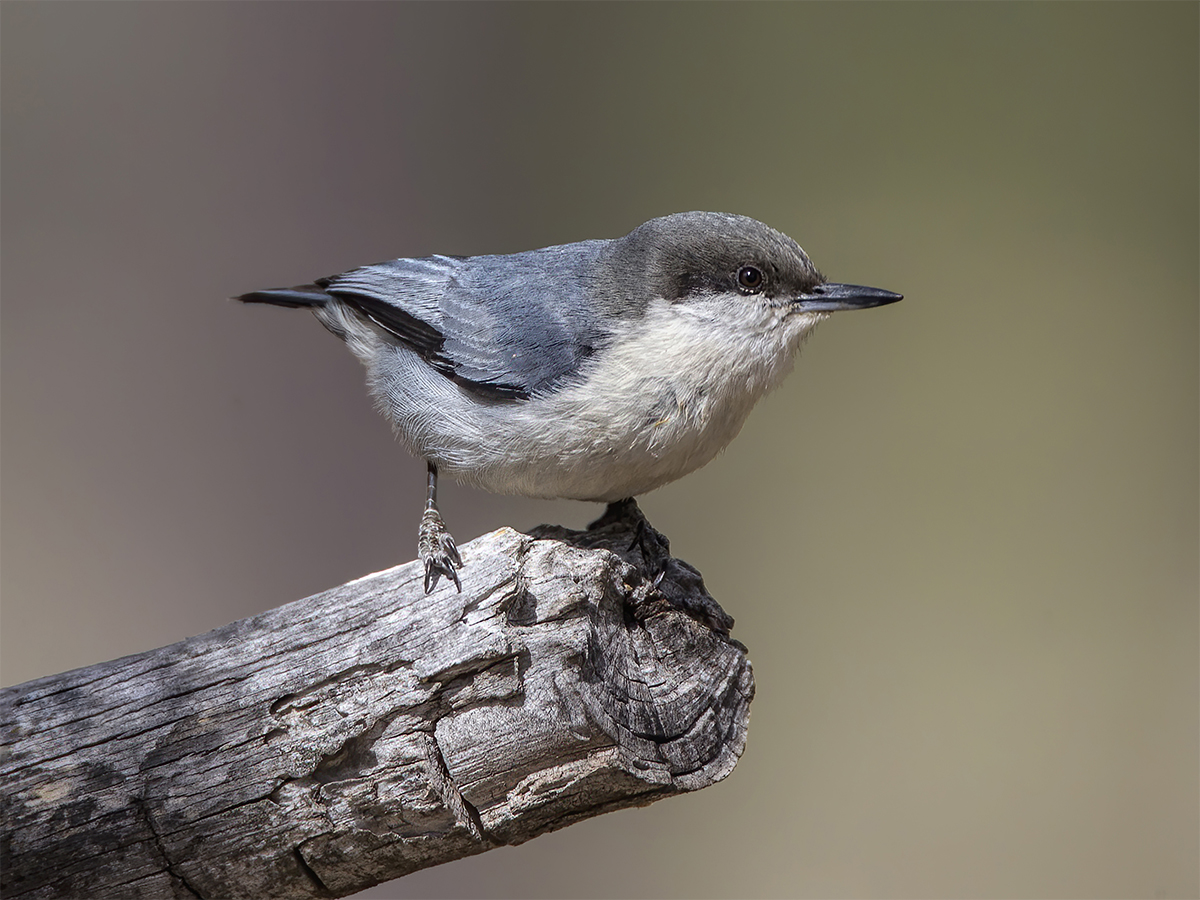
Pygmy Nuthatch: This tiny, energetic nuthatch is found in the pine forests of the western U.S., especially at higher elevations. Measuring just 4 inches long, it bounces through ponderosa pines in chattering flocks, hunting insects and seeds. Social and cooperative, it even roosts in groups to stay warm on cold nights.
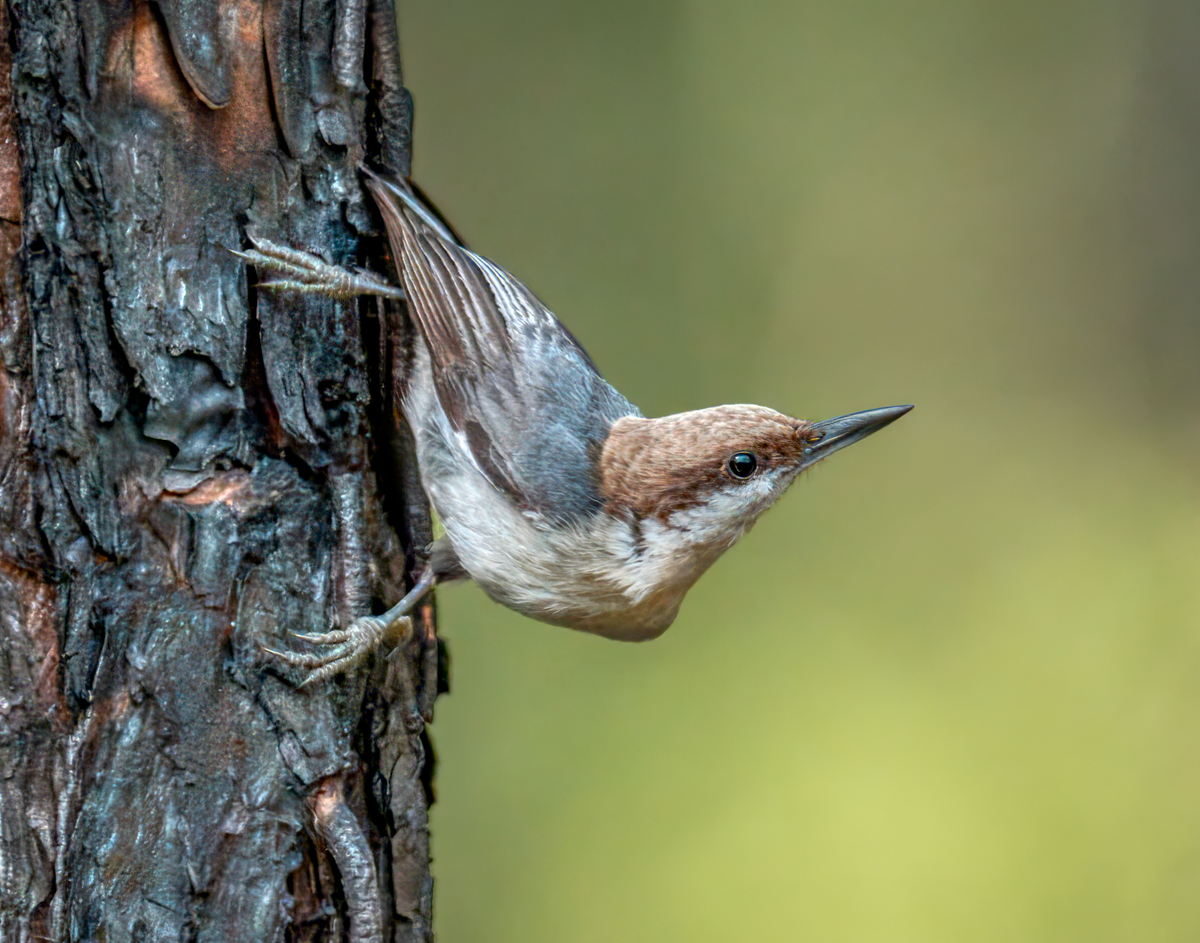
Brown-headed Nuthatch: A tiny pinewoods specialist of the southeastern U.S., this 4-inch dynamo flits through longleaf and loblolly pines, searching for insects in the bark and prying open pine seeds. Its soft brown cap and rubber-ducky call make it easy to recognize if you’re in its range.
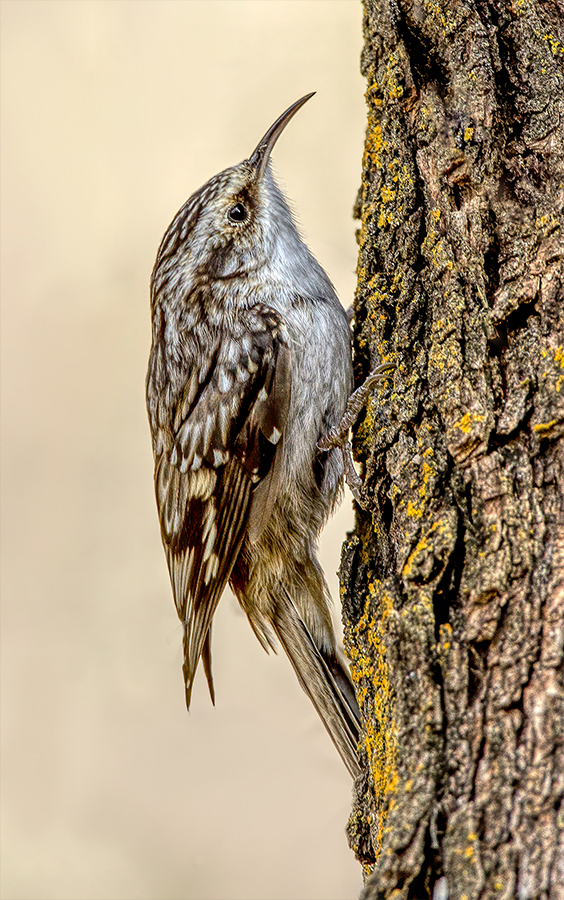
Brown Creeper: A tiny, bark-colored bird that spirals up tree trunks in search of insects, using its curved bill to probe crevices. Found across much of North America, it prefers mature forests, especially those with large trees. Unlike nuthatches, which move headfirst down, the Brown Creeper always climbs upward, then drops to the base of another tree to start again. Its soft, high-pitched call is easy to miss and reminiscent of the first few thin notes of a Golden-crowned Kinglet, though without the kinglet’s finishing song.
And on a lighter note: many flatulent birders have been known to call out “Brown Creeper!” when they fart.
This week, my contribution features the Nuthatches of North America, along with the Brown Creeper, which isn’t their closest relative but similarly forages on trees. Nuthatches are small, agile songbirds, best known for their ability to climb headfirst down tree trunks—a feat few birds can match. Compact and strong-billed, they forage by probing bark for insects, seeds, and nuts.
Though they resemble miniature woodpeckers, nuthatches aren’t closely related. The name “nuthatch” comes from their habit of wedging nuts into bark and “hacking” them open—originally “nut-hack.” There are 29 species worldwide, but only four in North America.
Next week: Dive Bombers
White-breasted Nuthatch classic pose: Found year-round across much of the U.S., southern Canada, and parts of northern Mexico. This nuthatch prefers mature deciduous forests with oaks, maples, or hickories but is also commonly seen in wooded parks and backyards. Bolder and more flexible than its relatives, it often forages in pairs, hopping along trunks and limbs. Unlike other nuthatches, it sometimes drops to the ground to find food. It also stores seeds in bark to eat later.
Red-breasted Nuthatch: The most colorful of North America’s nuthatches, this spruce-loving bird prefers conifer forests across Canada, the northern U.S., and into the mountains of the West. It’s a year-round resident in some areas but may irrupt southward in winter. Its nasal “yank-yank” call, reminiscent of a tiny toy trumpet, often gives it away before you spot it.
Pygmy Nuthatch: This tiny, energetic nuthatch is found in the pine forests of the western U.S., especially at higher elevations. Measuring just 4 inches long, it bounces through ponderosa pines in chattering flocks, hunting insects and seeds. Social and cooperative, it even roosts in groups to stay warm on cold nights.
Brown-headed Nuthatch: A tiny pinewoods specialist of the southeastern U.S., this 4-inch dynamo flits through longleaf and loblolly pines, searching for insects in the bark and prying open pine seeds. Its soft brown cap and rubber-ducky call make it easy to recognize if you’re in its range.
Brown Creeper: A tiny, bark-colored bird that spirals up tree trunks in search of insects, using its curved bill to probe crevices. Found across much of North America, it prefers mature forests, especially those with large trees. Unlike nuthatches, which move headfirst down, the Brown Creeper always climbs upward, then drops to the base of another tree to start again. Its soft, high-pitched call is easy to miss and reminiscent of the first few thin notes of a Golden-crowned Kinglet, though without the kinglet’s finishing song.
And on a lighter note: many flatulent birders have been known to call out “Brown Creeper!” when they fart.
Last edited:

 I can't say I have seen one of these when I knew what I was looking at before.

