

Bill Richards
Well-Known Member
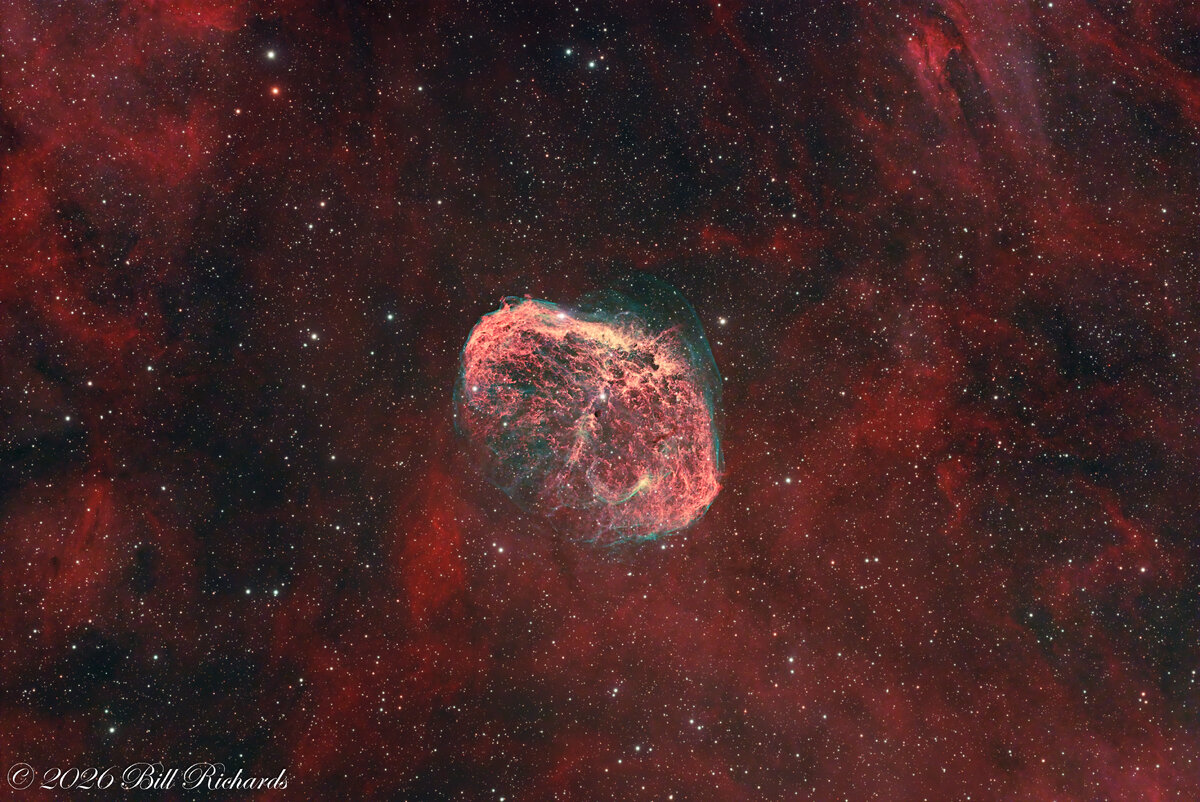
I posted this once before, but captured another 11.5 hours of data last week and the new version is (I think) much better.
The Crescent Nebula (aka NGC6888) is an emission nebula about 5000 light-years from Earth. It is formed by the fast stellar wind from a Wolf-Rayet star colliding with and energizing the slower moving wind ejected by the star when it became a red giant 250,000 - 400,000 years ago. The result of the collision is a shell and two shock waves, one moving outward and one moving inward. The inward moving shock wave heats the stellar wind to X-ray-emitting temperatures.
This is the result of nearly 15 hours of exposure time taken on 2023-07-14, 2023-09-08, and 2026-05-07 through 2026-05-11.
Equipment and Software:
=======================
Mounts: iOption CEM40 w/iPolar and Paramount MX+ Series 6
Telescope: Celestron EdgeHD 8 w/0.7x focal reducer and Astro-Physics AP155 6” refractor
Auto-Focuser: Rigel Systems nFOCUS and Optec FT30 Focuslynx
Imaging Camera: ASI2600MC-Pro and QHY268C
Filter: AstroHutech NBZ dual-band and Radian TriAd Quad
Guide Camera: ASI174MM-Mini on OAG
Imaging Software: NINA
Guiding Software: PHD2
Image Processing Software: PixInsight
Exposure Details:
=================
Camera Temperature -10C
49 x 240s (EdgeHD 8, ASI2600MC-Pro, and AstroHutech NBZ dual-band filter)
139 x 300s (AP155, QHY268C, and Radian TriAd Quad filter)
Plus 32x Darks, Flats, and Dark Flats
#CrescentNebula #NGC6888 #amateurastrophotography #astronomy #astronomyphotography #astrophotography #cosmos #deepsky #deepskyobject #longexposure #nebula #nightphotography #nightsky #outerspace #photography #science #space #spacephotography #stargazing #stars #telescope #universe
The Crescent Nebula (aka NGC6888) is an emission nebula about 5000 light-years from Earth. It is formed by the fast stellar wind from a Wolf-Rayet star colliding with and energizing the slower moving wind ejected by the star when it became a red giant 250,000 - 400,000 years ago. The result of the collision is a shell and two shock waves, one moving outward and one moving inward. The inward moving shock wave heats the stellar wind to X-ray-emitting temperatures.
This is the result of nearly 15 hours of exposure time taken on 2023-07-14, 2023-09-08, and 2026-05-07 through 2026-05-11.
Equipment and Software:
=======================
Mounts: iOption CEM40 w/iPolar and Paramount MX+ Series 6
Telescope: Celestron EdgeHD 8 w/0.7x focal reducer and Astro-Physics AP155 6” refractor
Auto-Focuser: Rigel Systems nFOCUS and Optec FT30 Focuslynx
Imaging Camera: ASI2600MC-Pro and QHY268C
Filter: AstroHutech NBZ dual-band and Radian TriAd Quad
Guide Camera: ASI174MM-Mini on OAG
Imaging Software: NINA
Guiding Software: PHD2
Image Processing Software: PixInsight
Exposure Details:
=================
Camera Temperature -10C
49 x 240s (EdgeHD 8, ASI2600MC-Pro, and AstroHutech NBZ dual-band filter)
139 x 300s (AP155, QHY268C, and Radian TriAd Quad filter)
Plus 32x Darks, Flats, and Dark Flats
#CrescentNebula #NGC6888 #amateurastrophotography #astronomy #astronomyphotography #astrophotography #cosmos #deepsky #deepskyobject #longexposure #nebula #nightphotography #nightsky #outerspace #photography #science #space #spacephotography #stargazing #stars #telescope #universe


