

Mike Lewis
Staff Member
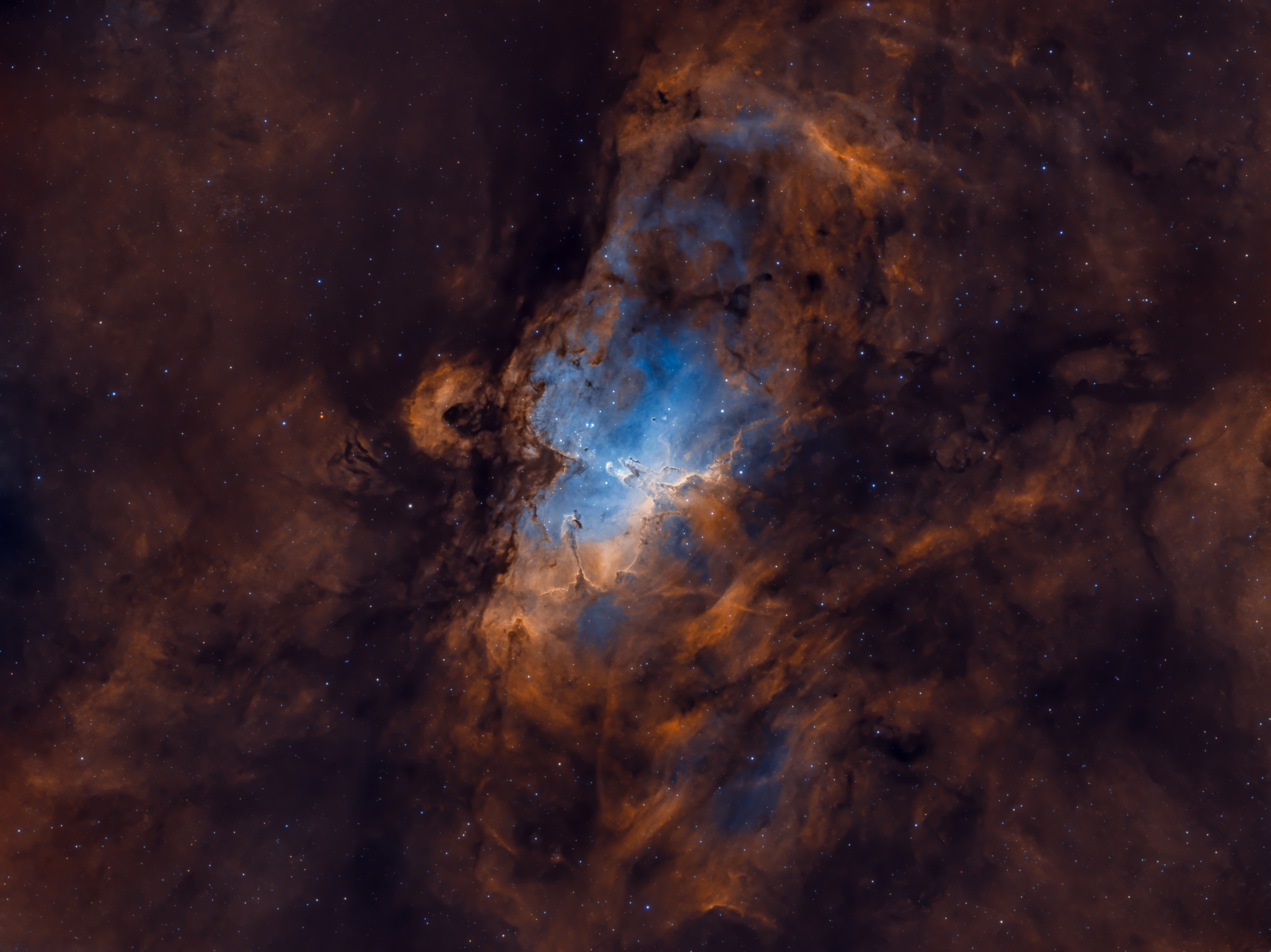
So here is the 2nd narrowband effort from my remote imaging in Green Valley, AZ. This was collected over a handful of nights in April and May of this year. The post processing was again time consuming, but not as bad as my Elephant Trunk, both because this is a brighter object, and also because I am starting to nail down the post processing steps that give me the results I am after, and avoid the ones that are unnecessary or dead ends. This is about 13 hours of data, mostly in narrowband, but with a very small amount of RGB star data thrown in to give my naturally colored stars. The fun thing about that technique is that when it works as desired, there is really no need for star reduction at all. In fact in this image, because I forgot to take any RGB data till the last night, I think the stars are perhaps too faint, but at least the star colors are pretty natural looking, with very few totally saturated stars.
So the Eagle Nebula is of course the location that the Hubble Telescope used to produce its famous 'Pillars of Creation' image. Those structures can be seen in the center of this image (much smaller of course ) It is hypothesized that the pillars may be in the process of being dissipated by the high energies of the nearby protostars that are forming, but because they are over 5000 light years away, they still appear intact from Earth.
Equipment:
ZWO ASI1600MM-C Camera @ -20C and
Gain:200 Offset:50
Software Bisque MyT Mount
Stellarvue SVQ100 Astrograph Refractor, 580mm @ f/5.8
Innovations Foresight ONAG
Software:
Pixinsight Commercial Version 1.8
Lightroom CC
Photoshop CC
Innovations Foresight SkyGuard
Light Frames:
Ha - 46 x 360 secs ( 4 hrs 36 mins)
OIII - 40 x 360 secs (4 hrs)
SII - 43 x 360 secs (4 hrs and 18 mins)
Red: 7 x 30 secs 3 mins 30 secs)
Green: 4 x 30 secs (3 mins 30 secs)
Blue: 7 x 30 secs (3 mins 30 secs)
13 hrs 4 mins 30 secs total
Dark Frames:
10 x 60 secs (20 mins)
Bias Frames
60
Flat Frames
20 each filter
Comments and critiques always appreciated.
ML
So the Eagle Nebula is of course the location that the Hubble Telescope used to produce its famous 'Pillars of Creation' image. Those structures can be seen in the center of this image (much smaller of course
) It is hypothesized that the pillars may be in the process of being dissipated by the high energies of the nearby protostars that are forming, but because they are over 5000 light years away, they still appear intact from Earth.Equipment:
ZWO ASI1600MM-C Camera @ -20C and
Gain:200 Offset:50
Software Bisque MyT Mount
Stellarvue SVQ100 Astrograph Refractor, 580mm @ f/5.8
Innovations Foresight ONAG
Software:
Pixinsight Commercial Version 1.8
Lightroom CC
Photoshop CC
Innovations Foresight SkyGuard
Light Frames:
Ha - 46 x 360 secs ( 4 hrs 36 mins)
OIII - 40 x 360 secs (4 hrs)
SII - 43 x 360 secs (4 hrs and 18 mins)
Red: 7 x 30 secs 3 mins 30 secs)
Green: 4 x 30 secs (3 mins 30 secs)
Blue: 7 x 30 secs (3 mins 30 secs)
13 hrs 4 mins 30 secs total
Dark Frames:
10 x 60 secs (20 mins)
Bias Frames
60
Flat Frames
20 each filter
Comments and critiques always appreciated.
ML


