

Mike Lewis
Staff Member
While I often aspire to getting that one image of an area that stands the test of time, it is certainly true that if one goes far enough back in the time in the hobby there are frequently images that were taken in the past that can be improved upon, and I think that is certainly the case with regard to this area of the sky for me.
So after a little more than 8 years, a revisit to this iconic area of the sky. While virtually every part of my gear setup besides the mount and OTA has changed in that time, it is always interesting to note how the objects themselves seem to be frozen in time, given there extreme distance from us. Of course, my post processing skills have also advanced, along with the tools available - all combining to give a more detailed view of this fascinating region.
Imaged in RGB filters with Hα added to the red channel. The processing of this was very challenging, due to some issues with my setup, and the presence of extremely bright stars in the FOV. I also ended up dialing back the saturation of the final result a little bit.
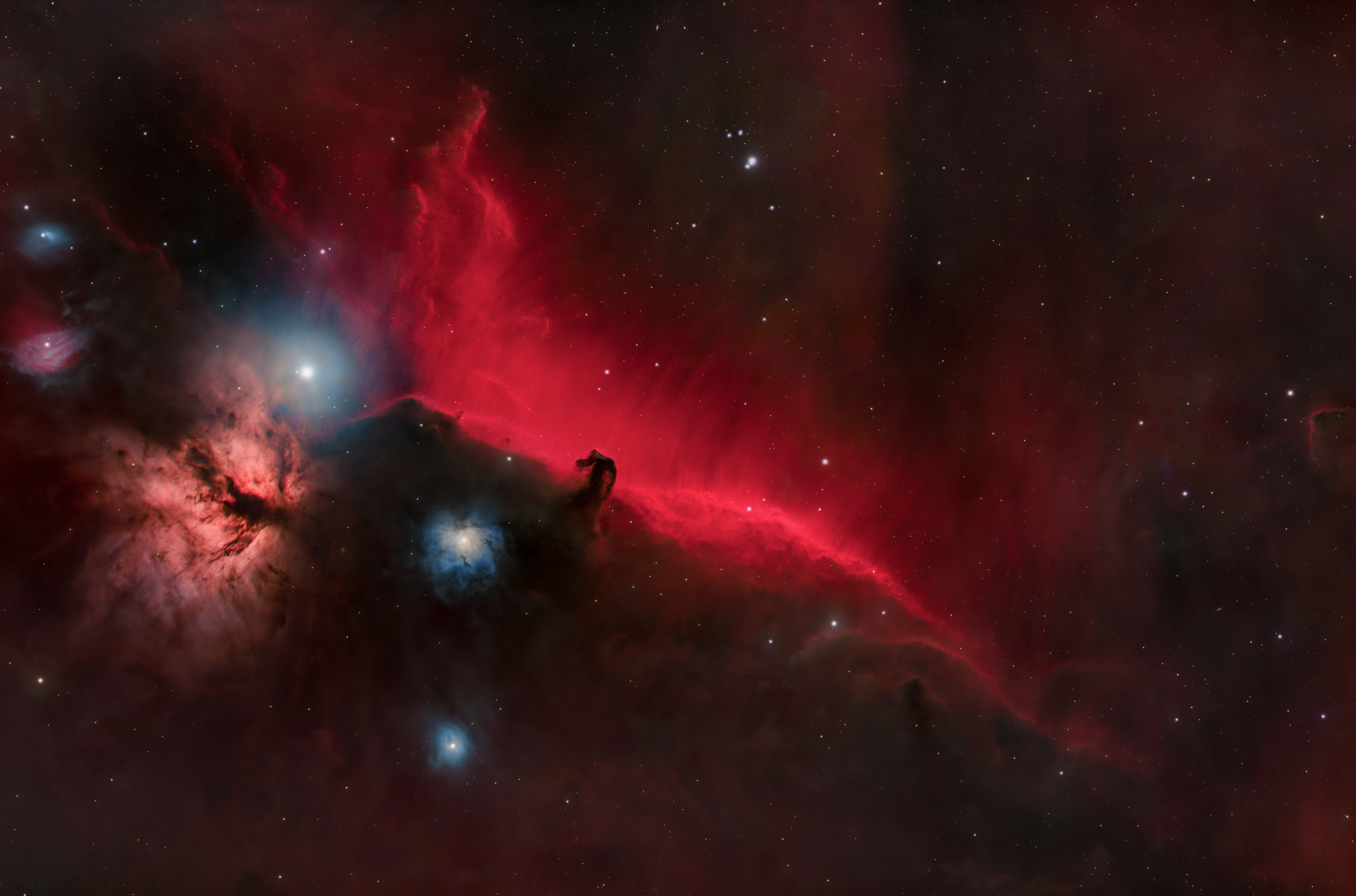
The famous Horsehead Nebula (a dark nebula designated as Barnard 33) is approximately centrally located in the frame, with the bright Orion belt star Alnitak to the upper left and the Flame Nebula below that. IC 434 is the bright emission nebula behind the Horsehead that highlights it so beautifully against the night sky.
Here is my newest attempt at the Horsehead:
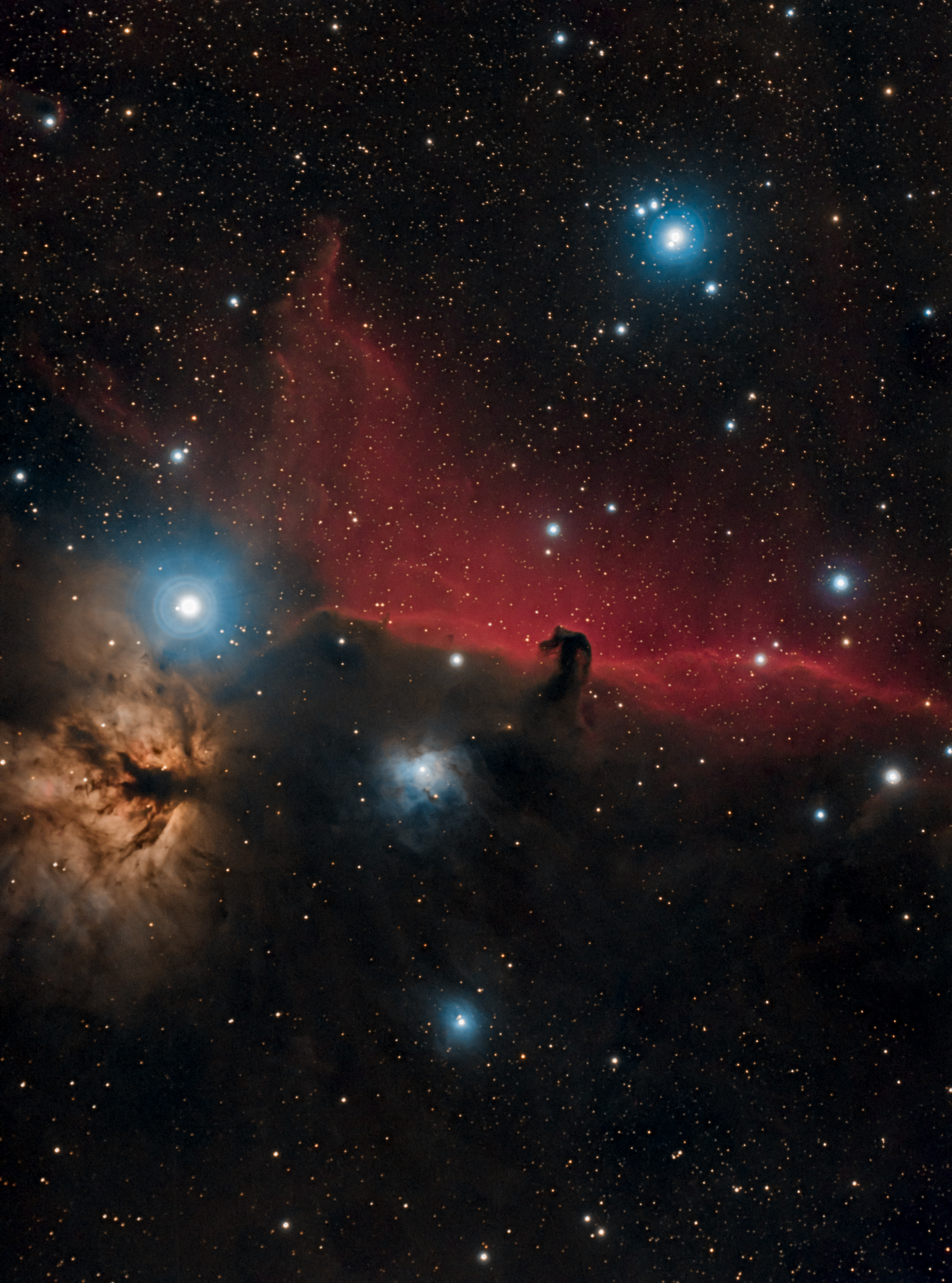
For comparison purposes here is my original attempt, rotated to present a similar orientation of the Horsehead. This was taken with a OSC camera and had only about 1/4th the imaging time. It was shot under slightly darker skies. But the big differences are likely in my post processing skills and the newer more capable tools available to us now. It is always fun to gauge one's progress in the hobby with these type of self-comparisons I think...
For the latest shot equipment and other details shown below...
Equipment:
QHY268M Camera @ -10C and
Gain:56 Offset:20 / Gain:0 Offset 20
Software Bisque MyT Mount
Stellarvue SVQ100 Astrograph Refractor, 580mm @ f/5.8
Antlia Pro Filters (3nm narrowband plus LRGB)
Askar FMA180 Guidescope/ASI290MM
Software:
Pixinsight Commercial Version 1.8
Lightroom CC
Photoshop CC
N.I.N.A. Control Software
BlurXTerminator (Russell Croman)
StarXTerminator (Russell Croman)
NoiseXTerminator (Russell Croman)
Light Frames:
Gain 56 / Offset 20
Ha: 22 x 60 secs (3 hrs 40 mins)
Red: 24 x 300 secs (2 hrs)
Green: 24 x 300 secs (2 hrs)
Blue: 23 x 300 secs (1 hr 55 mins)
Gain 0 / Offset 20
Red: 24 x 30 secs (12 mins)
Green: 24 x 30 secs (12 mins)
Blue: 23 x 30 secs (11 mins 30 secs)
10 hrs 10 mins 30 secs total
Dark Frames:
10 x 30 secs (5 mins)
10 x 300 secs (50 mins)
10 x 600 secs (1 hr 40 mins)
So after a little more than 8 years, a revisit to this iconic area of the sky. While virtually every part of my gear setup besides the mount and OTA has changed in that time, it is always interesting to note how the objects themselves seem to be frozen in time, given there extreme distance from us. Of course, my post processing skills have also advanced, along with the tools available - all combining to give a more detailed view of this fascinating region.
Imaged in RGB filters with Hα added to the red channel. The processing of this was very challenging, due to some issues with my setup, and the presence of extremely bright stars in the FOV. I also ended up dialing back the saturation of the final result a little bit.
The famous Horsehead Nebula (a dark nebula designated as Barnard 33) is approximately centrally located in the frame, with the bright Orion belt star Alnitak to the upper left and the Flame Nebula below that. IC 434 is the bright emission nebula behind the Horsehead that highlights it so beautifully against the night sky.
Here is my newest attempt at the Horsehead:
For comparison purposes here is my original attempt, rotated to present a similar orientation of the Horsehead. This was taken with a OSC camera and had only about 1/4th the imaging time. It was shot under slightly darker skies. But the big differences are likely in my post processing skills and the newer more capable tools available to us now. It is always fun to gauge one's progress in the hobby with these type of self-comparisons I think...
For the latest shot equipment and other details shown below...
Equipment:
QHY268M Camera @ -10C and
Gain:56 Offset:20 / Gain:0 Offset 20
Software Bisque MyT Mount
Stellarvue SVQ100 Astrograph Refractor, 580mm @ f/5.8
Antlia Pro Filters (3nm narrowband plus LRGB)
Askar FMA180 Guidescope/ASI290MM
Software:
Pixinsight Commercial Version 1.8
Lightroom CC
Photoshop CC
N.I.N.A. Control Software
BlurXTerminator (Russell Croman)
StarXTerminator (Russell Croman)
NoiseXTerminator (Russell Croman)
Light Frames:
Gain 56 / Offset 20
Ha: 22 x 60 secs (3 hrs 40 mins)
Red: 24 x 300 secs (2 hrs)
Green: 24 x 300 secs (2 hrs)
Blue: 23 x 300 secs (1 hr 55 mins)
Gain 0 / Offset 20
Red: 24 x 30 secs (12 mins)
Green: 24 x 30 secs (12 mins)
Blue: 23 x 30 secs (11 mins 30 secs)
10 hrs 10 mins 30 secs total
Dark Frames:
10 x 30 secs (5 mins)
10 x 300 secs (50 mins)
10 x 600 secs (1 hr 40 mins)


