

KevinA
Well-Known Member
Wikipedia
"The brown-hooded kingfisher (Halcyon albiventris) is a species of bird in the subfamily Halcyoninae, the tree kingfishers. It has a brown head and blackish and turquoise wings. It is found in Sub-Saharan Africa, living in woodland, scrubland, forest edges, and also suburban areas. The International Union for Conservation of Nature (IUCN) has assessed it as being of least concern."
Brown-Hooded Kingfisher, Halcyon albiventris

Wikipedia
"The pied kingfisher (Ceryle rudis) is a species of water kingfisher widely distributed across Africa and Asia. Originally described by Carl Linnaeus in 1758, it has five recognised subspecies. Its black and white plumage and crest, as well as its habit of hovering over clear lakes and rivers before diving for fish, make it distinctive. Males have a double band across the breast, while females have a single broken breast band. They are usually found in pairs or small family groups. When perched, they often bob their head and flick up their tail."
Pied Kingfisher, Ceryle rudis
"The brown-hooded kingfisher (Halcyon albiventris) is a species of bird in the subfamily Halcyoninae, the tree kingfishers. It has a brown head and blackish and turquoise wings. It is found in Sub-Saharan Africa, living in woodland, scrubland, forest edges, and also suburban areas. The International Union for Conservation of Nature (IUCN) has assessed it as being of least concern."
Brown-Hooded Kingfisher, Halcyon albiventris
Wikipedia
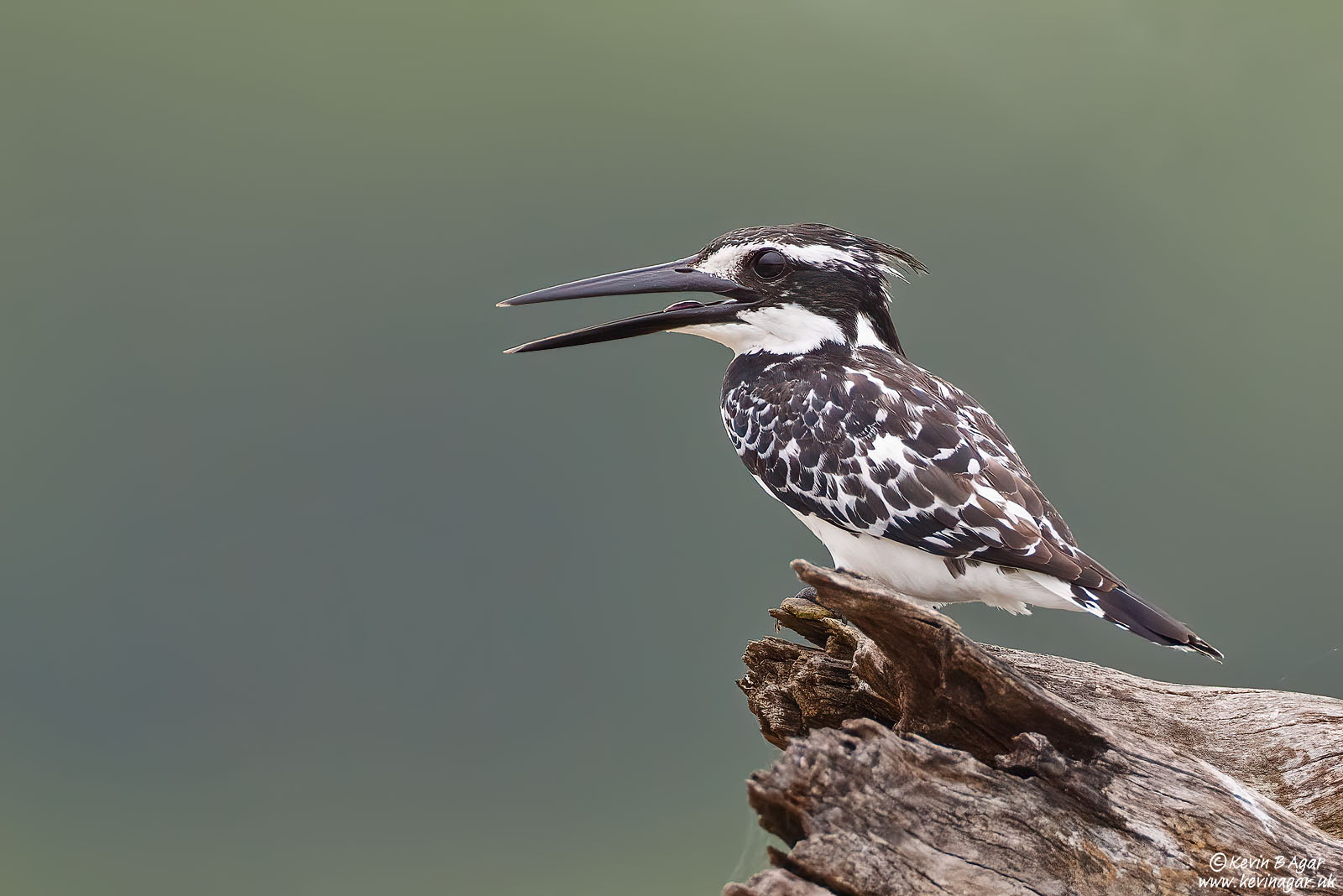
"The pied kingfisher (Ceryle rudis) is a species of water kingfisher widely distributed across Africa and Asia. Originally described by Carl Linnaeus in 1758, it has five recognised subspecies. Its black and white plumage and crest, as well as its habit of hovering over clear lakes and rivers before diving for fish, make it distinctive. Males have a double band across the breast, while females have a single broken breast band. They are usually found in pairs or small family groups. When perched, they often bob their head and flick up their tail."
Pied Kingfisher, Ceryle rudis


