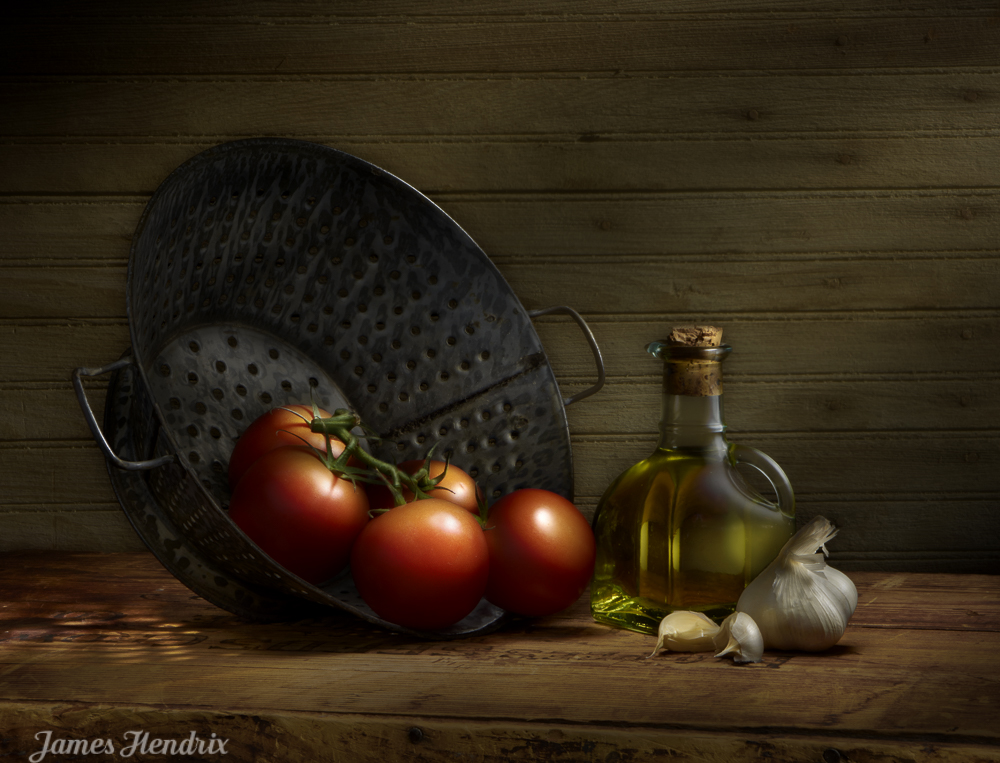
In my opinion, lighting is the most important element to photographs. The technique I use lets me control 100% of the lighting.
When I'm picking objects for an image I already have an idea of what I want the results to be. I spend a lot if time selecting objects that will work together. As a side note, I also try to use antique or vintage objects when I can. I think it adds to the image.
I shoot in complete darkness and everything on my camera is totally manual. I use the histogram as my meter. Exposures are from 5 seconds to 30 seconds, depending on how much light I want tp apply to each object.
I always hold the light from the same angle on each object. As an example, each tomato is photographed three times. I concentrate the light on the top right for one exposure, then move to the top left with a little less light for the second exposure, and then skim the light on the bottom half with even less light for the third exposure. Then move on to the next object.
After I have concentrated the light on each object, I use a LED block light to paint over all the objects from the top in a very fast circular motion. I set the LED output on the lowest setting and sometimes use a diffuser to help reduce and soften the light.
During the entire process I have a large black foam core board to prevent light from hitting the backdrop. When I've completed all the lighting on the objects, I remove the foam board and then skim the light on the back drop. I might take several images painting the back drop until I get the desired result.
When all the images are created I move to Photoshop and bring in each image one at a time. Each image is placed in its own layer. I create a layer mask and then use my graphic table to bring out highlights or to reduce the lighting. I continue to build the final image with the remaining images. Registration is very important as being off just a little causes horrible results. It also puts a strain on my computer as the file easily over a gig in size.
I shoot tethered using Capture One and then move onto Photoshop. Its been my experience that how ever long it takes me to photograph all the objects I then spend about the same amount in Photoshop. So two hours photographing, two hours in Photoshop.
Hope this helps a little. Its a long process but I find it very relaxing