More Milky Way

Dave Johnston

Well-Known Member
I live in a dark sky location (Bortle 2) so this summer I have done a bit of experimentation with Milky Way and night sky pictures. Most have been experiments in my front yard to refine techniques for when I have time to go to good locations. That's how this one started out. I wanted to learn more about stacking images in Sequator and blending in a foreground. But it turned out well enough to share with this group, at least as an indication of progress. This was from 33 star images and 7 dark frames, initially stacked and combined in raw and then processed in ACR and Photoshop. Sequator actually did a pretty good job of blending the foreground, but I found I could get a sharper and more nuanced foreground by blending in a single frame processed from raw.

My neighbors leave their flood lights on half the night, which has been an annoyance, but I decided to try to use the patterns that it makes on the (unmowed) grassy field that is my front yard to create some foreground interest. If nothing else, good practice!
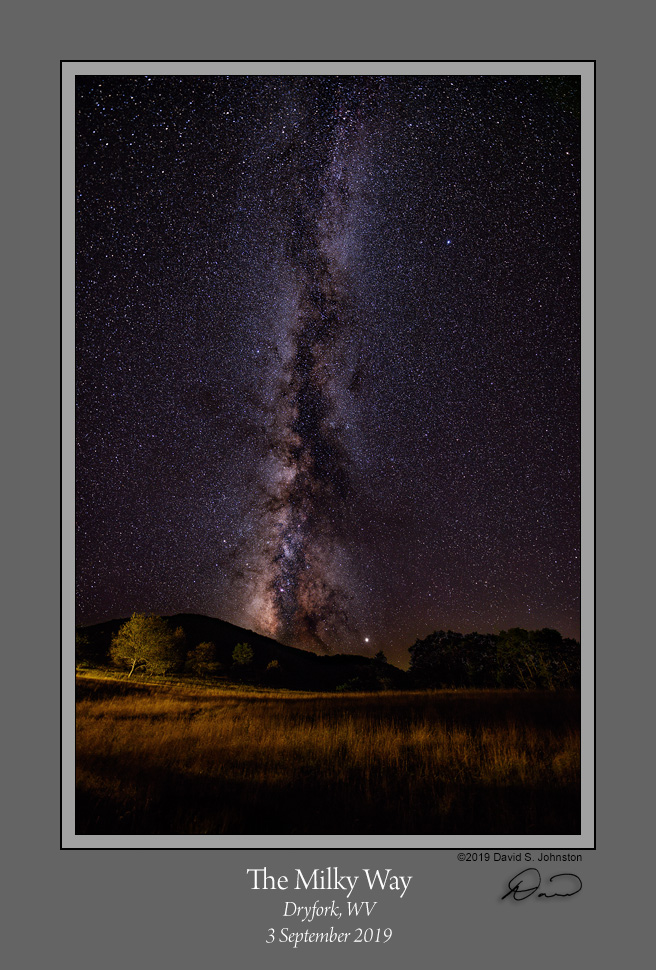

Comments and suggestions for further progress are welcome.

Dave
 

Kyle Jones

Moderator
Excellent job! The sky looks great, nice blending work, and I think the light on the ground adds to the image.
 

JimFox

Moderator
Staff member
This is very cool indeed Dave. That is so awesome you can shoot the Milky Way out in your front yard. If I look up in my sky I can see maybe 2 or 3 stars max. Of course I then will realize they are moving and are actually airplanes instead of stars.... :rolleyes:

The only suggestion I have to make is perhaps to use the Warp tool and pull down and out a bit the lower left so as not to have that tree look like it's leaning from WA distortion.
 

Dave Johnston

Well-Known Member
Thanks, Kyle, Alan, Brian, Jim and Jameel. Jim, I believe I would need to warp outward strongly from the top down to counter the leaning of the tree. That would cause stretching and trailing of the stars and I'd have to crop a lot off the top. On balance I think this result is preferable. However, I am also experimenting with using my tilt-shift (which unfortunately is a lot slower) for situations needing a straight foreground. I think that the stacking technique will make it possible to use the slower lens and still get good results.

Dave
 

JimFox

Moderator
Staff member
Thanks, Kyle, Alan, Brian, Jim and Jameel. Jim, I believe I would need to warp outward strongly from the top down to counter the leaning of the tree. That would cause stretching and trailing of the stars and I'd have to crop a lot off the top. On balance I think this result is preferable. However, I am also experimenting with using my tilt-shift (which unfortunately is a lot slower) for situations needing a straight foreground. I think that the stacking technique will make it possible to use the slower lens and still get good results.

Dave
Yeah, I had always considered using my TSE lens just as you describe. But it's only 24mm, and after years of shooting the night skies at 14mm, I just have a hard time wrapping my head around a smaller view of the sky. Plus as you mentioned it's much slower. I think mine is f4?
 

Bart Carrig

Well-Known Member
Well done, Dave. I've got to get cracking on more night sky techniques, and this is a great incentive. Thanks.

Bart
 

Dave Johnston

Well-Known Member
Jim, my TS-E is also 24 mm, but f/3.5. I agree that is is has way less view, though stitching a vertical panorama is a possibility. It is enough to make me consider getting the 17 mm TS-E!

Dave
 

Beth

Well-Known Member
that always cracks me up, people move to the middle of nowhere to get away from all of the light and noise of the city and the first thing they do is install and leave their outdoor lights on.

i think it works well for you in this case, the light provides just enough of a foreground to make it a worthwhile inclusion.
 
Top Bottom