Petrified Forest in IR

JimFox

Moderator
Staff member
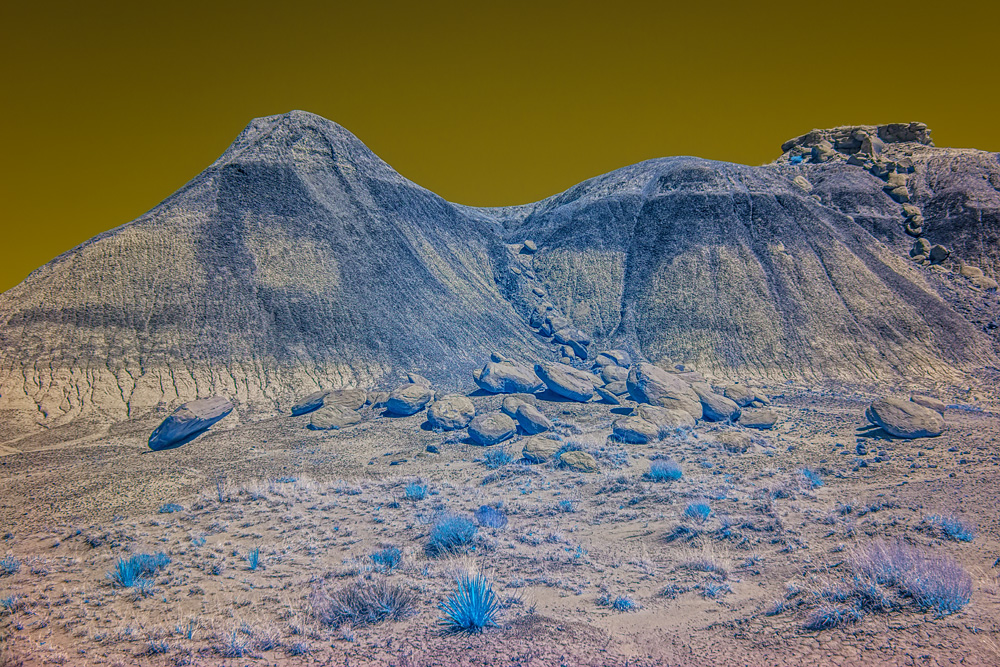
From a month ago in the Petrified Forest National Park in Arizona. I was really curious how that location would react to Infrared. I knew the vegetation would be cool, but there isn't much out there, but I wasn't sure just how the cool colored hills would react. Thinking about it more, I should have realized that they probably wouldn't react at all, not like vegetation. But I was young and naive back then. :)

So the ground layer with the IR, felt really blah. So I pushed the Vibrance up a lot in ACR when converting and a Purple haze started to come out of the ground. So I went with it, for better or worse. Probably for worse, but hey.... you have to try... :)

Nikon D7100 - 590nm
Not Channel Swapped

All comments are welcome,

Jim
_DSC0265_WBbox_Vib_dw.jpg
 

AlanLichty

Moderator
You do see the vegetation stand out quite well against the rocks and dirt without the channel swap. Not sure it would have been very visible at all with the swap.

I wouldn't have expected much in the way of IR reflectivity with this type of environment.
 

JimFox

Moderator
Staff member
You do see the vegetation stand out quite well against the rocks and dirt without the channel swap. Not sure it would have been very visible at all with the swap.

I wouldn't have expected much in the way of IR reflectivity with this type of environment.
Thanks Alan. Yeah, I shouldn't have expected it, but the problem with being an optimist is sometimes I don't really think about it. Now, I know. So unless there is vegetation, in the desert my goal would have to be a B&W conversion from IR.
 

AlanLichty

Moderator
Thanks Alan. Yeah, I shouldn't have expected it, but the problem with being an optimist is sometimes I don't really think about it. Now, I know. So unless there is vegetation, in the desert my goal would have to be a B&W conversion from IR.
I got a bit used to what gives us IR reflectivity when I was spending a lot of time poring over LANDSAT imagery. General rule was that if it wasn't green in visible light there wouldn't be much information in the IR bands. There are gaps even within visible greens in vegetation when it comes to deciduous trees vs. evergreens.
 

JimFox

Moderator
Staff member
I got a bit used to what gives us IR reflectivity when I was spending a lot of time poring over LANDSAT imagery. General rule was that if it wasn't green in visible light there wouldn't be much information in the IR bands. There are gaps even within visible greens in vegetation when it comes to deciduous trees vs. evergreens.
Yep, you have an advantage there. It's something I am slowly learning and remembering.
 
Top Bottom