

Mike Lewis
Staff Member
Want to take an image of a rare astronomical event, that requires nothing more exotic than a solar filter? Take a shot at the upcoming transit of Mercury across the face of the Sun, coming on November 11, 2019.
With Earth being the 3rd planet from the Sun, we are positioned to see planetary transits for only the 2 innermost planets in the solar system, Mercury and Venus. With both inner planets revolving around the sun faster than the Earth, it would seem this type of occurrence should be much more common, but in fact, Mercury transits occur only about 13 to 14 times each 100 years, and Venus transits are much more rare than that. The reasons for this are complex, and have to do with differences in the orbital geometries of the 3 planets. Venus in particular is hard to capture, as it transits the Sun as seen from Earth based a 243 year cycle, with pairs of transits separated by 8 years, then a gap of either 121.5 or 105.5, then another pair separated by 8 years.
More details can be found on Wikipedia for those interested in the details:
Mercury Transits:
https://en.wikipedia.org/wiki/Transit_of_Mercury
Venus Transits:
https://en.wikipedia.org/wiki/Transit_of_Venus
So unfortunately, without some impressive advances in medicine, no one alive today will see another Venus transit, and the next Mercury transit after this November is 13 years in the future.
So if you want a rare astro image that requires only a solar filter and a fixed tripod and a telephoto lens, the next Mercury transit image might be for you. It is an easy shot, as the transit occurs at a leisurely pace, with Mercury taking a couple hours to cross the Sun for a typical transit.
It is VERY important to stress the importance of a solar filter though, as pointing your camera lens at the sun when focused at infinity will fry your eye and your camera in pretty short order. A proper solar filter is not too expensive though, and can be found at many astro retailers. Here is just one suitable example.
https://www.bhphotovideo.com/c/prod...sgft040_66_94mm_starguy_adjustable_white.html
So to give you a sense of what you can image, here are my 2 transit images.
I was lucky enough to get a shot at the last Venus transit. I had only a 10 stop normal ND filter, so took a very quick shot without really looking through the camera except to get lined up. There were clouds to contend with that day too in Boulder where I was shooting, but still got a decent result. This was shot using a surplus manual focus Pentax Tele Takumar 400mm f/5.6 lens using my Canon DSLR at the time, the 40D.
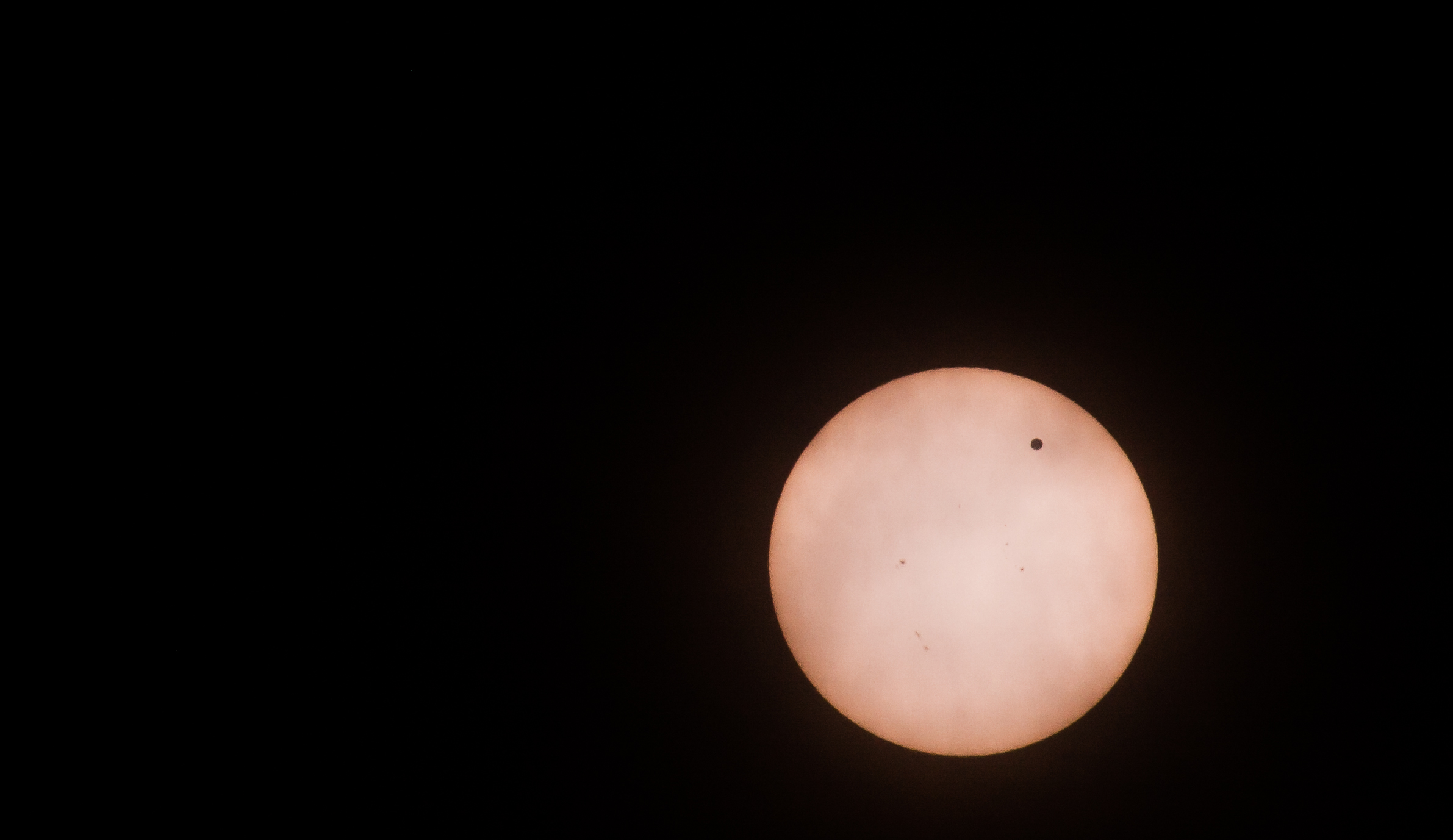
My Mercury transit image was a little more planned out, shot form my driveway using my tracking mount and my SVQ100 580mm f/5.8 telescope and my 5DSR. I took a number of shots, but have not managed to combine them to show the track across the sun in a way that does not introduce artifacts, due to the solar rotation. But this is one of the sharper versions I got:

In both these images you can also see some small patches of sunspot activity on the sun.
ML
With Earth being the 3rd planet from the Sun, we are positioned to see planetary transits for only the 2 innermost planets in the solar system, Mercury and Venus. With both inner planets revolving around the sun faster than the Earth, it would seem this type of occurrence should be much more common, but in fact, Mercury transits occur only about 13 to 14 times each 100 years, and Venus transits are much more rare than that. The reasons for this are complex, and have to do with differences in the orbital geometries of the 3 planets. Venus in particular is hard to capture, as it transits the Sun as seen from Earth based a 243 year cycle, with pairs of transits separated by 8 years, then a gap of either 121.5 or 105.5, then another pair separated by 8 years.
More details can be found on Wikipedia for those interested in the details:
Mercury Transits:
https://en.wikipedia.org/wiki/Transit_of_Mercury
Venus Transits:
https://en.wikipedia.org/wiki/Transit_of_Venus
So unfortunately, without some impressive advances in medicine, no one alive today will see another Venus transit, and the next Mercury transit after this November is 13 years in the future.
So if you want a rare astro image that requires only a solar filter and a fixed tripod and a telephoto lens, the next Mercury transit image might be for you. It is an easy shot, as the transit occurs at a leisurely pace, with Mercury taking a couple hours to cross the Sun for a typical transit.
It is VERY important to stress the importance of a solar filter though, as pointing your camera lens at the sun when focused at infinity will fry your eye and your camera in pretty short order. A proper solar filter is not too expensive though, and can be found at many astro retailers. Here is just one suitable example.
https://www.bhphotovideo.com/c/prod...sgft040_66_94mm_starguy_adjustable_white.html
So to give you a sense of what you can image, here are my 2 transit images.
I was lucky enough to get a shot at the last Venus transit. I had only a 10 stop normal ND filter, so took a very quick shot without really looking through the camera except to get lined up. There were clouds to contend with that day too in Boulder where I was shooting, but still got a decent result. This was shot using a surplus manual focus Pentax Tele Takumar 400mm f/5.6 lens using my Canon DSLR at the time, the 40D.
My Mercury transit image was a little more planned out, shot form my driveway using my tracking mount and my SVQ100 580mm f/5.8 telescope and my 5DSR. I took a number of shots, but have not managed to combine them to show the track across the sun in a way that does not introduce artifacts, due to the solar rotation. But this is one of the sharper versions I got:
LRCC_FW_SUN_MERCURY_SEQ_LIGHT_Tv13200s_100iso_+29c_solar_20160509-10h46m36s760ms
Mercury Transit - May 9th, 2016
In both these images you can also see some small patches of sunspot activity on the sun.
ML


