

Comet Hunter
Supporting Member
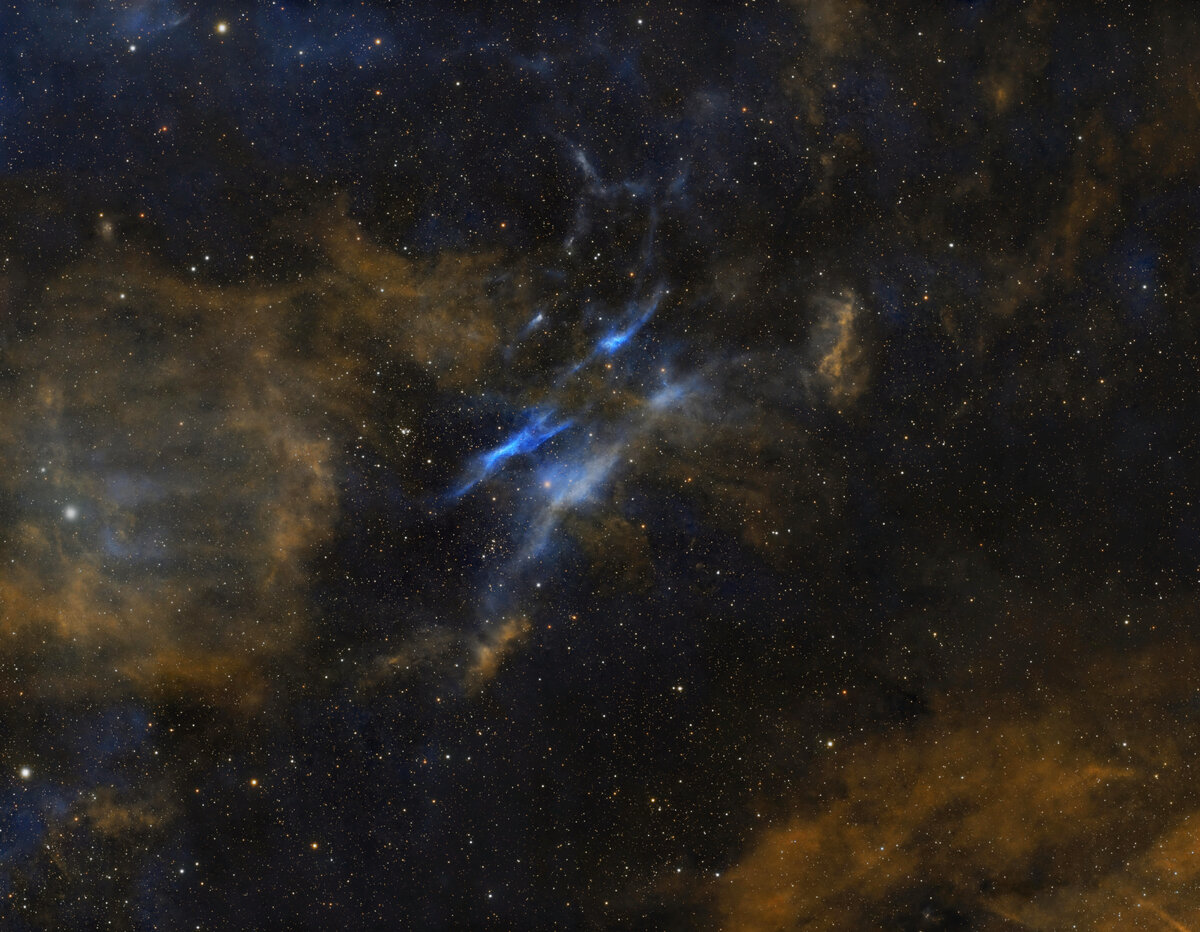
During the last week or so, with all the clear nights I had in a row, I decided to do an experiment with my 2600mc pro. I totaled 438 -5 min light frames (Just under 40 hours) on what they call OIII Shells or the Chill Dog Nebula which is near SH2-181). Im my last image I got just a portion of these and decided to focus just on the OIII Shells
This by far is the most data taken in on batch I have ever attempted. I used the Antlia ALPT Filter Per Google Gemini
• The Blue Filaments: These are genuine \(OIII\) (Oxygen-III) interstellar shells. They are low-density gas structures in the interstellar medium (ISM) that have been swept up and ionized.
• The Excitation Source: Astronomers suspect that the immense stellar winds from the nearby Wolf-Rayet star HD 4004 (WR 1) are responsible for energizing and shaping these faint \(OIII\) structures.
• The Surrounding Dust: The golden-brown structures wrapping around the frame are faint H-alpha emission and molecular dust clouds, including LDN 1303
All comments are welcome.
This by far is the most data taken in on batch I have ever attempted. I used the Antlia ALPT Filter Per Google Gemini
• The Blue Filaments: These are genuine \(OIII\) (Oxygen-III) interstellar shells. They are low-density gas structures in the interstellar medium (ISM) that have been swept up and ionized.
• The Excitation Source: Astronomers suspect that the immense stellar winds from the nearby Wolf-Rayet star HD 4004 (WR 1) are responsible for energizing and shaping these faint \(OIII\) structures.
• The Surrounding Dust: The golden-brown structures wrapping around the frame are faint H-alpha emission and molecular dust clouds, including LDN 1303
All comments are welcome.
Last edited:
