Barnard's Loop

Mike Lewis

Staff Member
This very faint nebula rings one side a of a number of more famous astroimaging targets, the Orion Nebula, The Horsehead Nebula, and the Flame Nebula, which all make up part of the Orion Molecular Cloud Complex. This early effort shows noise from a lack of enough integration time, but does give an idea of how large of an object it is. Shot at a very wide (by astronomy standards) 70mm, it still fills the frame.
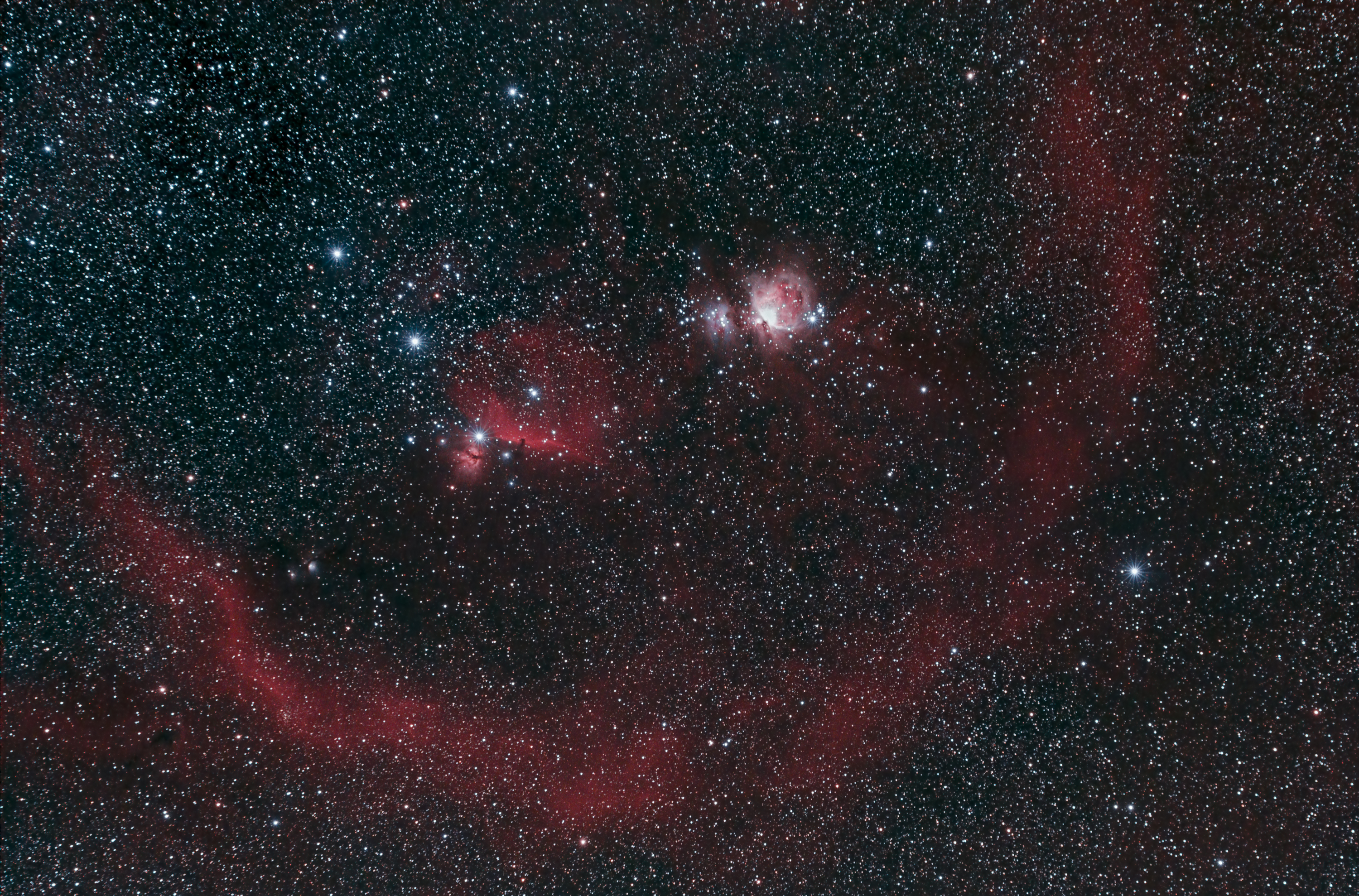

I hope to improve upon this result in the future if I can get set upon to take longer exposures and more frames, using a cooled camera. But it is still fun to see the interrelationship between all of these more often imaged areas, surrounded by this large supernova remnant.

Equipment:
Canon T2i (550D) (astro modified by Gary Honis)
iOptron iEQ45Pro Mount
Canon 70-300 f/4-5.6 L IS Zoom lens at 70mm and f/4.5
QHY5L-II Guide Camera / Orion 8 x50 Guide Scope

Software:
Pixinsight Commercial Version 1.8.2 (Ripley)
Lightroom 5.6

Light Frames:
1 x 420 secs (7 minutes total) @ ISO 800
7 x 600 secs (1 hour 10 minutes total) @ ISO 800
8 x 420 secs (56 minutes total) @ ISO 1600

Dark Frames:
4 x 420 secs @ ISO 1600

Flat Frames
10 x 1/80th sec @ ISO 1600
 

AlanLichty

Moderator
Cool imaging - I like the view you have captured here.

This is a world of photography I know next to nothing about beyond knowing that you aimed your camera away from the ground :)
 

JimFox

Moderator
Staff member
This sure looks really good Mike, but if you are able to improve upon this? That would be really sweet to see!
 

MonikaC

Well-Known Member
This is very cool, Mike. I'm totally ignorant of what is possible in this realm: what improvements would you be hoping for?
 

Mike Lewis

Staff Member
Thanks everyone for the comments!

Monika, to answer your question:

So primarily, longer exposures can bring out more detail, and more exposures being stacked can reduce noise. If you can combine that with a dark sky location and have everything else working right (good tracking to prevent star trailing, not much wind, no clouds, etc. etc.) you can make some impressive images. Also, this image was shot with an uncooled camera (regular DSLR) so that means the noise is much higher once you start taking images as long as these (7 and 10 minute individual exposures at higher ISO.) A dedicated cooled astro camera like I have now would have less noise per exposure for similar settings. Typically, each ~6 degrees C the temp can be lowered cuts the noise in half, and we would usually run between -10 to -20 C, so even on a cold night (say freezing ambient at 0 C) that helps a lot.

I do not expect to get to this same level, but here is the same object imaged by a top rate amateur imager, who was able to get a lot more time on target than I was here, and has also done a 16 pane mosaic, so the resolution and detail is greater too.

http://www.astrobin.com/full/341142/0/

The fun thing about astroimaging is, if you can put more time and effort into a particular target, you can almost always reveal more and more detail and color. So in that way, old targets can be made new again.

ML
 

MonikaC

Well-Known Member
Thanks everyone for the comments!

Monika, to answer your question:

So primarily, longer exposures can bring out more detail, and more exposures being stacked can reduce noise. If you can combine that with a dark sky location and have everything else working right (good tracking to prevent star trailing, not much wind, no clouds, etc. etc.) you can make some impressive images. Also, this image was shot with an uncooled camera (regular DSLR) so that means the noise is much higher once you start taking images as long as these (7 and 10 minute individual exposures at higher ISO.) A dedicated cooled astro camera like I have now would have less noise per exposure for similar settings. Typically, each ~6 degrees C the temp can be lowered cuts the noise in half, and we would usually run between -10 to -20 C, so even on a cold night (say freezing ambient at 0 C) that helps a lot.

I do not expect to get to this same level, but here is the same object imaged by a top rate amateur imager, who was able to get a lot more time on target than I was here, and has also done a 16 pane mosaic, so the resolution and detail is greater too.

http://www.astrobin.com/full/341142/0/

The fun thing about astroimaging is, if you can put more time and effort into a particular target, you can almost always reveal more and more detail and color. So in that way, old targets can be made new again.

ML
Thanks, Mike, for the explanation & example. Well done!
 

Tom Narwid

Well-Known Member
This very faint nebula rings one side a of a number of more famous astroimaging targets, the Orion Nebula, The Horsehead Nebula, and the Flame Nebula, which all make up part of the Orion Molecular Cloud Complex. This early effort shows noise from a lack of enough integration time, but does give an idea of how large of an object it is. Shot at a very wide (by astronomy standards) 70mm, it still fills the frame.


I hope to improve upon this result in the future if I can get set upon to take longer exposures and more frames, using a cooled camera. But it is still fun to see the interrelationship between all of these more often imaged areas, surrounded by this large supernova remnant.

Equipment:
Canon T2i (550D) (astro modified by Gary Honis)
iOptron iEQ45Pro Mount
Canon 70-300 f/4-5.6 L IS Zoom lens at 70mm and f/4.5
QHY5L-II Guide Camera / Orion 8 x50 Guide Scope

Software:
Pixinsight Commercial Version 1.8.2 (Ripley)
Lightroom 5.6

Light Frames:
1 x 420 secs (7 minutes total) @ ISO 800
7 x 600 secs (1 hour 10 minutes total) @ ISO 800
8 x 420 secs (56 minutes total) @ ISO 1600

Dark Frames:
4 x 420 secs @ ISO 1600

Flat Frames
10 x 1/80th sec @ ISO 1600
Outstanding!
 

Mike Lewis

Staff Member
you pic makes me want to modify my Canon 60D which I dont use anymore and sits in a closet
Johnny,

Modifying a 60D that is otherwise unused is a great approach. In fact, if you go with a clear glass filter replacement instead of just having a wider pass lowpass filter put in, you will then also be able to have a very nice IR camera if you put a dedicated IR filter on the front of it. Additionally, having a flip screen on the camera like the 60D has really can be advantageous to allow you to still see the display when the camera is flipped around to an awkward angle on the back of your telescope or lens, tracking the stars.

There are a few very reputable and experienced folks out there who do the mods. Mine was done by Hap Griffin (http://www.imaginginfinity.com/dslrmods.html) and was a clear glass mod on a used T2i I bought just for the purpose of astro. It is now my back up astro camera and my IR camera. Of course, there are many other outfits out there who also perform this service.

ML
 

Nilo Photography

Well-Known Member
This very faint nebula rings one side a of a number of more famous astroimaging targets, the Orion Nebula, The Horsehead Nebula, and the Flame Nebula, which all make up part of the Orion Molecular Cloud Complex. This early effort shows noise from a lack of enough integration time, but does give an idea of how large of an object it is. Shot at a very wide (by astronomy standards) 70mm, it still fills the frame.


I hope to improve upon this result in the future if I can get set upon to take longer exposures and more frames, using a cooled camera. But it is still fun to see the interrelationship between all of these more often imaged areas, surrounded by this large supernova remnant.

Equipment:
Canon T2i (550D) (astro modified by Gary Honis)
iOptron iEQ45Pro Mount
Canon 70-300 f/4-5.6 L IS Zoom lens at 70mm and f/4.5
QHY5L-II Guide Camera / Orion 8 x50 Guide Scope

Software:
Pixinsight Commercial Version 1.8.2 (Ripley)
Lightroom 5.6

Light Frames:
1 x 420 secs (7 minutes total) @ ISO 800
7 x 600 secs (1 hour 10 minutes total) @ ISO 800
8 x 420 secs (56 minutes total) @ ISO 1600

Dark Frames:
4 x 420 secs @ ISO 1600

Flat Frames
10 x 1/80th sec @ ISO 1600
Such an amazing image!
 

Tom Narwid

Well-Known Member
This very faint nebula rings one side a of a number of more famous astroimaging targets, the Orion Nebula, The Horsehead Nebula, and the Flame Nebula, which all make up part of the Orion Molecular Cloud Complex. This early effort shows noise from a lack of enough integration time, but does give an idea of how large of an object it is. Shot at a very wide (by astronomy standards) 70mm, it still fills the frame.


I hope to improve upon this result in the future if I can get set upon to take longer exposures and more frames, using a cooled camera. But it is still fun to see the interrelationship between all of these more often imaged areas, surrounded by this large supernova remnant.

Equipment:
Canon T2i (550D) (astro modified by Gary Honis)
iOptron iEQ45Pro Mount
Canon 70-300 f/4-5.6 L IS Zoom lens at 70mm and f/4.5
QHY5L-II Guide Camera / Orion 8 x50 Guide Scope

Software:
Pixinsight Commercial Version 1.8.2 (Ripley)
Lightroom 5.6

Light Frames:
1 x 420 secs (7 minutes total) @ ISO 800
7 x 600 secs (1 hour 10 minutes total) @ ISO 800
8 x 420 secs (56 minutes total) @ ISO 1600

Dark Frames:
4 x 420 secs @ ISO 1600

Flat Frames
10 x 1/80th sec @ ISO 1600
This is the best I have ever seen of this nebula Mike.
 
Top Bottom