Bodes and Cigar Galaxies 2020/04/23

JimFox

Moderator
Staff member
With the new moon upon us I drove 2 hours to get out into the desert to capture some new Deep Space Astro objects (DSO) and ones that were new to me. I so far have only captured 1 Galaxy, the Andromeda, and I wanted to capture some other ones. The Andromeda is very large and easy to find and capture, but most of the other galaxies are much smaller, some of them are only 10 to 20% of it's size.

So it was a challenge, as with my totally manual Astro guider, trying to find these smaller galaxies totally by eye is not an easy task and at times can almost feel impossible. But I did it... :) I could not see the galaxy on my display, I had to find it by eye, and then actually aim my camera like a shooting a rifle back in the old Army days. It worked... :rolleyes:

This is my first time with Bodes and Cigar Galaxies as I mentioned, so while with all of my Astro work, it's not perfect, it did seem like a great first step and attempt.

I was not able to use my normal DeepSkyStar stacker. Well, I used it, but I had gotten advice to severly underexpose these Deep Space shots, so that the histogram is packed to the left. For some reason after stacking no matter how careful I was in Photoshop with using Curves to Stretch the data, the Galaxy info kept disappearing.

So I went to plan B, which was to simply pull in my Data into Photoshop. I increased the exposure by 2 stops in ACR, then in Photoshop I then went to stack it, align it, and then use Median blending as a Smart Object to get my data out. Then I could use my normal Photoshop processing with Curves to stretch the data. So in the end, I am pretty happy with how it turned out.

Nikon D850
Tamron 150-600mm @ 600mm in DX mode = 850mm
SkyGuider Pro - tracking
41 x 120secs at ISO 800
No Dark, Flat or Bias used since I did it all in Photoshop. I could have used Darks, but at ISO 800 I didn't have any noise issues.

All comments are welcome,
Jim
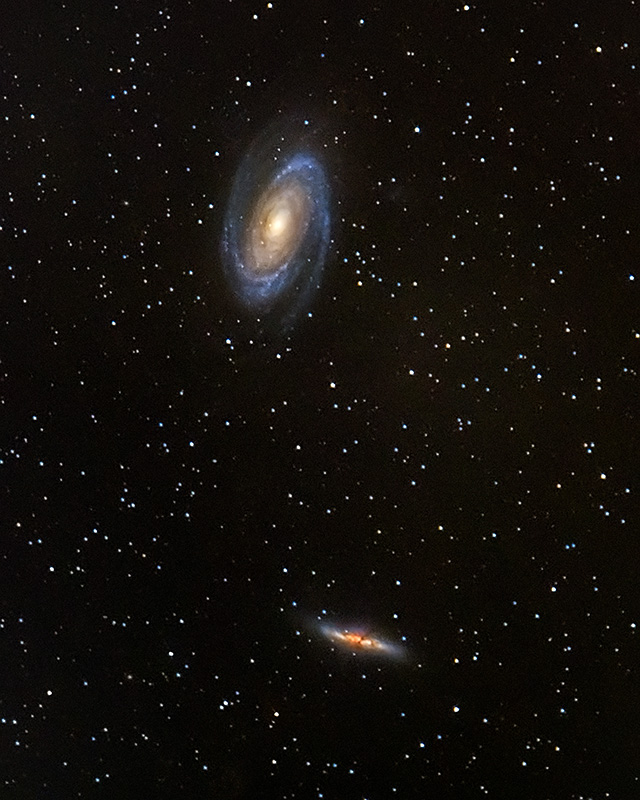
_D853661_BodesCigarNebula_20200423_dw.jpg
 

Ben Egbert

Forum Helper
Staff member
These looks really good to my eyes Jim. I admire your efforts to capture but perhaps even more to process these images.
 

JimFox

Moderator
Staff member
These looks really good to my eyes Jim. I admire your efforts to capture but perhaps even more to process these images.
Thanks Ben!

These are really so small in the sky, and far enough away from any real identifying stars that to be able to find it manually like I did really makes me feel like it was a Christmas gift. The degree of difficulty is pretty much up there.
 
With the new moon upon us I drove 2 hours to get out into the desert to capture some new Deep Space Astro objects (DSO) and ones that were new to me. I so far have only captured 1 Galaxy, the Andromeda, and I wanted to capture some other ones. The Andromeda is very large and easy to find and capture, but most of the other galaxies are much smaller, some of them are only 10 to 20% of it's size.

So it was a challenge, as with my totally manual Astro guider, trying to find these smaller galaxies totally by eye is not an easy task and at times can almost feel impossible. But I did it... :) I could not see the galaxy on my display, I had to find it by eye, and then actually aim my camera like a shooting a rifle back in the old Army days. It worked... :rolleyes:

This is my first time with Bodes and Cigar Galaxies as I mentioned, so while with all of my Astro work, it's not perfect, it did seem like a great first step and attempt.

I was not able to use my normal DeepSkyStar stacker. Well, I used it, but I had gotten advice to severly underexpose these Deep Space shots, so that the histogram is packed to the left. For some reason after stacking no matter how careful I was in Photoshop with using Curves to Stretch the data, the Galaxy info kept disappearing.

So I went to plan B, which was to simply pull in my Data into Photoshop. I increased the exposure by 2 stops in ACR, then in Photoshop I then went to stack it, align it, and then use Median blending as a Smart Object to get my data out. Then I could use my normal Photoshop processing with Curves to stretch the data. So in the end, I am pretty happy with how it turned out.

Nikon D850
Tamron 150-600mm @ 600mm in DX mode = 850mm
SkyGuider Pro - tracking
41 x 120secs at ISO 800
No Dark, Flat or Bias used since I did it all in Photoshop. I could have used Darks, but at ISO 800 I didn't have any noise issues.

All comments are welcome,
Jim

View attachment 27511
Beautiful, Jim. I sure wouldn't complain about this image. These deep space images are just spectacular.
 

Mike Lewis

Staff Member
Wow - amazing post-processing prowess when DSS would not work. Actually, a really nice result also. I like the colors and framing, and your stars and background look very natural on this one. And kudos for finding it and framing it too - as we have discussed, that problem had me out of a manual tracker and into a more sophisticated mount in short order. Your patience definitely paid off on this one!

I have a large stack of this same target that I will be processing, likely after I finish my post processing on Markarian's Chain.

ML
 

Colorado CJ

Well-Known Member
Wow Jim! Your processing and image capturing are getting VERY good.

Interesting that you used Photoshop to stack. I've never tried that before. Looks like it worked well for you though!
 

JimFox

Moderator
Staff member
Wow Jim! Your processing and image capturing are getting VERY good.

Interesting that you used Photoshop to stack. I've never tried that before. Looks like it worked well for you though!
Thanks Andrew, it is nice to see the images improving and being able to pull more out of them. It's a real rewarding feeling.

I prefer the DeepSkyStacker, that's my main stacking program as it has a lot to offer as you know. At it's core though, DSS is just stacking and applying Median blending as far as I can figure. And that's at it's core that is no including all of the flats and bias, etc it can do. But this is now the 2nd one where I ended up feeling like I got better results from just stacking in Photoshop, turning the stack into a Smart Object and then applying a Median Blend. It won't work all of the time because Photoshop has a weakness with aligning the stars, but so far I am glad that when I have struggled with the result from DSS I have been able to turn to Photoshop and it's come through for me. In fact, I might have to go that route for the Pinwheel Galaxy.
 

Ben Egbert

Forum Helper
Staff member
Just the opposite here, these Deep sky guys scare me off when I see the effort required. I do enjoy them however. I once looked into it and visited a place nearby that did astro conversions for cameras. They had to make a lot of mods to cameras 6-7 years ago. Sensor coolers, filter changes on the sensor, added flocking inside and shutter mods to avoid shake.
 

JimFox

Moderator
Staff member
I'm impressed - and you've just about got me convinced to start giving this a try myself.
You should do it Kyle! You have everything you need to go shoot some Deep Space Astro because you have the SkyGuider pro too I think?
 

JimFox

Moderator
Staff member
Just the opposite here, these Deep sky guys scare me off when I see the effort required. I do enjoy them however. I once looked into it and visited a place nearby that did astro conversions for cameras. They had to make a lot of mods to cameras 6-7 years ago. Sensor coolers, filter changes on the sensor, added flocking inside and shutter mods to avoid shake.
My camera isn't Astro modified, which makes it even better I think Ben. It's just a plain old Nikon D850.

Ultimately I could get one that is cooled and had the sensor modified, but for now I am pretty happy with what a plain old DSLR is giving me.
 

Jameel Hyder

Moderator
Staff member
Impressive Jim. If I were anywhere close where I can count on clear and darker skies, I'd be tempted to try this.
 

JimFox

Moderator
Staff member
Impressive Jim. If I were anywhere close where I can count on clear and darker skies, I'd be tempted to try this.
You should too Jameel! I don't know how far you have to go for dark skies, but it's something you should think about for this summer perhaps.
 
Top Bottom