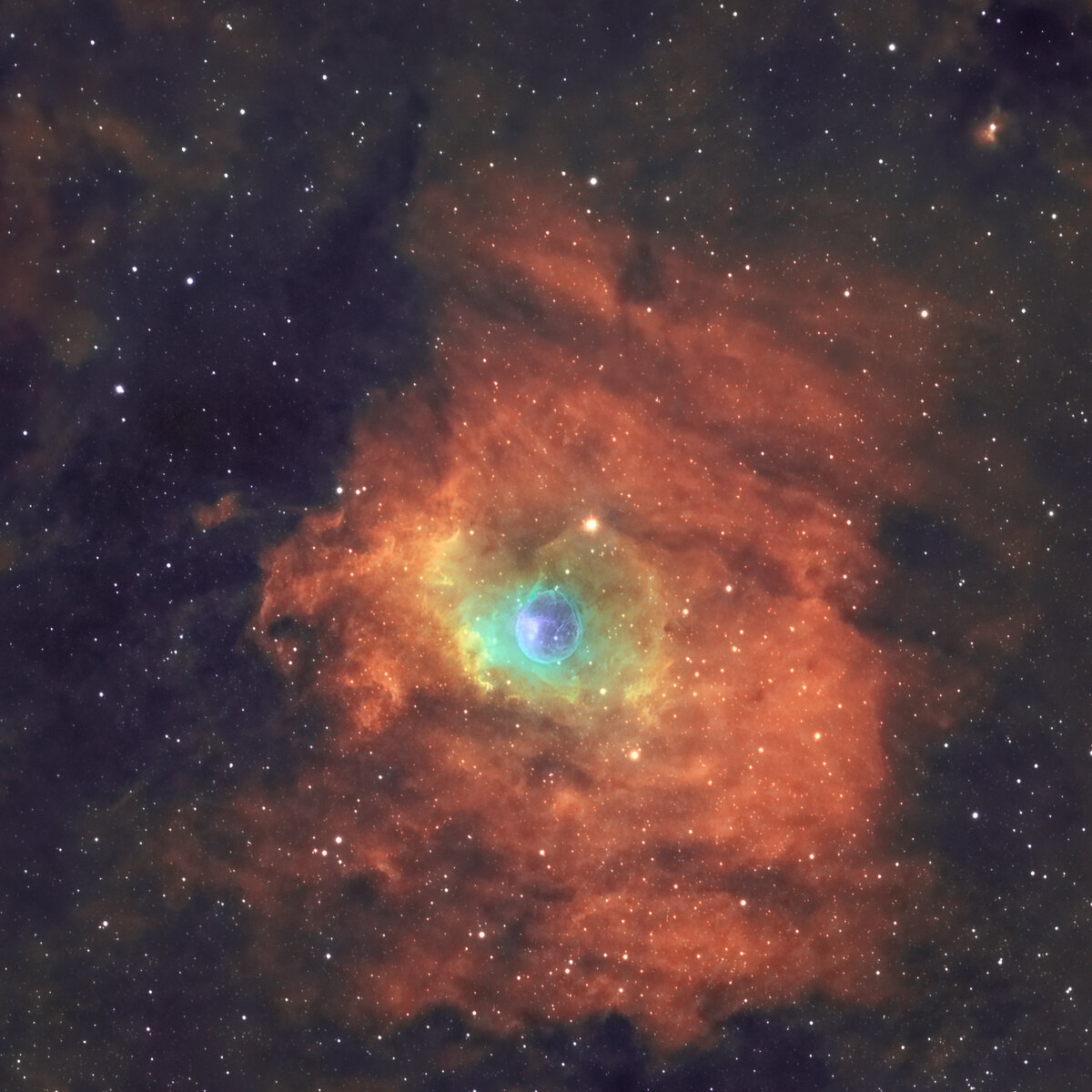
Bubble Nebula OSC SHO

Andy Nowlen

Well-Known Member
My last real project this fall before the rain and clouds, is the Bubble Nebula, NGC 7635 in Cassiopeia. The seething star forming this nebula is 45 times more massive than our sun. Gas on the star gets so hot that it escapes away into space as a "stellar wind" moving at over 4 million miles per hour and we see the bubble. (Hubblesite dot org)

Two different scopes on two different nights. These are one-shot color cameras and the processing was a derivative of the SHO style.
6.5 hours integration
Takahashi FSQ 106n @ 530
ES ED 102 @ 714
97 x 240
CEM40 EC
CEM40
Filters = L-extreme, L-ehance
AsiAir Pro
Asi533mc pro x 2
Astropixel Processor
Pixinsight
Photoshop

Bubble Nebula OSC SHO.jpg
 

JimFox

Moderator
Staff member
Wow! This is so awesome Andy! I love it.

This is the kind of results I hope that I can get from the Asi194mc Pro when I get it. I like how you worked a SHO palette out of it. I have been watching a few video's on how some people are doing it. I don't use APP, I currently just use DeepSkyStacker and Photoshop. Hopefully I can emulate this look in Photoshop too, I think I can.
 

Mike Lewis

Staff Member
Andy,

Great results, well deserving of the Daily Featured status! It is interesting to see narrowband processing of OSC data. Those filters really seem to help make that work. I am interested to know what caused you to use both the L-Enhance and the L-Extreme filters for this? Is that typical for this kind of processing? The differences seem to be that the L-Extreme is blocking the Hβ signal and the passbands for the other desired narrowband signals are narrower.

I am still in the camp of shooting with mono cameras with separate filters, especially for narrowband, but I am watching your results with interest, especially when you are able to post these kind of images!

ML
 

Andy Nowlen

Well-Known Member
Thanks Mike, I am glad to share the image and for the nice reception at Focal World.

Regarding the 2 different but similar filters: If I had all my 'druthers' I would now have 2 L-extreme filters. When I originally thought about shooting the same target with two systems my thinking was that the extreme and the enhance would work to complement each other in the final image, with some helpful data being added by the broader bandwidths of the enhance. After a few of these efforts I now conclude that this is true only for certain targets. I have had some images in which the data from the enhance unhelpfully 'shadows' that of the extreme. But not in a way that processing can happily blend. But then again, there are some images in which the two filters seem to be totally in sync with each other.

Someday, should I have the budget, I will try to get into a mono system. But for now, I have to make the best use of the dual narrowband filters as best I can. Like you and others I have scoured the net for approaches to use the OSC data for 'faux' narrowband results. On youtube Lukomatico and Cuiv the lazy geek have provided me with the best steps toward that end, AND with links to other resources that have contributed to my limited success.

On a side note, this extended period of clouds has pushed me to review some of my early attempts at DSO images. I am just now 16 months into this adventure after a long 'normal' photographic journey prior to that. At any rate, I am glad I did NOT share some of those early images. They are simply terrible. So in my archive, I marked a number of those folders as "BAD DATA" - meaning don't go there!! :>) After all, I am glad to have noticed some improvement with time, experience, and an equipment upgrade.

Merry Christmas to one and all.
 

JimFox

Moderator
Staff member
Thanks for the added info Andy! I have looked a bit at the two guys and their YouTube videos on OSC processing. I will review them again when I am ready to take that step.

Merry Christmas to you too Andy! It's really awesome to have you here.
 
Top Bottom