

Mike Lewis
Staff Member
So this is a project that has been on my to-do list for a while, but as many of you know, I can only image at certain times of the year when my AZ dwelling friend is at his place, so this has had to wait. This is the second mosaic I have attempted and I am happy with how it came out. Comments, questions, and critiques always welcome! 
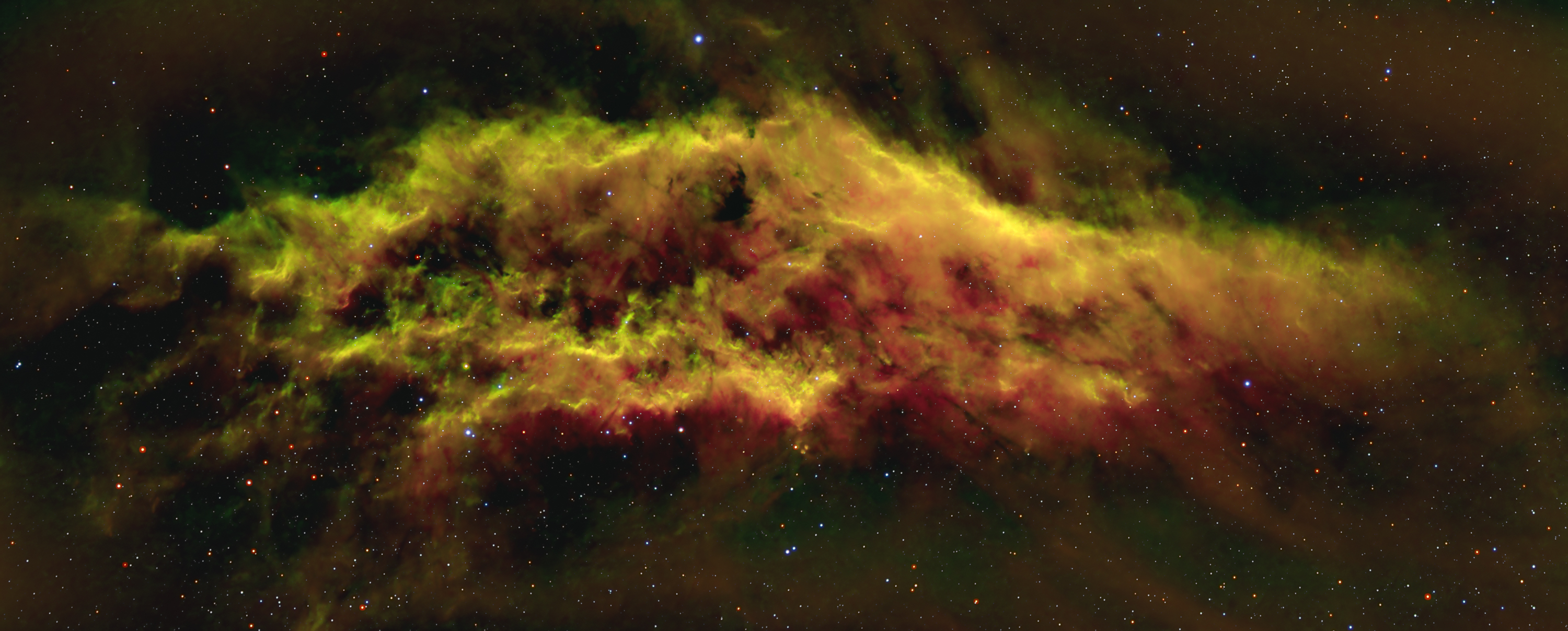
This target is supposed to be rich in all 3 typical emissions lines captured by amateur imagers, but I just could not seem to get any appreciable OIII to come out and since I was also imaging close to the moon I eventually just gave up and decided to try a somewhat non-traditional bi-color approach. I had an idea of how I wanted the palette to come out, but as those of you who work narrowband images know, that can often be a problem as the data wants to take the result in its own direction. I ended up with a palette that shows Hα in the red channel, SII in the green channel, and then the blue channel consisting of some more of the Hα data at a reduced level. Specifically, the mix was Red - Hα @ 100%, Green - SII @ 100%, and OIII - Hα @ 50%, with the file combination happening in Pixinsight on starless master frames. This was then tweaked quite a bit first in Photoshop and then again in Lightroom to get the final result, and then separate RGB stars were blended back in to the starless NB mix for the final result.
About the object - The California Nebula (NGC 1499) is a somewhat faint emission region in the constellation Perseus. Its name comes from the resemblance to the state that it gets its name from. It is being energized by emissions from the nearby O7 type star XI Persei (commonly called Menkib) shown in this image as the bright blue star along the top edge of the image. It is estimated to be approximated 1,000 light years distant.
Here is the gear used and the integration breakdown:
Equipment:
ZWO ASI1600MM-C Camera @ -15C and
Gain:200 Offset:50
Software Bisque MyT Mount
Stellarvue SVQ100 Astrograph Refractor, 580mm @ f/5.8
Innovations Foresight ONAG
Software:
Pixinsight Commercial Version 1.8
Lightroom CC
Photoshop CC
Innovations Foresight SkyGuard
Light Frames:
Hα: 112 x 300 secs (9 hrs 20 mins )
SII: 82 x 300 secs (6 hrs 50 mins)
Red: 50 x 30 secs (25 mins)
Green: 51 x 30 secs 25 mins 30 secs)
Blue: 46 x 30 secs (24 mins 30 secs)
17 hrs 25 mins total
Dark Frames:
10 x 30 secs each, RGB (15 mins total)
10 x 300 secs each, Hα, OIII(1 hr 40 mins total)
Bias Frames:
60 total
This target is supposed to be rich in all 3 typical emissions lines captured by amateur imagers, but I just could not seem to get any appreciable OIII to come out and since I was also imaging close to the moon I eventually just gave up and decided to try a somewhat non-traditional bi-color approach. I had an idea of how I wanted the palette to come out, but as those of you who work narrowband images know, that can often be a problem as the data wants to take the result in its own direction. I ended up with a palette that shows Hα in the red channel, SII in the green channel, and then the blue channel consisting of some more of the Hα data at a reduced level. Specifically, the mix was Red - Hα @ 100%, Green - SII @ 100%, and OIII - Hα @ 50%, with the file combination happening in Pixinsight on starless master frames. This was then tweaked quite a bit first in Photoshop and then again in Lightroom to get the final result, and then separate RGB stars were blended back in to the starless NB mix for the final result.
About the object - The California Nebula (NGC 1499) is a somewhat faint emission region in the constellation Perseus. Its name comes from the resemblance to the state that it gets its name from. It is being energized by emissions from the nearby O7 type star XI Persei (commonly called Menkib) shown in this image as the bright blue star along the top edge of the image. It is estimated to be approximated 1,000 light years distant.
Here is the gear used and the integration breakdown:
Equipment:
ZWO ASI1600MM-C Camera @ -15C and
Gain:200 Offset:50
Software Bisque MyT Mount
Stellarvue SVQ100 Astrograph Refractor, 580mm @ f/5.8
Innovations Foresight ONAG
Software:
Pixinsight Commercial Version 1.8
Lightroom CC
Photoshop CC
Innovations Foresight SkyGuard
Light Frames:
Hα: 112 x 300 secs (9 hrs 20 mins )
SII: 82 x 300 secs (6 hrs 50 mins)
Red: 50 x 30 secs (25 mins)
Green: 51 x 30 secs 25 mins 30 secs)
Blue: 46 x 30 secs (24 mins 30 secs)
17 hrs 25 mins total
Dark Frames:
10 x 30 secs each, RGB (15 mins total)
10 x 300 secs each, Hα, OIII(1 hr 40 mins total)
Bias Frames:
60 total


