

From Thursday night, I made a run out to Joshua Tree to take advantage of the clear skies. Everything is lower in the sky right now, at least all of the objects that we want to image. So it's hard to get more then 3 hours on an object in one single night. But of course 3 hours is about twice the amount of time I was spending on an object when I was using my DSLR setup, so while the detail could get better with 10 to 12 hours, 3 hours is a huge improvement from my work from a year or two ago.
The California Nebula is all pure Ha (red) as far as I know. Red is about all you see here, especially when imaging with a OSC (Color) astro camera.
I hope to get some more time on this next week, but for now, I am pretty happy with this.
The moon was at 82% full, so I used my L-Enhance filter. The moon hadn't risen for this yet, so perhaps the L-Enhance wasn't needed yet, but I just wanted to run with the same filter all night long instead of hassling with changing it. I have a filter drawer assembly so it's physically not hard to change, but it gives a chance for dust to get into the optical train by opening it.
48 - Lights at 180 secs with the Optolong L-Enhance Filter
30 - Flats
30 - Dark/Flats
10 - Darks
iOptron Gem28
ZWO ASI2600mc Pro
ZWO 120mm Mini - Guide Camera
Askar Fra500
Stacked in DeepSkyStacker
Processed in Pixinsight
BlurXterminator
NoiseXterminator
StarXterminator
Final Touches in Photoshop
All comments are welcome,
Jim
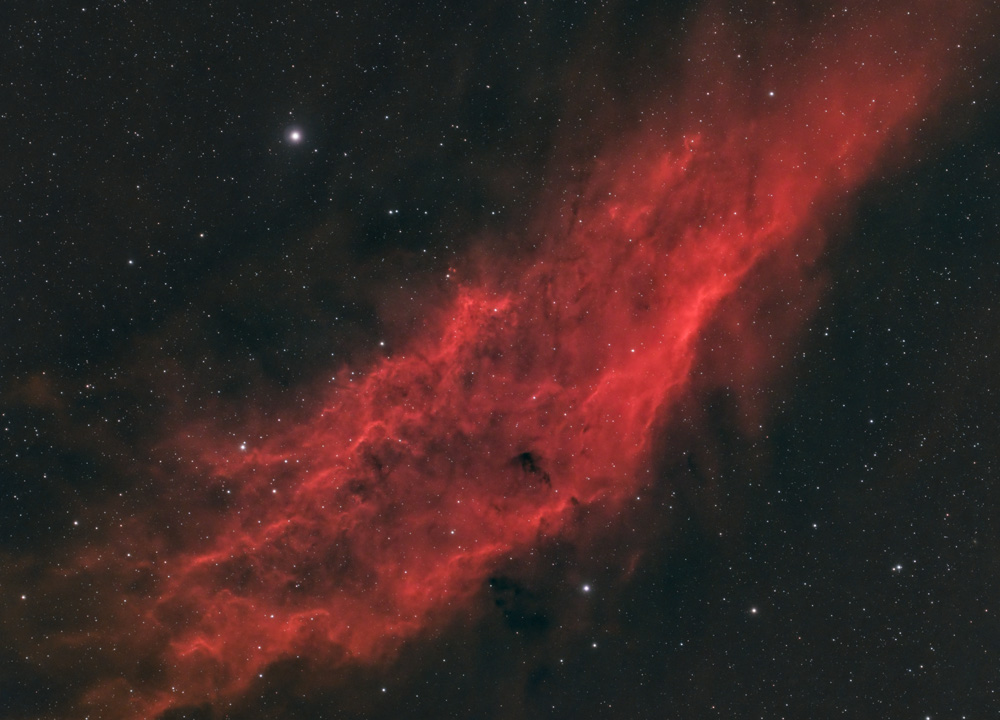
The California Nebula is all pure Ha (red) as far as I know. Red is about all you see here, especially when imaging with a OSC (Color) astro camera.
I hope to get some more time on this next week, but for now, I am pretty happy with this.
The moon was at 82% full, so I used my L-Enhance filter. The moon hadn't risen for this yet, so perhaps the L-Enhance wasn't needed yet, but I just wanted to run with the same filter all night long instead of hassling with changing it. I have a filter drawer assembly so it's physically not hard to change, but it gives a chance for dust to get into the optical train by opening it.
48 - Lights at 180 secs with the Optolong L-Enhance Filter
30 - Flats
30 - Dark/Flats
10 - Darks
iOptron Gem28
ZWO ASI2600mc Pro
ZWO 120mm Mini - Guide Camera
Askar Fra500
Stacked in DeepSkyStacker
Processed in Pixinsight
BlurXterminator
NoiseXterminator
StarXterminator
Final Touches in Photoshop
All comments are welcome,
Jim


