Close Up Moon Experimentation

Mike Lewis

Staff Member
And now for something completely different (for me anyway). Here is a Moon close up, produced from lucky imaging techniques from about ~1.5 mins of 1080p video of the Moon, using my EdgeHD 925 with reducer (1645mm focal Length) and my ASI1600MM camera. This was shot through my Hα filter, which I think manages to help the seeing a little bit as well as possibly tame down the extreme dynamic range that exists even along the terminator. Although not considered to be a planetary camera, my ASI1600, subframed to 1920 x 1080, was giving me around 35 frames per second of video which I think is at least respectable.

If I was more experienced with this perhaps I could tell you where exactly this is on the Moon but I cannot :) Perhaps one of our planetary imagers might recognize some features.

This was processed using Autostakkert (frame analysis, alignment, and stacking), Registax 6 (wavelet sharpening), Photoshop (high pass sharpening), PixInsight (mis-applied Blur XTerminator), and then Lightroom (2x size enhancement and additional tweaks to brightness and contrast). It is VERY easy to overdo the sharpening on this stuff and I may at least be on the borderline of having done that here. I have like 6 other versions of this with mixes of different sharpening and resizing, and after going cross-eyed evaluating, this is my favorite, although they really are all more similar than different. Such is the curse of an unreformed pixel-peeper :)

I ended up using a very light touch on all the techniques in any case. My focusing on the Moon was just tweaked by eye (running remotely I could not use a Bahtinov) so might not have quite been dialed in either. So with all of those caveats and excuses out of the way here it is. I am fairly certain I could improve on these results but I think this came out pretty well. I am interested to figure out what my resolvable scale is in this image, but I will likely need to identify some object(s) of known size to make progress on that I expect.

Comments and critiques welcome.
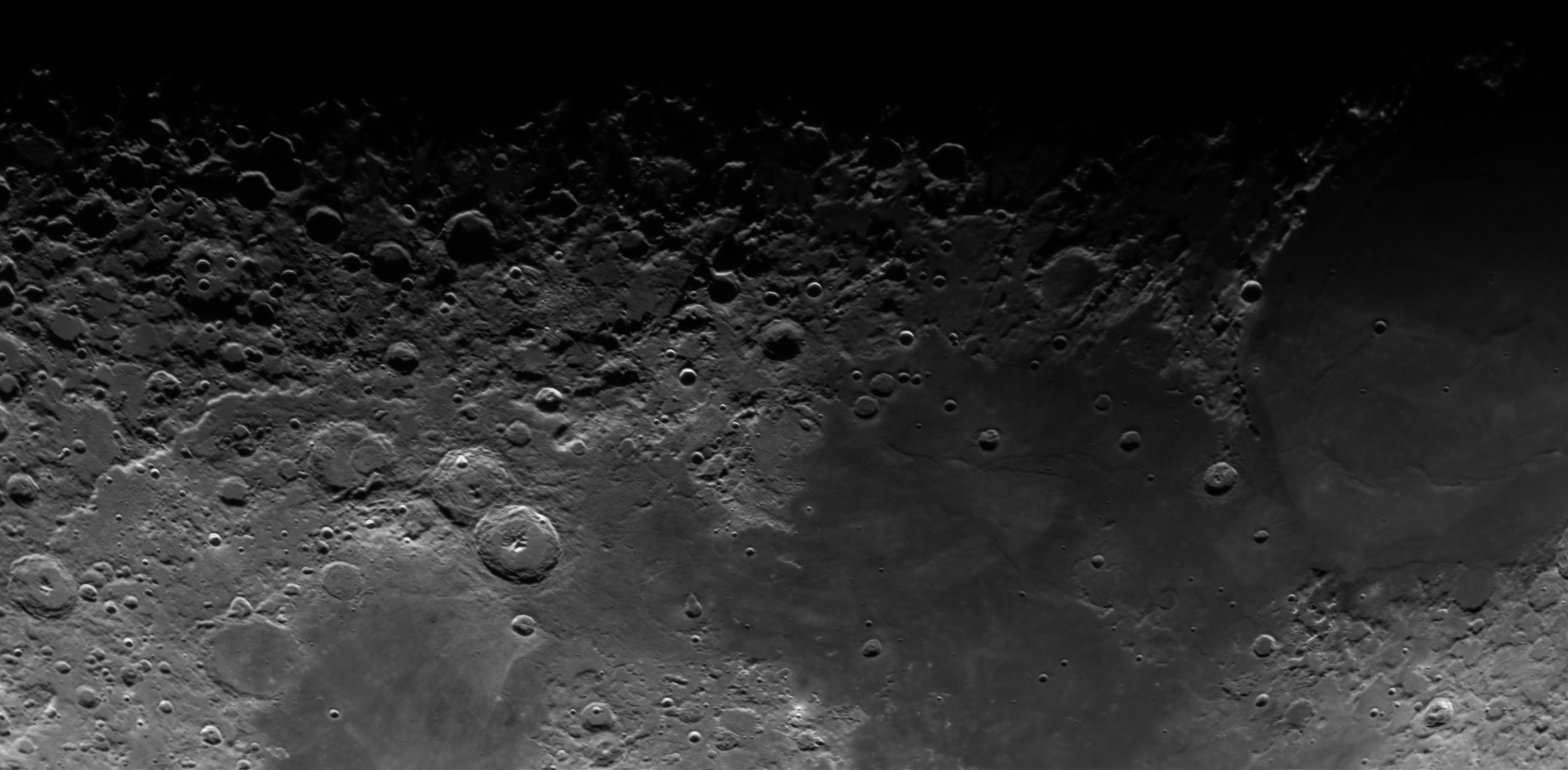
LRCC_sRGB_FW_sRGB_2023-04-27-0315_2-Moon_lapl5_ap8246_PSCC-Enhanced-SR_BXT-2_0.jpg


ML
 

JimFox

Moderator
Staff member
Hey Mike congrats on going Loony for Lunar! ;)

Since I am on the road having just left the Black Canyon of the Gunnison, all I can do is view this on my iPhone, but I would say that it looks really good! I would be happy with this.

You mentioned a Bahtinov mask, would that work with the moon? It wouldn't seem like it would. One of my questions is how are people focusing when focusing on the moon? I am guessing the autofocuser won't work.

I did a similar workflow when I did mine, I think that the way to go.

Had this not been remote you could have shot this without your reducer right? The moon is so bright, it can handle the higher fstop I think.
 

DavidWright2010

Well-Known Member
Hey Mike congrats on going Loony for Lunar! ;)


You mentioned a Bahtinov mask, would that work with the moon? It wouldn't seem like it would. One of my questions is how are people focusing when focusing on the moon? I am guessing the autofocuser won't work.
If you are using a consumer camera, focus peaking is the best way to focus.

David
 

Mike Lewis

Staff Member
Thanks everyone for the kind comments.

- This was shot with my astro camera, so no focus peaking there to use.

- I am not 100% sure, but I'm guessing focusing at infinity with a Bahtinov mask using a star is going to also be in focus for the Moon. I guess it might be a fun experiment though to try to verify that.

- Yes this would definitely be fine without the reducer. Plenty of signal to work with, although much dimmer through the Hα filter too. Next time I'll have to try my Luminance filter and see if the ability to take shorter exposures offsets any benefit of shooting in the far red passband.

ML
 

DavidWright2010

Well-Known Member
And now for something completely different (for me anyway). Here is a Moon close up, produced from lucky imaging techniques from about ~1.5 mins of 1080p video of the Moon, using my EdgeHD 925 with reducer (1645mm focal Length) and my ASI1600MM camera. This was shot through my Hα filter, which I think manages to help the seeing a little bit as well as possibly tame down the extreme dynamic range that exists even along the terminator. Although not considered to be a planetary camera, my ASI1600, subframed to 1920 x 1080, was giving me around 35 frames per second of video which I think is at least respectable.

If I was more experienced with this perhaps I could tell you where exactly this is on the Moon but I cannot :) Perhaps one of our planetary imagers might recognize some features.

This was processed using Autostakkert (frame analysis, alignment, and stacking), Registax 6 (wavelet sharpening), Photoshop (high pass sharpening), PixInsight (mis-applied Blur XTerminator), and then Lightroom (2x size enhancement and additional tweaks to brightness and contrast). It is VERY easy to overdo the sharpening on this stuff and I may at least be on the borderline of having done that here. I have like 6 other versions of this with mixes of different sharpening and resizing, and after going cross-eyed evaluating, this is my favorite, although they really are all more similar than different. Such is the curse of an unreformed pixel-peeper :)

I ended up using a very light touch on all the techniques in any case. My focusing on the Moon was just tweaked by eye (running remotely I could not use a Bahtinov) so might not have quite been dialed in either. So with all of those caveats and excuses out of the way here it is. I am fairly certain I could improve on these results but I think this came out pretty well. I am interested to figure out what my resolvable scale is in this image, but I will likely need to identify some object(s) of known size to make progress on that I expect.

Comments and critiques welcome.

View attachment 59857


ML
Rotating the image 90 degrees left puts north (roughly) up, giving a more recognizable view. From right to left in your view are the seas Serenity, Tranquility, and Nectar.

lunar seas.JPG


My offhand guess is that you are about 0.5 km resolution. If I can locate the lunar map that shows scale (I have it somewhere), I can give you a better number.

David
 

DavidWright2010

Well-Known Member
Rotating the image 90 degrees left puts north (roughly) up, giving a more recognizable view. From right to left in your view are the seas Serenity, Tranquility, and Nectar.

View attachment 59865

My offhand guess is that you are about 0.5 km resolution. If I can locate the lunar map that shows scale (I have it somewhere), I can give you a better number.

David
I like to find a rille that runs north-south (so that there are shadows at low sun angle, and then look at catalogs of rilles, which usually give their width. I didn't see any rilles like that in your image, but look at this comparison with a Moon map:
lunar  maps.JPG


There is a rille (Hypatia) above center, but runs east-west. Even so, it is slightly visible in your image. (But the info I found didn't mention width...)

I forgot to say it previously, but nice image. However you can see some processing defects (arrays of spots), when you look at this scale.

Note the URL for this map - it's handy to have.

The reason I'm into rilles is the rille (Hadley) at the Apollo 15 site, and I'd like to capture a decent image. So far, I just get a hint.

David
 

Mike Lewis

Staff Member
David, (@DavidWright2010)

Wow, very cool!

That is fantastic! The map you posted seems to be at about the same scale as what I have posted - that's very fun and informative. I did not know anything like that existed. I do not see where the URL for that amazing map is listed, perhaps I am just missing it? I definitely would like to have that to use it as a reference for future efforts.

I am not at all surrprised there are some processing artifacts, thanks for pointing them out. I REALYY do not know much about running either Autostakkert or Registax 6, (probably close to monkey with a typwriter level atm) so I just tried to muddle through and get something I liked. beyond that I also did some processing after the fact, the most egregious of which was to use Blur XTerminator on the file, for which it is not designed for - if I had to guess that is a liely culprit to introduce artifacting. I found any kind of sharpening very easy to overdo.

In any case, thanks so much for all this info it is very fun to see the map matched to the image. So if you can point me towards that map URL I would appreciate it.

Best Regards,

ML
 

DavidWright2010

Well-Known Member
David, (@DavidWright2010)

Wow, very cool!

That is fantastic! The map you posted seems to be at about the same scale as what I have posted - that's very fun and informative. I did not know anything like that existed. I do not see where the URL for that amazing map is listed, perhaps I am just missing it? I definitely would like to have that to use it as a reference for future efforts.

I am not at all surrprised there are some processing artifacts, thanks for pointing them out. I REALYY do not know much about running either Autostakkert or Registax 6, (probably close to monkey with a typwriter level atm) so I just tried to muddle through and get something I liked. beyond that I also did some processing after the fact, the most egregious of which was to use Blur XTerminator on the file, for which it is not designed for - if I had to guess that is a liely culprit to introduce artifacting. I found any kind of sharpening very easy to overdo.

In any case, thanks so much for all this info it is very fun to see the map matched to the image. So if you can point me towards that map URL I would appreciate it.

Best Regards,

ML
Sorry, it was in the picture - I should have mentioned that. The URL is Lunar-map.com

Another source that is not quite as flexible is actual photos from the Lunar Reconnaissance Orbiter (LRO). Here is the site that shows the Apollo landing sites. I think that the Apollo 11 site is in the range of your photo. (But I didn't check)

David
 

Mike Lewis

Staff Member
Sorry, it was in the picture - I should have mentioned that. The URL is Lunar-map.com

Another source that is not quite as flexible is actual photos from the Lunar Reconnaissance Orbiter (LRO). Here is the site that shows the Apollo landing sites. I think that the Apollo 11 site is in the range of your photo. (But I didn't check)

David
Awesome! Thanks! Did not realize I might possibly captured that location.

ML
 

chuckp

Well-Known Member
Hi Mike, nice capture! Glad to see you are starting to capture some solar system images. I use the 1600mm on a lot of my planetary shots, moon shots and solar. I think 1600mm s a great solar system camera. I prefer it over my 224c but I use the 224 for those days when there is patchy clouds so I can get a quick color image.
 
Top Bottom