Eagle Nebula - M16

JimFox

Moderator
Staff member
The Eagle Nebula or M16 is a super cool nebula and one that I had not captured before. It's a little hard to find manually, but I am getting better at that. What's cool with the Eagle Nebula is not only how it looks, but that the famous Pillars of Creation is seen in it. The Pillars of Creation are one of the coolest area's to image I think, but it's getting pretty small with my current setup. So it's awesome for myself that I can pick out the Pillars of Creation, but they are really too small in the frame to really try to crop and have an image about them. One day... :)

This one doesn't look the best to me, the star removal program Starnet++ doesn't always work as well as it should each time. So looking in too close you can see some artifacts around some of the stars because of it. But as long as you don't pixel peep I think it looks decent. Not great, but decent. I think it's a good starting point for this one, and something that I can improve upon in the future.

SkyGuider Pro - Tracking
Nikon D850 - Unmodifed
Tamron 150-600mm @500mm

120 images @ ISO1600 and 60 secs and f6.3
20 - Dark Frames
20 - Flat Frames
20 - Bias Frames

Stacked in DSS
Processed in Photoshop

All comments are welcome,

Jim

PS. The larger one shows some of the dust from the Milky Way that is close to it.

Original Crop
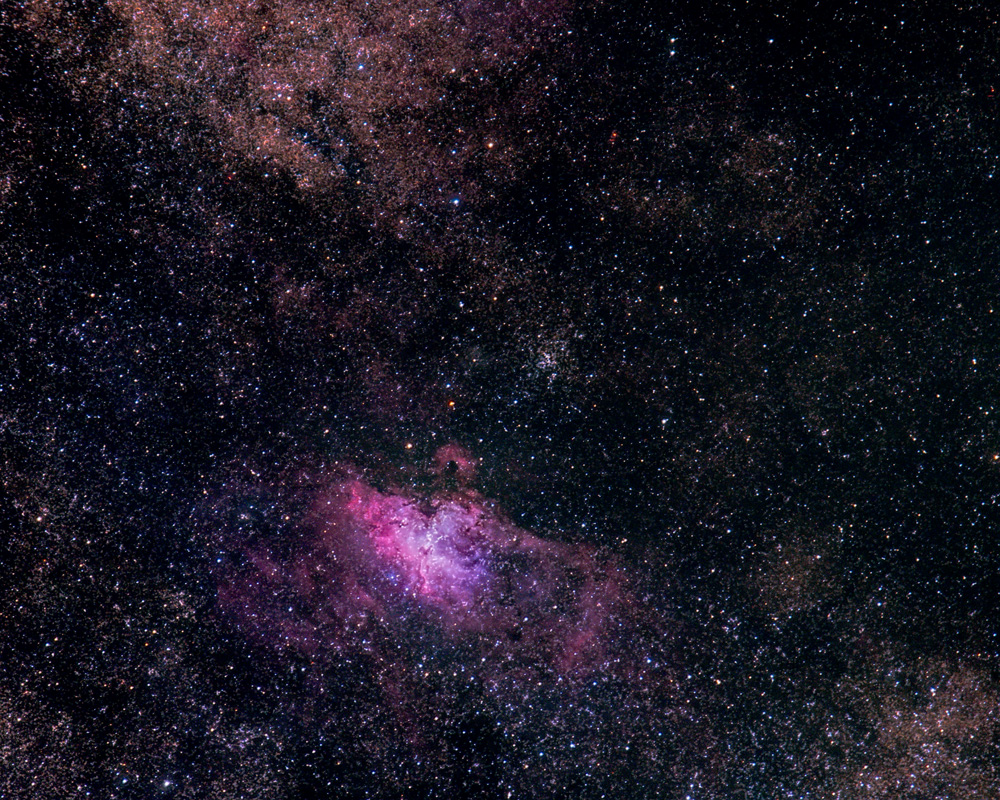
EagleNebula_20210614_dw.jpg


Additional Crop - Pillars of Creation is almost dead center in the nebula
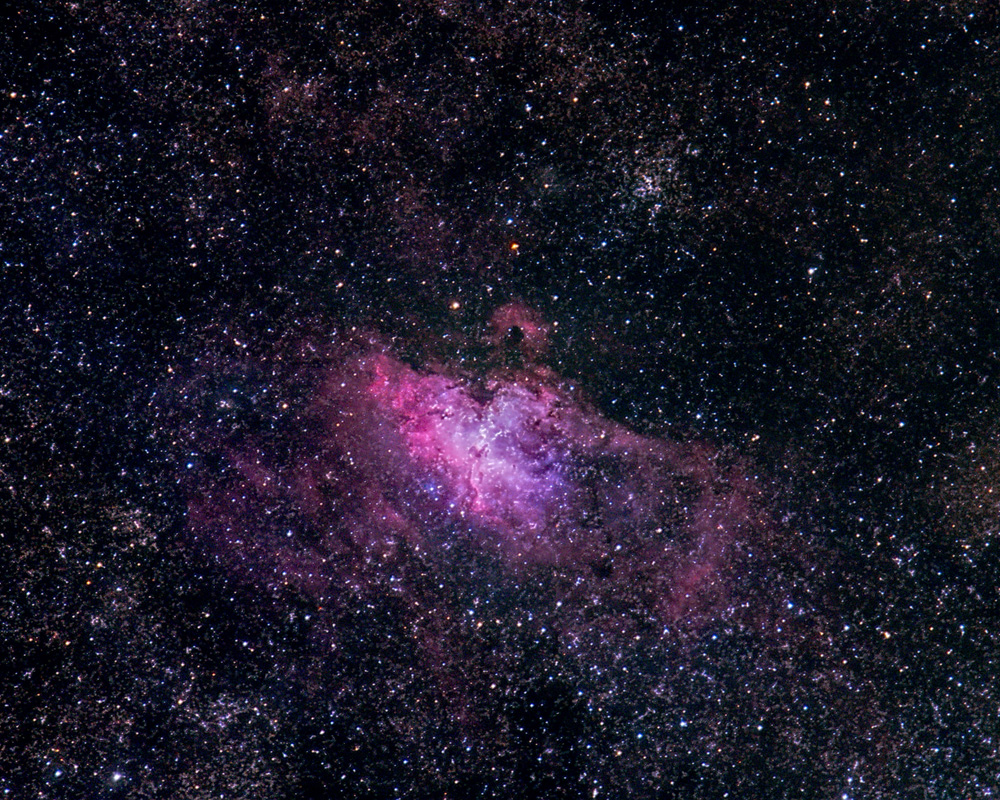
EagleNebula_20210614_d1w.jpg
 

AlanLichty

Moderator
Targets like this one show the advantages of dedicated astro photo gear. At web resolution the artifacts you mention don't really jump out.

Have you ordered your backyard telescope to shoot things like this yet? 😎
 

JimFox

Moderator
Staff member
Targets like this one show the advantages of dedicated astro photo gear. At web resolution the artifacts you mention don't really jump out.

Have you ordered your backyard telescope to shoot things like this yet? 😎
For sure dedicated Astro gear definitely can make objects like this on sing in regards to the Pillar of Creation. The size of objects captured is basically due to the lens or scope's Focal Length and the size of the sensor of the camera being used. So in this case, I could keep my Tamron 150-600mm and then add an Astro Camera like Mike Lewis' which is actually only a 4/3rds sensor instead of the Full Frame I am using and the object immediately becomes 4 times larger. That's why I am really considering a camera like Mike uses, since it would give my existing Tamron so much more reach.

Since I was talking about the size a DSO appears in the image, the 3rd way that some guys can enlarge or reduce the size of an image is by what's called a Barlow. It comes in different magnifications a 2x is pretty common. It's like a Teleconverter but works with Scopes and not Lenses.

I think that's what I have learned so far in that regards... :)
 

Mike Lewis

Staff Member
Jim,

Nice job on this, you are getting some decent detail given the scale. I like the colors too. Some might call this result 'too pink', but I like it.

My scale with my setup is 1.34 arcsec/pixel. You might be surprised to see how close you are to that. I am assuming you are using the D850? A rough calculation using 4.35 micron pixels (check me on this number) and 600mm yields an arcsec/pixel value with that setup of 1.49, not significantly different than my value. The implication then would be that your resolution when cropped to m4/3 size would not be that much less than the 16 MP of my astro camera. So you might not see much of a bump in resolving power.

As a fun off the top of my head thought experiment, here are what I think the other differences in play would be:

  • Sky Brightness - Not sure, but for at least some of your locations I think you are shooting under darker conditions than I have. I just estimated in another thread that my remote location in in AZ is likely about a Bortle 4.
  • Mono versus One Shot Color (OSC, Bayer array) - I am getting some advantage here in collection efficiency (especially in Hα), as well as some small resolution advantage having all pixels sensitive to each color (although in practice I think that difference is minor)
  • Cooling - I am getting ~half the noise for every ~6 degrees Celsius I cool my sensor. This last time running in the desert in the spring I ran at a constant -15C. That will give me cleaner sub-exposures to start with. You likely get cool, but it is inconsistent and likely never with the sensor at -15C or the like. You also have no temperature control, so your darks are not at the same temperature as your lights, which can introduce some issues with dark subtraction.
  • Seeing - I think we are guessing that at many of the areas you are using, like JTNP for instance, you probably have very good seeing, comparable to what I am getting in AZ
  • Integration Time - Of course, I am spending LOTS more time on target than you, which reduces noise and brings out faint detail
  • Tracking - I am getting consistent < 1 arcsec tracking RMS (almost always less than 0.5 arcsec RMS). That mount you are using is good but I am sure not that good. This will also help to resolve the small details better.
  • Processing - I still maintain you would get better results with different processing software, especially for stacking, versus DSS. That certainly has been my experience anyway.

P.S. - Forgot one:


  • Narrowband Filters - as shown in my recent post, high quality narrowband filters really can kick up the contrast and bring out some amazing details that just don't show up when shooting in broadband light. Having a mono camera with narrow versions of these filters really accentuates that, as well as fighting light pollution pretty effectively.

My Eagle Nebula shot I posted a while ago is one of my favorites - it really is an amazing area. I think you are getting great results given all of your constraints, and your post processing has grown by leaps and bounds. That exercise you did using external astro data really was a smart thing to do., and immediately seemed to give your post processing technique a bump.

ML
ML
 
Top Bottom