

Bill Richards
Well-Known Member
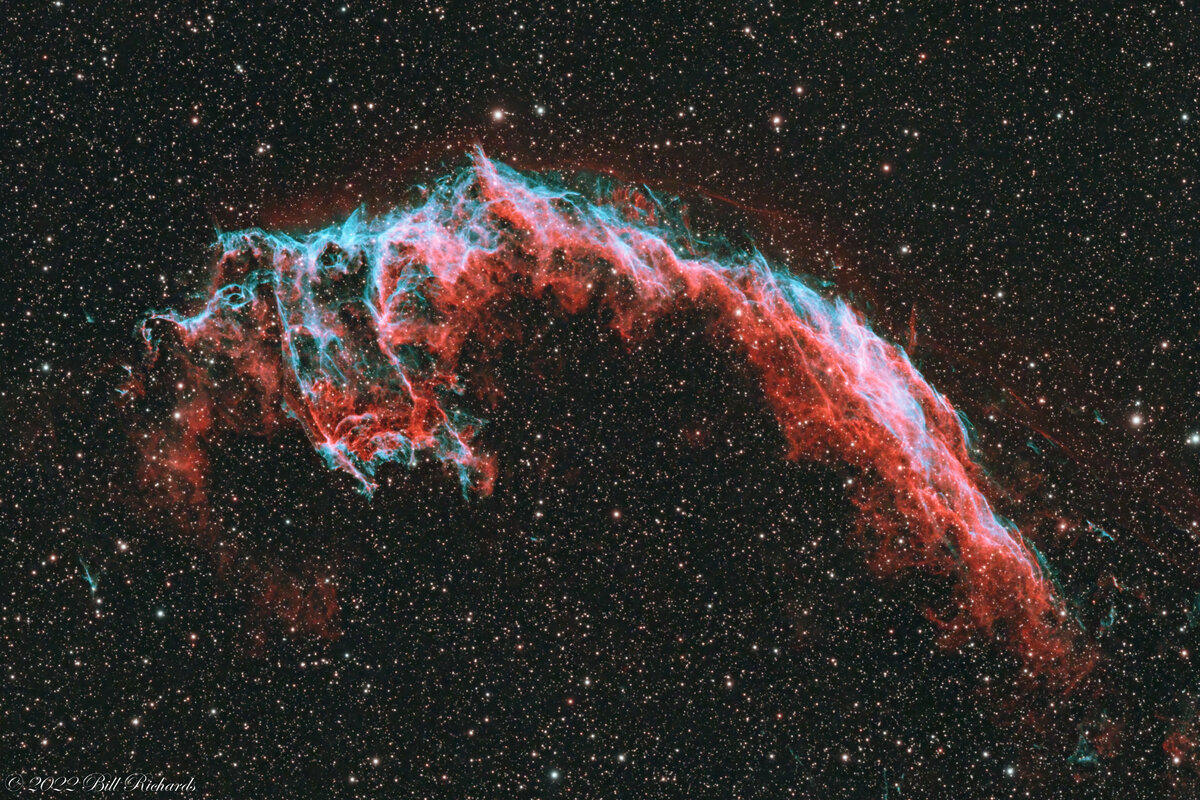
The Eastern Veil Nebula (aka NGC 6992) is the eastern half of a supernova remnant about 1400 light-years away. This debris cloud was blasted out from the cataclysmic explosion of a dying star (supernova) over 10,000 years ago. The interstellar shock wave plows through space sweeping up and exciting interstellar material. Imaged with narrow band filters, the glowing filaments are like long ripples in a sheet seen almost edge on, remarkably well separated into atomic hydrogen (red) and oxygen (blue-green) gas.
This is the result of over 6 hours of exposure time taken on 8/16/2022.
Equipment and Software:
=======================
Mount: iOption CEM40 w/iPolar
Telescope: SkyWatcher Esprit 100ED
Auto-Focuser: Pegasus FocusCube2
Imaging Camera: ASI2600MC-Pro
Filter: AstroHutech NBZ dual-band filter
Guide Camera: ASI290MM-Mini on OAG
Imaging Software: NINA
Guiding Software: PHD2
Image Processing Software: PixInsight
Exposure Details:
=================
Camera Temperature -10C
Bias: 50
Gain: 100
125 x 180s (rejected 15)
Plus 32x Darks, Flats, and Dark Flats
#VeilNebula #NGC6992 #amateurastrophotography #asiweek #astro #astronomy #astronomymagazine #astronomyphotography #astronomypicturesdaily #astrophotography #cosmos #deepsky #deepskyobject #longexpo #longexposure #nasa #nebula #nightphotography #nightsky #outerspace #photography #science #skyandtelescopemag #space #spacephotography #stars #telescope #universe
This is the result of over 6 hours of exposure time taken on 8/16/2022.
Equipment and Software:
=======================
Mount: iOption CEM40 w/iPolar
Telescope: SkyWatcher Esprit 100ED
Auto-Focuser: Pegasus FocusCube2
Imaging Camera: ASI2600MC-Pro
Filter: AstroHutech NBZ dual-band filter
Guide Camera: ASI290MM-Mini on OAG
Imaging Software: NINA
Guiding Software: PHD2
Image Processing Software: PixInsight
Exposure Details:
=================
Camera Temperature -10C
Bias: 50
Gain: 100
125 x 180s (rejected 15)
Plus 32x Darks, Flats, and Dark Flats
#VeilNebula #NGC6992 #amateurastrophotography #asiweek #astro #astronomy #astronomymagazine #astronomyphotography #astronomypicturesdaily #astrophotography #cosmos #deepsky #deepskyobject #longexpo #longexposure #nasa #nebula #nightphotography #nightsky #outerspace #photography #science #skyandtelescopemag #space #spacephotography #stars #telescope #universe


