

Bill Crawford
Well-Known Member
From reading Mike's post, and comments from Jim and Alan, as well as some other posts, it's obvious that Eclipses are hard to photograph. I had similar difficulties. Looking at the different weather forecasts, I had all but given up on getting a shot. It was going to snow or rain all day, then starting to break up in the evening. Then I found cleardarksky.com, which said most of South Central Washington would start clearing by 7pm, and totally clear by 9. My friend Curt and I decided to drive to Bickleton, which is at a higher altitude and has dark skies. We headed up, and barely left the valley floor, when we hit a heavy snow storm. 4or 5 inches of snow on the road and still snowing hard. We ended up a few miles west of Bickleton, near Cleaveland. It stopped snowing about 5pm, and we got a glimpse of the moon at 5:35. At 7 the wife sent a text that she could see the moon in Yakima. We were packing our gear, when the clouds miraculously began to break up! Before 8 we were taking photos through a thin cloud cover. I had the same questions about motion blur as many of you. In my search for info on photographing an eclipse, I found this: https://iwillbeyourphotoguide.com/advanced-shutter-speed-calculator-astrophotography/ I have a 100-400mm Canon on a 5D mk III. I also have a 2X extender, which I decided not to use, considering I would be shooting at F/11. By the calculator, I planned on shooting at F/5.6, 1/2sec. and adjust ISO as needed. My first shots were at 100 ISO, but spoiled by the cloud cover. After some experimenting later on, I should have stopped down to F/6.3 or even 7.1. By the time clouds finally cleared completely, I was up to about ISO 2500. Most of my totality shots were at ISO 5000. I was not impressed. I started turning the ISO down and went clear up to a 1sec. exposure. Here are the results:

This is 5000 ISO, 1/2 sec., F5.6

This is 2500 ISO, 1 sec., F5.6.
It appears to me that, at least for my camera, a little motion blur is better than high ISO noise.

This is 800 ISO, 1/2 sec., F/5.6.
My best shots were after totality, when I was able to shoot at a low ISO and had clear skies, but then the temperature plunged, and the cold combined with the humidity, iced up everything including our lenses. So out of the whole eclipse, where I took about 235 photos, I got a few good shots right after totality, like the one above, and a couple right at the very end, after I de-iced my lens!
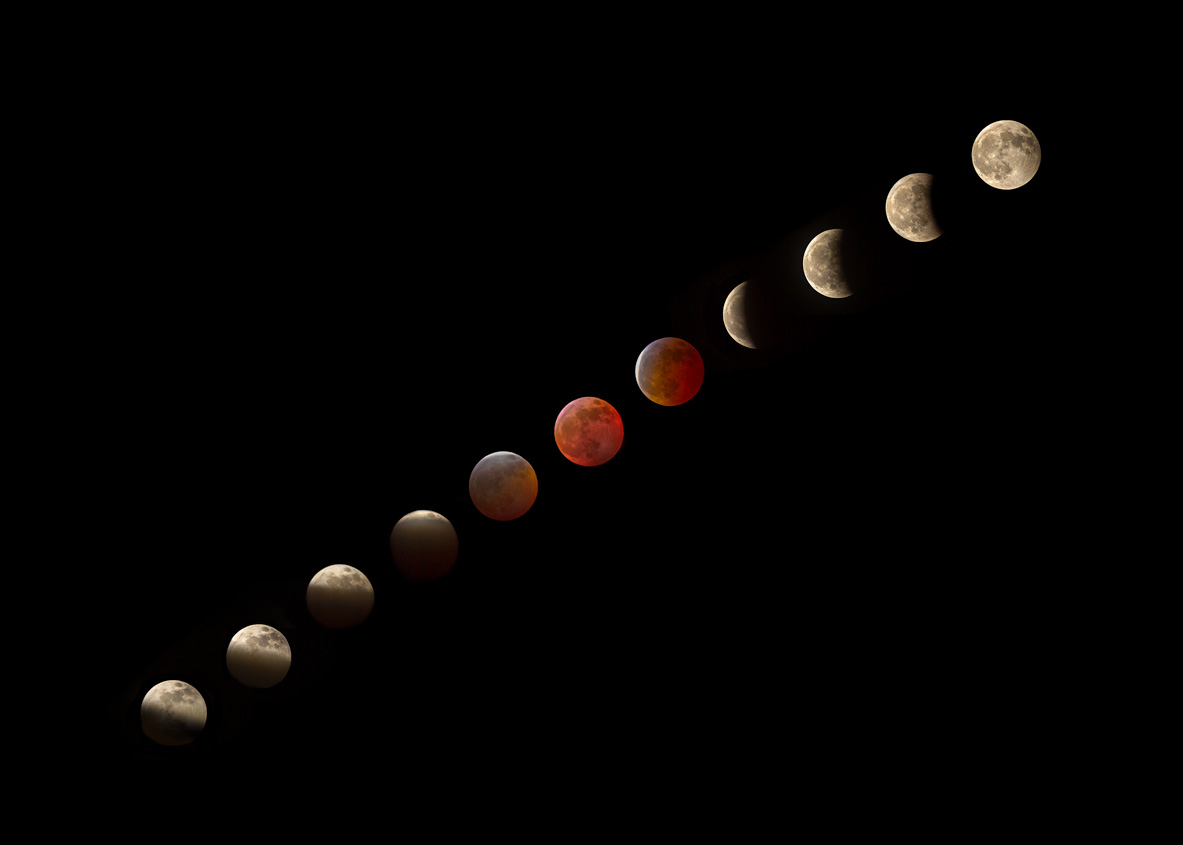
I made this by stacking the last full moon photo behind the others with a partial mask, to recover some detail. I didn't have a pre- eclipse full moon because of the clouds.
This is 5000 ISO, 1/2 sec., F5.6
This is 2500 ISO, 1 sec., F5.6.
It appears to me that, at least for my camera, a little motion blur is better than high ISO noise.
This is 800 ISO, 1/2 sec., F/5.6.
My best shots were after totality, when I was able to shoot at a low ISO and had clear skies, but then the temperature plunged, and the cold combined with the humidity, iced up everything including our lenses. So out of the whole eclipse, where I took about 235 photos, I got a few good shots right after totality, like the one above, and a couple right at the very end, after I de-iced my lens!
I made this by stacking the last full moon photo behind the others with a partial mask, to recover some detail. I didn't have a pre- eclipse full moon because of the clouds.


