

Mike Lewis
Staff Member
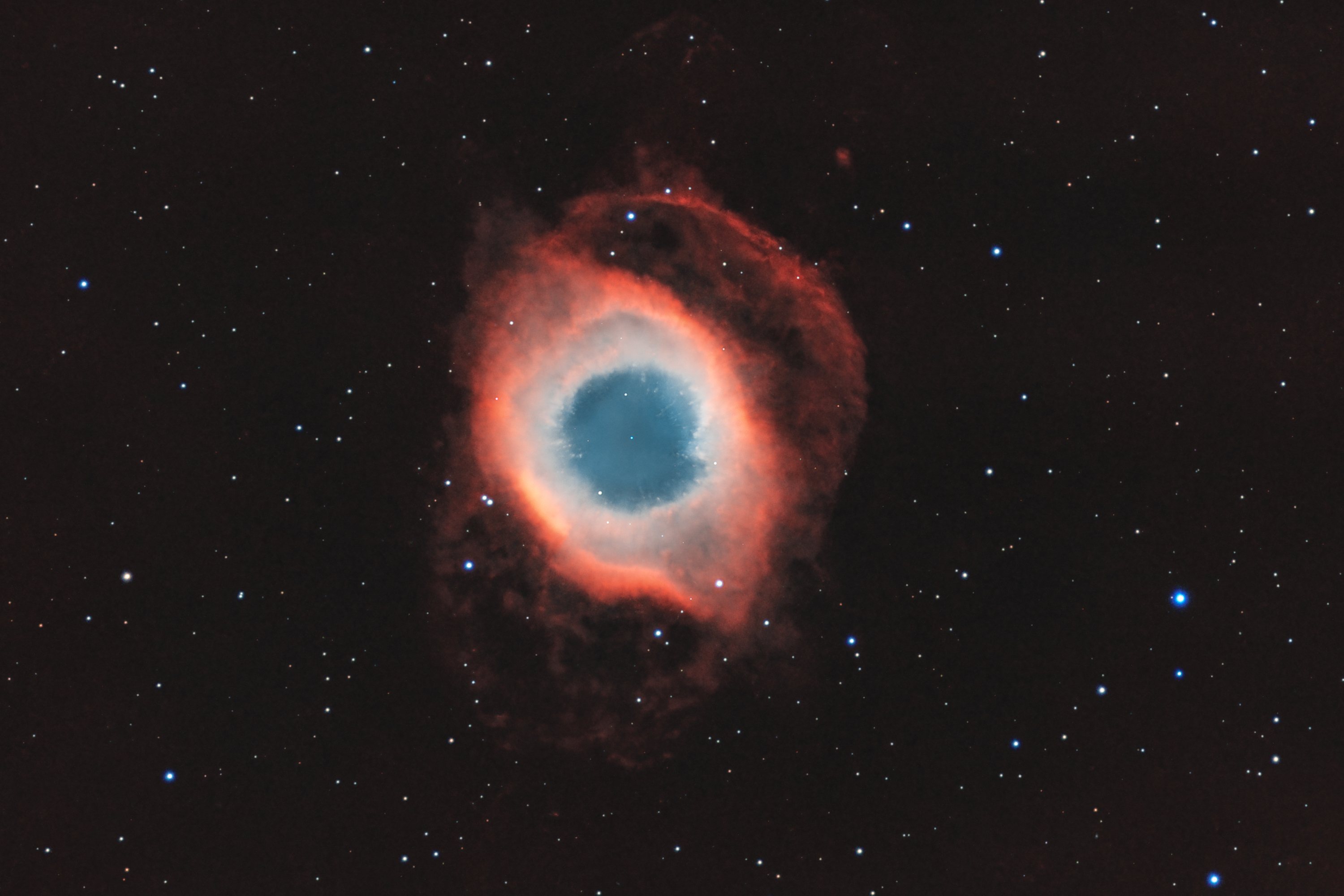
I have wanted to image this amazing object for quite a while, and this last imaging session I was finally able to get some time on it.
The Helix Nebula is the closest planetary nebula to the Earth, at an estimated distance of about 650 light years. This then also makes it the largest planetary nebula in the night sky. Planetary nebula have nothing to do with planets, but are created when some stars, nearing the end of their stellar lifetime, begin to blow off layers of material. This object is low in the sky, even imaged from Southern AZ, but still makes for an interesting object, even with a 100mm refractor. The Helix Nebula has sometimes been referred to as the 'Eye of God', as well as the 'Eye of Sauron'.
This was imaged in the standard 3 NB filters (Ha, OIII, and SII) as well as a small amount of RGB data for the stars. The SII signal was very weak compared to the other 2, and in retrospect I might have been better off to put that integration time into the collection of more Ha and OII instead, although the SII is being used in the color mix.
Palette:
Red: (1.1 x Ha) + (0.5 x SII)
Green: (0.5 x ha) + (0.5 x OIII)
Blue: (1.2 x OIII)
RGB mixed and used for the star field
Rescaled to keep all channels inside of available dynamic range
The SII was blurred to mitigate the higher noise levels, as it was being used for a hint of color and not detail. Most of the detail is coming from the Ha channel, which is typical as it is almost always the strongest NB channel. In this case there is a pretty decent OIII signal as well, which accounts for the blue in the middle of the nebula. The small blue dot in the middle is the star responsible for the beautiful display. It is on its way to becoming a white dwarf, a star that has consumed its fuel but that will still shine due to residual heat for many billions of years. In fact, it is estimated to take ~15 billion years for a white dwarf star to cool to the point of not being visible - longer than the estimated current age of the Universe, at 13.8 billion years. So every star ever created in the Universe that is small enough not to go out as a supernova is still shining today...
Equipment:
ZWO ASI1600MM-C Camera @ -20C and
Gain:200 Offset:50
Software Bisque MyT Mount
Stellarvue SVQ100 Astrograph Refractor, 580mm @ f/5.8
Innovations Foresight ONAG
Software:
Pixinsight Commercial Version 1.8
Lightroom CC
Photoshop CC
Innovations Foresight SkyGuard
Light Frames:
Ha: 41 x 300 secs ( 3 hrs 25 mins)
OIII: 37 x 300 secs (3 hrs 5 mins)
SII: 34 x 300 secs (2 hrs 50 mins)
Red: 11 x 30 secs (5 mins 30 secs)
Green: 12 x 30 secs (6 mins)
Blue: 12 x 30 secs (6 mins)
9 hrs 37 mins 30 secs total
Dark Frames:
10 x 60 secs, RGB (30 mins)
10 x 360 secs, Ha,OIII,SII (3 hrs)
Bias Frames
100
Flat Frames
20 each filter
Comments and critiques welcome.
ML
The Helix Nebula is the closest planetary nebula to the Earth, at an estimated distance of about 650 light years. This then also makes it the largest planetary nebula in the night sky. Planetary nebula have nothing to do with planets, but are created when some stars, nearing the end of their stellar lifetime, begin to blow off layers of material. This object is low in the sky, even imaged from Southern AZ, but still makes for an interesting object, even with a 100mm refractor. The Helix Nebula has sometimes been referred to as the 'Eye of God', as well as the 'Eye of Sauron'.
This was imaged in the standard 3 NB filters (Ha, OIII, and SII) as well as a small amount of RGB data for the stars. The SII signal was very weak compared to the other 2, and in retrospect I might have been better off to put that integration time into the collection of more Ha and OII instead, although the SII is being used in the color mix.
Palette:
Red: (1.1 x Ha) + (0.5 x SII)
Green: (0.5 x ha) + (0.5 x OIII)
Blue: (1.2 x OIII)
RGB mixed and used for the star field
Rescaled to keep all channels inside of available dynamic range
The SII was blurred to mitigate the higher noise levels, as it was being used for a hint of color and not detail. Most of the detail is coming from the Ha channel, which is typical as it is almost always the strongest NB channel. In this case there is a pretty decent OIII signal as well, which accounts for the blue in the middle of the nebula. The small blue dot in the middle is the star responsible for the beautiful display. It is on its way to becoming a white dwarf, a star that has consumed its fuel but that will still shine due to residual heat for many billions of years. In fact, it is estimated to take ~15 billion years for a white dwarf star to cool to the point of not being visible - longer than the estimated current age of the Universe, at 13.8 billion years. So every star ever created in the Universe that is small enough not to go out as a supernova is still shining today...
Equipment:
ZWO ASI1600MM-C Camera @ -20C and
Gain:200 Offset:50
Software Bisque MyT Mount
Stellarvue SVQ100 Astrograph Refractor, 580mm @ f/5.8
Innovations Foresight ONAG
Software:
Pixinsight Commercial Version 1.8
Lightroom CC
Photoshop CC
Innovations Foresight SkyGuard
Light Frames:
Ha: 41 x 300 secs ( 3 hrs 25 mins)
OIII: 37 x 300 secs (3 hrs 5 mins)
SII: 34 x 300 secs (2 hrs 50 mins)
Red: 11 x 30 secs (5 mins 30 secs)
Green: 12 x 30 secs (6 mins)
Blue: 12 x 30 secs (6 mins)
9 hrs 37 mins 30 secs total
Dark Frames:
10 x 60 secs, RGB (30 mins)
10 x 360 secs, Ha,OIII,SII (3 hrs)
Bias Frames
100
Flat Frames
20 each filter
Comments and critiques welcome.
ML


