
Keith Grice
Active Member
Nothing else to do when your locked down but to look back at old data that hasn`t been processed.
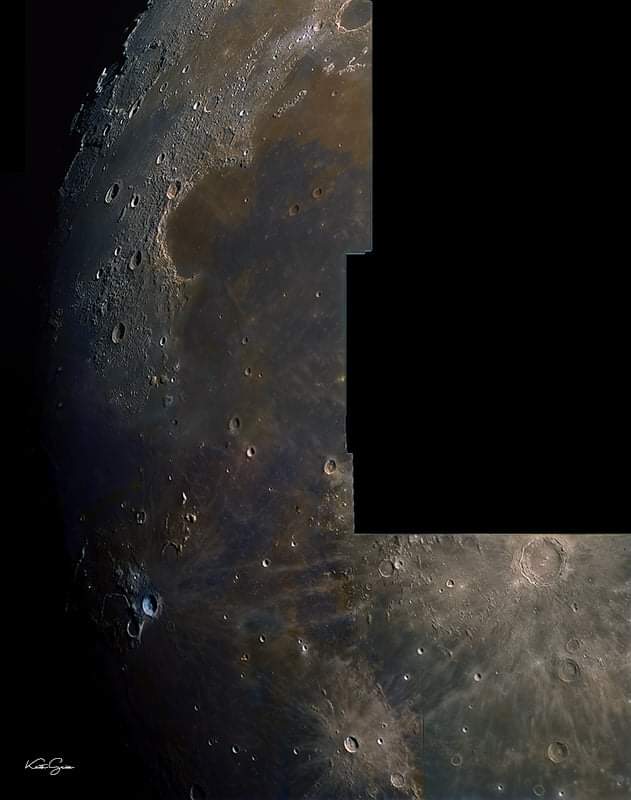
Introducing the western Moon from my back yard.
7 seperate images of this interesting detailed western terminator were captured during the spring of 2020. The Moon was almost overhead so I was imaging through the thinest atmosphere and therefore capturing excellent data.
Each image consists of 3000 frames of which 15% were used to make this final mosaic.
To the north is the crater Plato ( 101 km ) and coming south onto The Bay Of Rainbows ( Sinus Iridum ) and onto Mare Imbrium and the Aristarchus Plateau...Aristarchus crater ( 40 km ) is one of the brightet features on the Moon and is illuminated blue in the morning sunshine. Beside it is a sinuous rille, the largest one on the Moon, discovered by the German astronomer Johann Schröter in 1787. Named in his honour, Schröter’s Valley is a deep, winding channel, hundreds of kilometres long, with a smaller inner channel that meanders just as slow rivers do on Earth. The end of this “river” simply tapers away to nothing and disappears on the mare plains.
Far right is the mighty Copernicus crater ( 100 km ) and lower centre is Kepler ( 32 km )
The Moons various mineral rich deposits can be seen in this detailed image.
Mak 180 Pro telescope
ZWO ASI224MC Planetary camera
Captured with Sharpcap
Stacking in Autostakkert 3
Mosaic constructed with Microsoft Composite Editor
Processed in Photoshop CC 2019
06.02.2020
Introducing the western Moon from my back yard.
7 seperate images of this interesting detailed western terminator were captured during the spring of 2020. The Moon was almost overhead so I was imaging through the thinest atmosphere and therefore capturing excellent data.
Each image consists of 3000 frames of which 15% were used to make this final mosaic.
To the north is the crater Plato ( 101 km ) and coming south onto The Bay Of Rainbows ( Sinus Iridum ) and onto Mare Imbrium and the Aristarchus Plateau...Aristarchus crater ( 40 km ) is one of the brightet features on the Moon and is illuminated blue in the morning sunshine. Beside it is a sinuous rille, the largest one on the Moon, discovered by the German astronomer Johann Schröter in 1787. Named in his honour, Schröter’s Valley is a deep, winding channel, hundreds of kilometres long, with a smaller inner channel that meanders just as slow rivers do on Earth. The end of this “river” simply tapers away to nothing and disappears on the mare plains.
Far right is the mighty Copernicus crater ( 100 km ) and lower centre is Kepler ( 32 km )
The Moons various mineral rich deposits can be seen in this detailed image.
Mak 180 Pro telescope
ZWO ASI224MC Planetary camera
Captured with Sharpcap
Stacking in Autostakkert 3
Mosaic constructed with Microsoft Composite Editor
Processed in Photoshop CC 2019
06.02.2020


