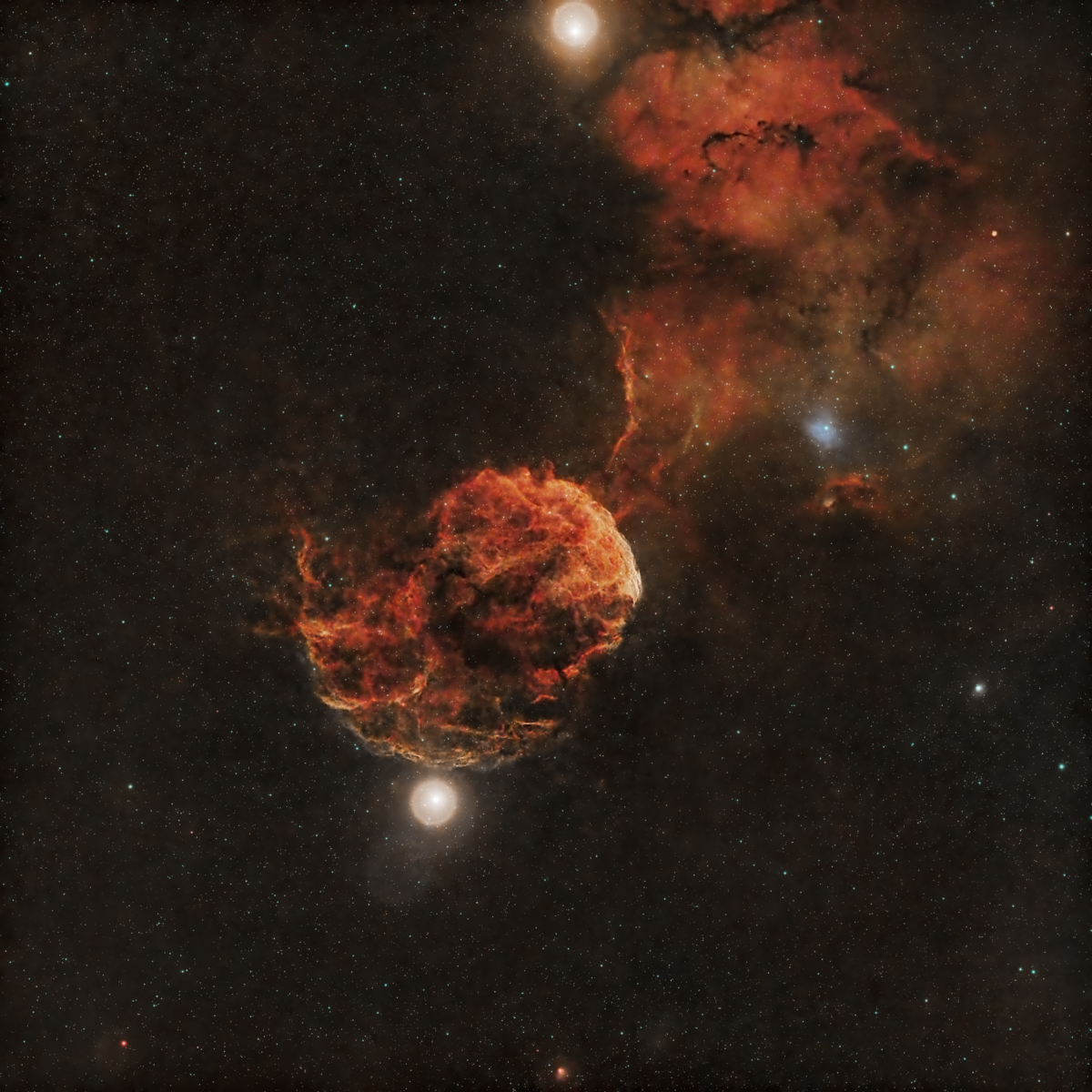
Jellyfish Nebula

jsb

Well-Known Member
First time targeting the Jellyfish Nebula (IC 443).
Redcat 51, ais533mc pro (gain 101, -10C cooled), Star adventure 2i, Asiair plus, guided, EAF.
Optolong L-enhance filter, Bortle 5, 61x180" subs, Calibration frames; darks, flats, bias, Bortle 5.
Stacked and processed in Pixinisight.
pm2 sr rotated.png
 

JimFox

Moderator
Staff member
So this is what it looks wider. I had captured it for the first time a couple of months ago, but at 500mm. I thought that if I could capture it at 350mm which is closer to the Red Cat 51 framing that it might look great.

You really captured this very well John. I like seeing that nebulosity pouring out to the upper right. Great job on this.
 
  • Like
Reactions: jsb

jsb

Well-Known Member
So this is what it looks wider. I had captured it for the first time a couple of months ago, but at 500mm. I thought that if I could capture it at 350mm which is closer to the Red Cat 51 framing that it might look great.

You really captured this very well John. I like seeing that nebulosity pouring out to the upper right. Great job on this.
Thank you
 

jsb

Well-Known Member
Neat object I like the large white stars? At each end
Yes I agree it’s an interesting target with two large bright stars. I created a semi-starless version without the two stars (Propus, Tejat) but leaving the rest. I’m not sure which version like more.
 

JimFox

Moderator
Staff member
Yes I agree it’s an interesting target with two large bright stars. I created a semi-starless version without the two stars (Propus, Tejat) but leaving the rest. I’m not sure which version like more.
Hey John, it's probably not kosher, but I have done that a few times where there was a star that just felt like it was overwhelming the image. Not sure if there is a right or wrong, but I wanted to enjoy the nebula, and the star was messing it up. The Rosette is one I had done that on before I think.
 
  • Like
Reactions: jsb

Mike Lewis

Staff Member
REALLY nice - the framing with the Redcat and the 533 seems to work out perfectly, and the details are popping out with your excellent processing. The star reduction lets the nebulosity take center stage too. I love this target and you have really done it justice!

ML
 
  • Like
Reactions: jsb

jsb

Well-Known Member
REALLY nice - the framing with the Redcat and the 533 seems to work out perfectly, and the details are popping out with your excellent processing. The star reduction lets the nebulosity take center stage too. I love this target and you have really done it justice!

ML
Thank you. I did apply a star reduction using Bill Blanshan’s Pixinisight pixel math script. However I would like to find a method to tame the halo of the bright stars of Propus and Tejat. I can crush them with clonestamp but would like something better. Do you have any recommendations?
 

Mike Lewis

Staff Member
Thank you. I did apply a star reduction using Bill Blanshan’s PixInisight pixel math script. However I would like to find a method to tame the halo of the bright stars of Propus and Tejat. I can crush them with clonestamp but would like something better. Do you have any recommendations?

I also use Bill Blanshan's star reduction Pixel math scripts, they are the best thing out there, and now combined with BlurXterminator run early in your post processing flow are a really effective combo to star reduction. That being said, once you get REALLY bright stars in the FOV even these tools cannot really control them to the same degree as the dimmer stars in your image.

I have taken to recording completely separate data in RGB for my stars. I started with this just because I didn't like the look of the narrowband palette star colors, and all the classical workarounds for that seemed to me to be tedious and unsatisfactory. But I quickly realized that a side effect of this approach is that you can under-stretch your star data and get not only more colorful RGB stars to add back in to your image but also naturally smaller stars as well. This has allowed me to use a finer touch on the star reduction later. While this partially mitigates the issue you are mentioning with very bright stars, it still does not bring those really bright ones down to a level that blends in to the rest of the star field. On balance though I really like the colorful smaller stars I get from this approach. It only takes like ~30 mins of total integration using like 30 sec subframes to get enough data for this usijng my mono setup. You can experiment with the 533C and see what you think.

At the end of the day though, I think really bright stars can look ok with the type of treatment you have above, as long as you don't have a large number of them in the FOV.

All a long winded way of saying, 'No, I don't have a better approach once the star gets to be this bright..." :)

ML
 
  • Like
Reactions: jsb

jsb

Well-Known Member
I also use Bill Blanshan's star reduction Pixel math scripts, they are the best thing out there, and now combined with BlurXterminator run early in your post processing flow are a really effective combo to star reduction. That being said, once you get REALLY bright stars in the FOV even these tools cannot really control them to the same degree as the dimmer stars in your image.

I have taken to recording completely separate data in RGB for my stars. I started with this just because I didn't like the look of the narrowband palette star colors, and all the classical workarounds for that seemed to me to be tedious and unsatisfactory. But I quickly realized that a side effect of this approach is that you can under-stretch your star data and get not only more colorful RGB stars to add back in to your image but also naturally smaller stars as well. This has allowed me to use a finer touch on the star reduction later. While this partially mitigates the issue you are mentioning with very bright stars, it still does not bring those really bright ones down to a level that blends in to the rest of the star field. On balance though I really like the colorful smaller stars I get from this approach. It only takes like ~30 mins of total integration using like 30 sec subframes to get enough data for this usijng my mono setup. You can experiment with the 533C and see what you think.

At the end of the day though, I think really bright stars can look ok with the type of treatment you have above, as long as you don't have a large number of them in the FOV.

All a long winded way of saying, 'No, I don't have a better approach once the star gets to be this bright..." :)

ML
Thanks for your reply. Taking a separate session on the stars seems like a good solution.
 
Top Bottom