

Mike Lewis
Staff Member
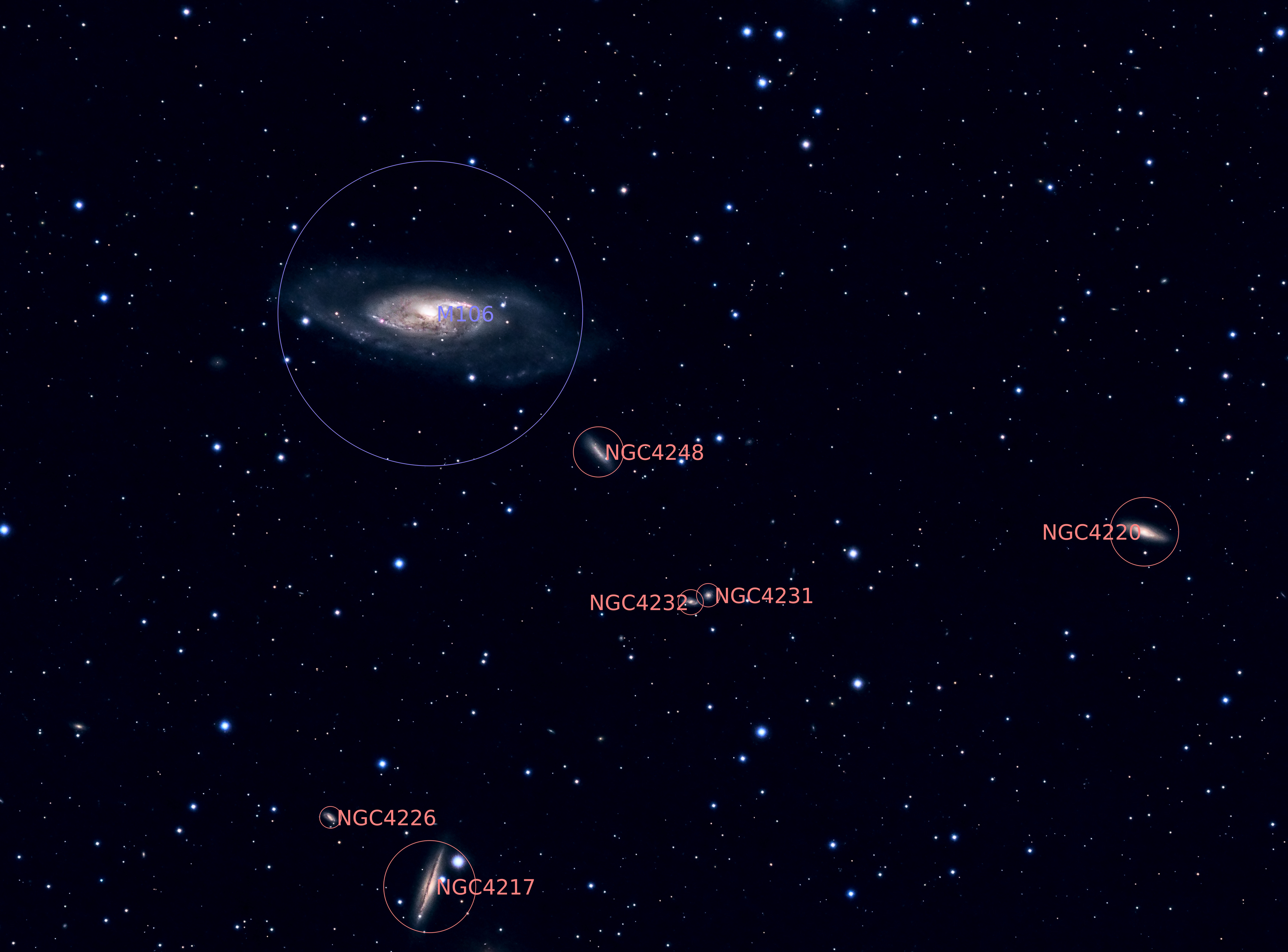
So I am heading into galaxy season now armed only with my 4" refractor, so I am starting to find whatever targets I can. Here is a wider view that includes M106, the main spiral galaxy dominating the view here, along with a handful of other smaller galaxies. This image was surprisingly hard to edit to my liking, and I eventually just decided to post this version. I actually threw out my original data set completely, as I think it was 'overexposed' and I shot this again at a lower gain and with shorter subs. Even so, the bright stars do not look good, so much so that the worst offenders have been cropped off the bottom of this image, which is why NGC 4217 has ended up uncomfortably close to the edge of the frame. This is proof that not every astro image can be a masterpeice, and makes me think that in all the work I have put in during the last year to get my narrowband processing to a certain level I have managed to lose my recipe for processing RGB data. Always something new to learn (or re-learn) it seems like, but that is what keeps the hobby fresh. Comments, critiques, and suggestions welcome, as always.
Here is the image:

And here is an annotated version, showing the other NGC galaxies in the frame.
And believe it or not, if I turn on the PGC catalog objects (PGC stands for Principal Galaxies Catalog and contains entries for over 73,000 galaxies!), there are many many more small dots that are also galaxies and not stars, visible in the image:

It starts to TRULY boggle the mind and fire the imagination when you realize each marked spot is an entire galaxy, and we are only looking at a small patch of sky in this image
Capture details and some more info on M106 from Wikipedia:
Equipment:
ZWO ASI1600MM-C Camera @ -15C and
Gain:0 Offset:10
Software Bisque MyT Mount
Stellarvue SVQ100 Astrograph Refractor, 580mm @ f/5.8
Software:
Pixinsight Commercial Version 1.8
Lightroom CC
Photoshop CC
Light Frames:
Luminance: 205 x 30 secs (1 hr 42 mins 30 secs)
Red:111 x 60 secs (1 hr 51 mins)
Green:105 x 60 secs (1 hr 45 mins)
Blue: 105 x 60 secs (1 hr 45 mins)
7 hrs 3 mins total
Dark Frames:
10 x 30 secs, RGB (5 mins)
10 x 60 secs, Luminance (10 mins)
Bias Frames
60
Flat Frames
10 each filter
More M106 Details from Wikipedia:
Messier 106 (also known as NGC 4258) is an intermediate spiral galaxy in the constellation Canes Venatici. It was discovered by Pierre Méchain in 1781. M106 is at a distance of about 22 to 25 million light-years away from Earth. M106 contains an active nucleus classified as a Type 2 Seyfert, and the presence of a central supermassive black hole has been demonstrated from radio-wavelength observations of the rotation of a disk of molecular gas orbiting within the inner light-year around the black hole.
ML
Here is the image:
And here is an annotated version, showing the other NGC galaxies in the frame.
And believe it or not, if I turn on the PGC catalog objects (PGC stands for Principal Galaxies Catalog and contains entries for over 73,000 galaxies!), there are many many more small dots that are also galaxies and not stars, visible in the image:
It starts to TRULY boggle the mind and fire the imagination when you realize each marked spot is an entire galaxy, and we are only looking at a small patch of sky in this image
Capture details and some more info on M106 from Wikipedia:
Equipment:
ZWO ASI1600MM-C Camera @ -15C and
Gain:0 Offset:10
Software Bisque MyT Mount
Stellarvue SVQ100 Astrograph Refractor, 580mm @ f/5.8
Software:
Pixinsight Commercial Version 1.8
Lightroom CC
Photoshop CC
Light Frames:
Luminance: 205 x 30 secs (1 hr 42 mins 30 secs)
Red:111 x 60 secs (1 hr 51 mins)
Green:105 x 60 secs (1 hr 45 mins)
Blue: 105 x 60 secs (1 hr 45 mins)
7 hrs 3 mins total
Dark Frames:
10 x 30 secs, RGB (5 mins)
10 x 60 secs, Luminance (10 mins)
Bias Frames
60
Flat Frames
10 each filter
More M106 Details from Wikipedia:
Messier 106 (also known as NGC 4258) is an intermediate spiral galaxy in the constellation Canes Venatici. It was discovered by Pierre Méchain in 1781. M106 is at a distance of about 22 to 25 million light-years away from Earth. M106 contains an active nucleus classified as a Type 2 Seyfert, and the presence of a central supermassive black hole has been demonstrated from radio-wavelength observations of the rotation of a disk of molecular gas orbiting within the inner light-year around the black hole.
ML


