

Dave Johnston
Well-Known Member
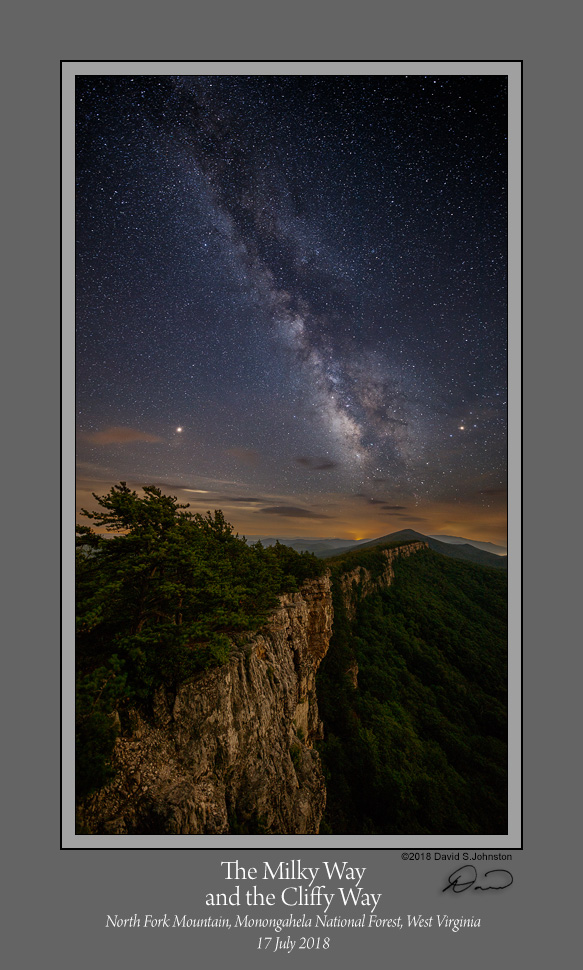
It has been a while since I have had a chance to get out and take anything worth posting on these pages. But last week I found that the right combination of Milky Way position and timing, moon phase and timing during the evening, weather and work schedule was going to happen to allow me to try for a shot I had been contemplating for about a year.
North Fork Mountain is a long ridge just east of the Allegheny Front in West Virginia. The sandstone is bedded and faulted to create long, unbroken cliffs of 80 to 100 feet, and posts, pedestals and other formations. Because the cliffs face west it is a popular spot for sunset pictures, but it is a several-mile, 1300 foot climb so you need to either stumble down in the dark or bivy. The ridge line runs almost perfectly north-south meaning that this time of the year the MW will line up with it. It is within one of the darker sky zones in the east.
But without the moon to throw some light on the cliffs it would be just a silhouette, not unique to the location. Last week the crescent moon was just right to provide enough light from the west after sunset, but set at about midnight to allow the MW to shine through. It had rained most of the previous two days, but cleared up late that afternoon, and stayed mostly clear most of the night.
This is panorama of two images, one exposed for the cliffs with moonlight and the other of the sky a couple hours later. This one is sized for this screen, but you can see a somewhat bigger version at http://www.pbase.com/dsjtecserv/image/167854077
Comments and suggestions are welcome.
Dave
North Fork Mountain is a long ridge just east of the Allegheny Front in West Virginia. The sandstone is bedded and faulted to create long, unbroken cliffs of 80 to 100 feet, and posts, pedestals and other formations. Because the cliffs face west it is a popular spot for sunset pictures, but it is a several-mile, 1300 foot climb so you need to either stumble down in the dark or bivy. The ridge line runs almost perfectly north-south meaning that this time of the year the MW will line up with it. It is within one of the darker sky zones in the east.
But without the moon to throw some light on the cliffs it would be just a silhouette, not unique to the location. Last week the crescent moon was just right to provide enough light from the west after sunset, but set at about midnight to allow the MW to shine through. It had rained most of the previous two days, but cleared up late that afternoon, and stayed mostly clear most of the night.
This is panorama of two images, one exposed for the cliffs with moonlight and the other of the sky a couple hours later. This one is sized for this screen, but you can see a somewhat bigger version at http://www.pbase.com/dsjtecserv/image/167854077
Comments and suggestions are welcome.
Dave
Last edited:


