

Mike Lewis
Staff Member
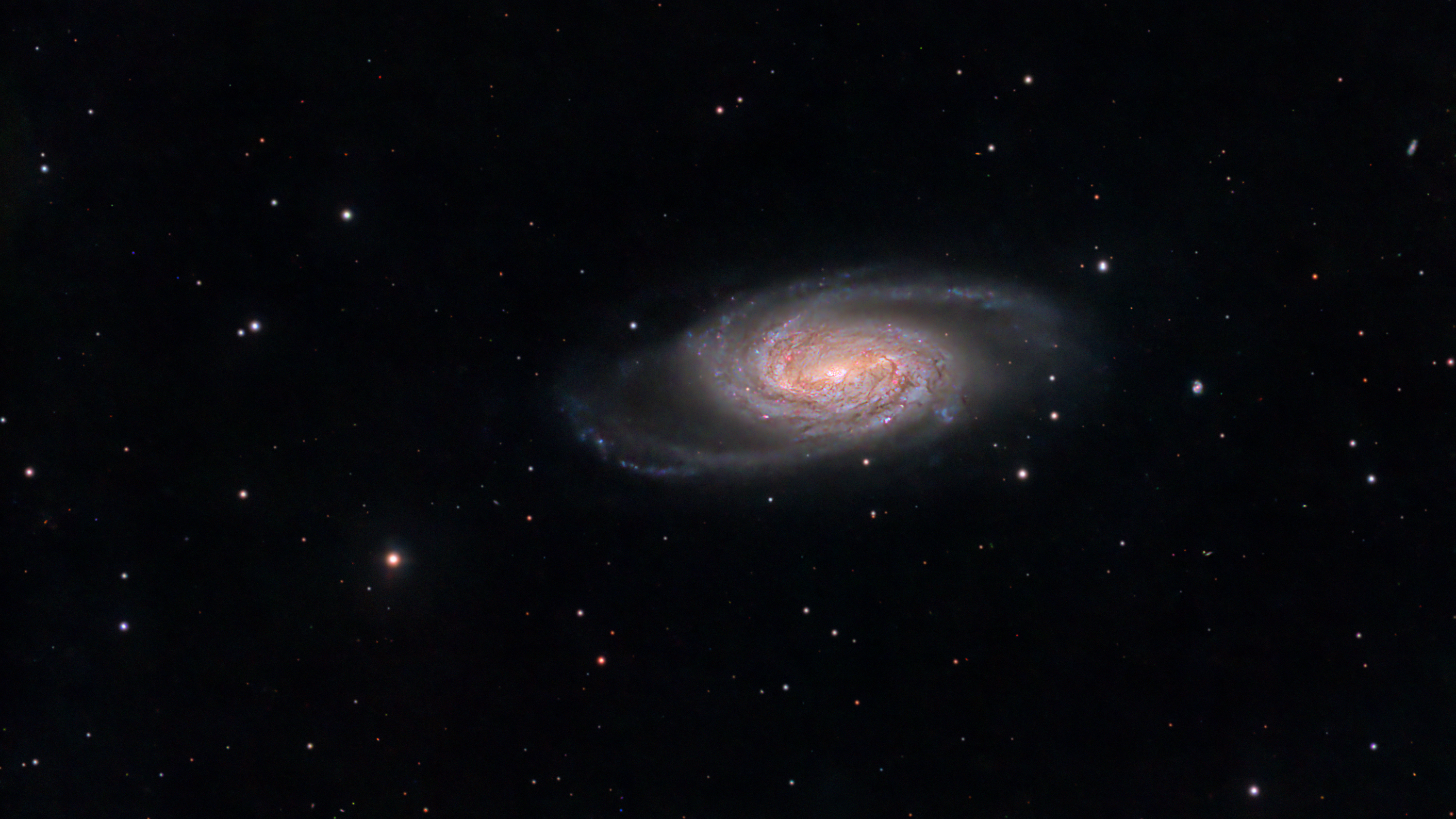
So it has taken a little while to get my new (purchased used but new to me) higher magnification scope online. It started out with collimation problems, and then I had to work through a few issues with getting the new setup to run under NINA and also some issues with focus and star sizes. Predictably, I am not completely sure I have everything optimized, but the results I have gotten on this target, a smaller galaxy that is just not very impressive through my 4" refractor, are the kind of results I was at least hoping for when I decided to add this scope to my arsenal.
This galaxy is about 13 x 6 arcminutes is size, and is imaged here with the EdgeHD 9.25 inch scope and a 0.7x reducer, yielding 1645mm of focal length at f/7. This is using my older ASI1600 mono camera that was moved from the refractor to make way for the larger and newer QHY268M camera. As I have stated elsewhere, after a couple of years perfecting my post processiong for narrowband nebula targets, I am finding the RGB processing to be trickier than I would have thought. On this image the colors and especially the stars (which were removed for stretching the galaxy and then added back in later) really were a time sink to get acceptable, and I still see some issues with them, but the colors are nice and I think all is mostly well with the end result, but of course, as always, I am keenly interested to get feedback from all of you on the end result.
This is made from 7 hours and 42 mins of data, although almost 12 hours of data were collected, much under periods of bright moonlight. Subframes were discarded due to eccentricity or FWHM issues, and the almost 2 hours of Hα data was not used at all as it just did not combine well, although the reddish magenta star forming regions do seem to have come through quite well with just the RGB filters anyway.
From Wikipedia:
NGC 2903 is an isolated barred spiral galaxy in the equatorial constellation of Leo, positioned about 1.5° due south of Lambda Leonis.[10] It was discovered by German-born astronomer William Herschel, who cataloged it on November 16, 1784. He mistook it as a double nebula, as did subsequent observers, and it wasn't until the nineteenth century that the Third Earl of Rosse resolved into a spiral form.[5] J. L. E. Dreyer assigned it the identifiers 2903 and 2905 in his New General Catalogue; NGC 2905 now designates a luminous knot in the northeastern spiral arm.[11]
This field galaxy[12] is located about 30[3] million light-years away from the Milky Way, and is a member of the Virgo Supercluster.[4]
Equipment:
ZWO ASI1600MM-C Camera @ -10C and
Gain:139 Offset:21
Software Bisque MyT Mount
Celestron EdgeHD 9.25 SCT w/0.7x Reducer, 1645mm @ f/7
Primaluce Labs Esatto 2" Autofocuser
Software:
Pixinsight Commercial Version 1.8
Lightroom CC
Photoshop CC
Innovations Foresight SkyGuard
Light Frames:
Red: 48 x 180 secs (2 hrs 24 mins)
Green: 58 x 180 secs 2 hrs 54 mins)
Blue: 48 x 180 secs (2 hrs 24 mins)
7 hrs 42 mins total
Dark Frames:
10 x 180 secs, LRGB (30 mins)
Bias Frames
60
Flat Frames
20 each filter
This galaxy is about 13 x 6 arcminutes is size, and is imaged here with the EdgeHD 9.25 inch scope and a 0.7x reducer, yielding 1645mm of focal length at f/7. This is using my older ASI1600 mono camera that was moved from the refractor to make way for the larger and newer QHY268M camera. As I have stated elsewhere, after a couple of years perfecting my post processiong for narrowband nebula targets, I am finding the RGB processing to be trickier than I would have thought. On this image the colors and especially the stars (which were removed for stretching the galaxy and then added back in later) really were a time sink to get acceptable, and I still see some issues with them, but the colors are nice and I think all is mostly well with the end result, but of course, as always, I am keenly interested to get feedback from all of you on the end result.
This is made from 7 hours and 42 mins of data, although almost 12 hours of data were collected, much under periods of bright moonlight. Subframes were discarded due to eccentricity or FWHM issues, and the almost 2 hours of Hα data was not used at all as it just did not combine well, although the reddish magenta star forming regions do seem to have come through quite well with just the RGB filters anyway.
From Wikipedia:
NGC 2903 is an isolated barred spiral galaxy in the equatorial constellation of Leo, positioned about 1.5° due south of Lambda Leonis.[10] It was discovered by German-born astronomer William Herschel, who cataloged it on November 16, 1784. He mistook it as a double nebula, as did subsequent observers, and it wasn't until the nineteenth century that the Third Earl of Rosse resolved into a spiral form.[5] J. L. E. Dreyer assigned it the identifiers 2903 and 2905 in his New General Catalogue; NGC 2905 now designates a luminous knot in the northeastern spiral arm.[11]
This field galaxy[12] is located about 30[3] million light-years away from the Milky Way, and is a member of the Virgo Supercluster.[4]
Equipment:
ZWO ASI1600MM-C Camera @ -10C and
Gain:139 Offset:21
Software Bisque MyT Mount
Celestron EdgeHD 9.25 SCT w/0.7x Reducer, 1645mm @ f/7
Primaluce Labs Esatto 2" Autofocuser
Software:
Pixinsight Commercial Version 1.8
Lightroom CC
Photoshop CC
Innovations Foresight SkyGuard
Light Frames:
Red: 48 x 180 secs (2 hrs 24 mins)
Green: 58 x 180 secs 2 hrs 54 mins)
Blue: 48 x 180 secs (2 hrs 24 mins)
7 hrs 42 mins total
Dark Frames:
10 x 180 secs, LRGB (30 mins)
Bias Frames
60
Flat Frames
20 each filter


