

Mike Lewis
Staff Member
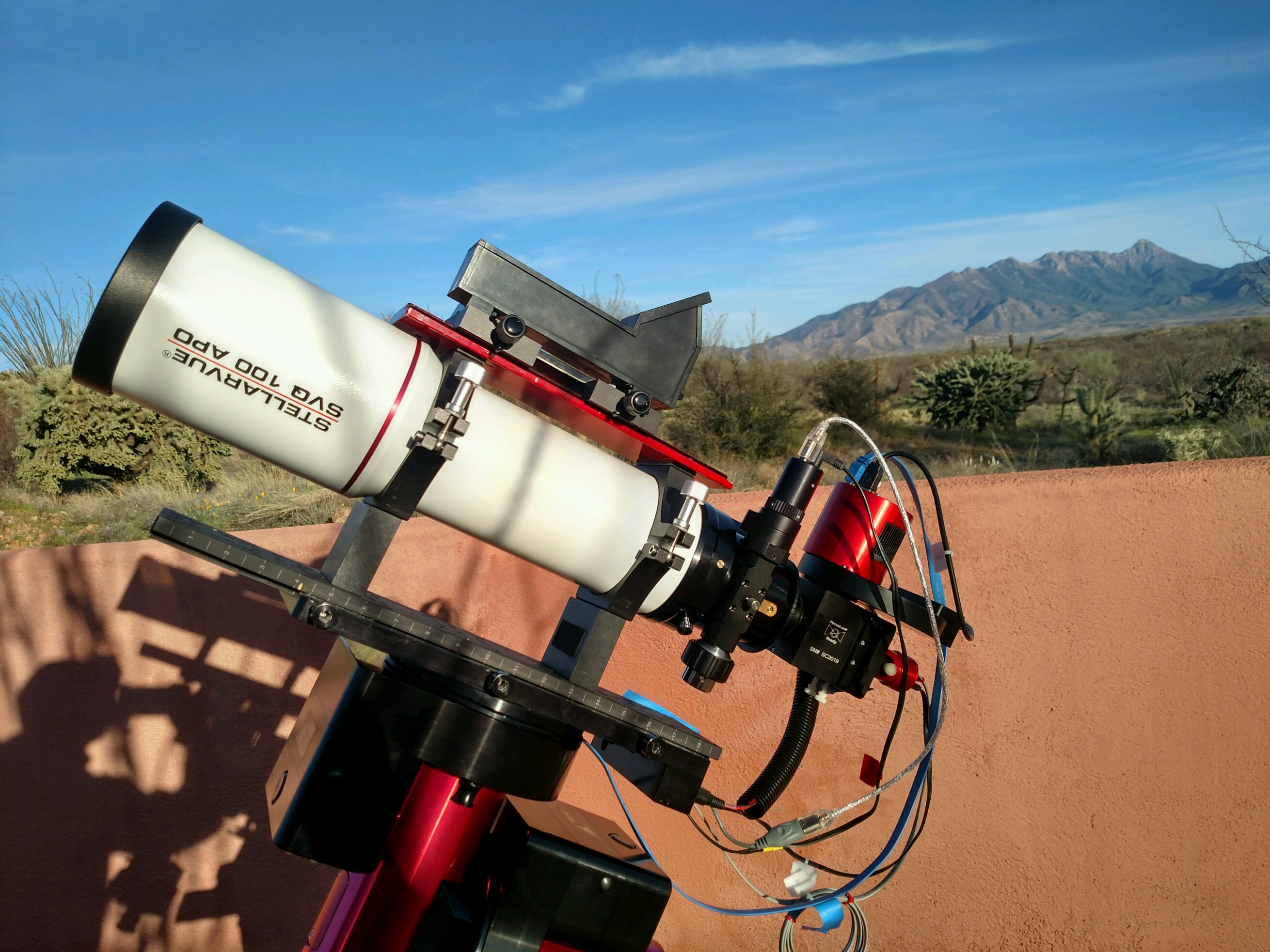
So I am getting excited for another few months of remote astro for me coming up, perhaps as early as about a week from now. My firiend delayed his travel to get his 2 COVID shots (2nd one this week) and will then be heading back down to his place in Southern AZ where my astro gear is situated. Just as a rfresher, here is what my setup looks lie:
The mount setup:

A closer detail showing the scope and the camera stack (ASI1600 imager, ONAG, ASI290 guider). I have since had those cables tied up even better after a cable snag during a TPoint alignment run
So anyway, here are some things I hope to get data on remotely running my gear from here in CO over the next few months. Some of these targets were a little better earlier in the year, but I still hope to get some usable data.
1) NGC1499, California Nebula - this is a relatively bright object and a little too big for my FOV. But I hope to delve into a mosaic for this, as with the proper camera rotation relative to the target I think I can fit it in a 2 x 1 mosaic. This introduces a lot of complexity but can make for an amazing result. So time to see what is involved. I will be imaging this in narrowband (Hα, OIII, SII) which will hopefully mitigate the moon somewhat, as the start of the remote imaging will be when the moon is bright. This object continues to degrade with time but also perhaps still some data to be had during March too.
2) M78 / Barnard's Loop Section - This is going to be an LRGB natural light target. I also has a diminishing amount of imaging time as we head into spring, being close to the M42 area. We will see how things go with this.
3) Rosette Nebula - a classic object and one that I kinda botched due to a camera setting the first time I imaged it years ago. I plan to do a NB HOO somewhat 'natural looking' bicolor for this I think. Once again, I will need to get data early on as this degrades as the days go by. This is a rare target that is impressive either in natural light LRGB or in NB, but as stated, I think I will try for NB this time.
4) NGC 2403 - this is a galaxy that may be too small for me at 580mm (and no way to swap my telescope out) but it is still almost optimally placed in the sky to be a good target all night, so I will at least evaluate what I can get from it. I assume a LRGB only target if it proves interesting enough at this small scale.
5) M106 and friends - M106 is also small, but turns out there are some other galaxies that will be in the FOV so this could turn out to be a fun widefield of the area and still hopefully get some detail on M106 too. This will be an all night available target for almost the entire range of time I will have to image (late Feb through new moon May as it is planned atm) so if it is a goods target it is likely to get a good amount of data to work with to try to bring out some detail in even the small fuzzies in the FOV. Definitely a LRGB plus Hα target.
6) Butterfly Nebula/Sadr Region - this is one of the few targets that improves as time passes. It will not be good in Feb or even March but will start to get usable in April and May. So much cool nebulosity in the this region that it is hard to point anywhere close and not get some cool nebulosity. Another NB target.
7) NGC6357, Lobster Nebula - this is a tough target, staying low in the sky from my observing latitude even at best date in June. It is a very cool target though and frames quite well at 580mm in my camera. I will see how I do with it on the back end of the sessions in April/May, if I am done with other targets. Definitely a NB target I think.
So while no plan survives first contact with the enemy as they say, this is a starting point. Lots will depend on how quickly things get set back up, what the weather wants to do, the effect of the moon in Feb, and what things end up looking like and framing like. Something pretty special though about sitting here inside at a warm computer with a hot chocolate slewing around to targets and watching the data roll in while it snows outside
ML
The mount setup:
A closer detail showing the scope and the camera stack (ASI1600 imager, ONAG, ASI290 guider). I have since had those cables tied up even better after a cable snag during a TPoint alignment run
So anyway, here are some things I hope to get data on remotely running my gear from here in CO over the next few months. Some of these targets were a little better earlier in the year, but I still hope to get some usable data.
1) NGC1499, California Nebula - this is a relatively bright object and a little too big for my FOV. But I hope to delve into a mosaic for this, as with the proper camera rotation relative to the target I think I can fit it in a 2 x 1 mosaic. This introduces a lot of complexity but can make for an amazing result. So time to see what is involved. I will be imaging this in narrowband (Hα, OIII, SII) which will hopefully mitigate the moon somewhat, as the start of the remote imaging will be when the moon is bright. This object continues to degrade with time but also perhaps still some data to be had during March too.
2) M78 / Barnard's Loop Section - This is going to be an LRGB natural light target. I also has a diminishing amount of imaging time as we head into spring, being close to the M42 area. We will see how things go with this.
3) Rosette Nebula - a classic object and one that I kinda botched due to a camera setting the first time I imaged it years ago. I plan to do a NB HOO somewhat 'natural looking' bicolor for this I think. Once again, I will need to get data early on as this degrades as the days go by. This is a rare target that is impressive either in natural light LRGB or in NB, but as stated, I think I will try for NB this time.
4) NGC 2403 - this is a galaxy that may be too small for me at 580mm (and no way to swap my telescope out) but it is still almost optimally placed in the sky to be a good target all night, so I will at least evaluate what I can get from it. I assume a LRGB only target if it proves interesting enough at this small scale.
5) M106 and friends - M106 is also small, but turns out there are some other galaxies that will be in the FOV so this could turn out to be a fun widefield of the area and still hopefully get some detail on M106 too. This will be an all night available target for almost the entire range of time I will have to image (late Feb through new moon May as it is planned atm) so if it is a goods target it is likely to get a good amount of data to work with to try to bring out some detail in even the small fuzzies in the FOV. Definitely a LRGB plus Hα target.
6) Butterfly Nebula/Sadr Region - this is one of the few targets that improves as time passes. It will not be good in Feb or even March but will start to get usable in April and May. So much cool nebulosity in the this region that it is hard to point anywhere close and not get some cool nebulosity. Another NB target.
7) NGC6357, Lobster Nebula - this is a tough target, staying low in the sky from my observing latitude even at best date in June. It is a very cool target though and frames quite well at 580mm in my camera. I will see how I do with it on the back end of the sessions in April/May, if I am done with other targets. Definitely a NB target I think.
So while no plan survives first contact with the enemy as they say, this is a starting point. Lots will depend on how quickly things get set back up, what the weather wants to do, the effect of the moon in Feb, and what things end up looking like and framing like. Something pretty special though about sitting here inside at a warm computer with a hot chocolate slewing around to targets and watching the data roll in while it snows outside
ML


