

kiwiapple
Well-Known Member
Ever since I got into astrophotography, my attitude toward the end of summer and the onset of autumn with the prospect of winter just around the corner has changed immensely. Whereas before I saw the ever-earlier dusk and the longer nights as something to dread, now that I have a greater appreciation for the night sky I find I actually look forward to it, since it gives me more time to capture the wonders of the heavens.
On Sunday night just past, we had the promise of a long, clear night lasting nearly 10 hours. Unfortunately, I had made plans to go out to dinner with friends, which meant that the first two hours of the night were lost, since I would not be able to polar align my mount before we left for our appointment. (I do have one mount that is permanently set up, but I just got a new one, a ZWO AM5 that I wanted to use, and my partner has drawn the line at my having two tripods occupying space in our garden at the same time). So when I got home, I rushed to the patio, got the telescope quickly polar aligned (which is no longer something I dread, since the ASIAIR makes it so easy, even in the Southern Hemisphere) and set it up to go all night.
Up until now, I have not really shot any galaxies, preferring to focus on nebulae and other large subjects. One reason for that is that my imaging telescope only has a 443mm focal length with its reducer, so its reach is not that great. Another is that I am much more confident with narrowband imaging with a monochrome camera, so shooting in LRGB or with a one-shot colour camera is far less familiar, as is the subsequent processing of such images. But I decided to give it a try, using a ZWO ASI533MC-Pro camera (a colour camera with a square sensor) equipped with just a UV/IR cut filter to reduce any light pollution from the moon (and I'm not sure that even works for such a task).
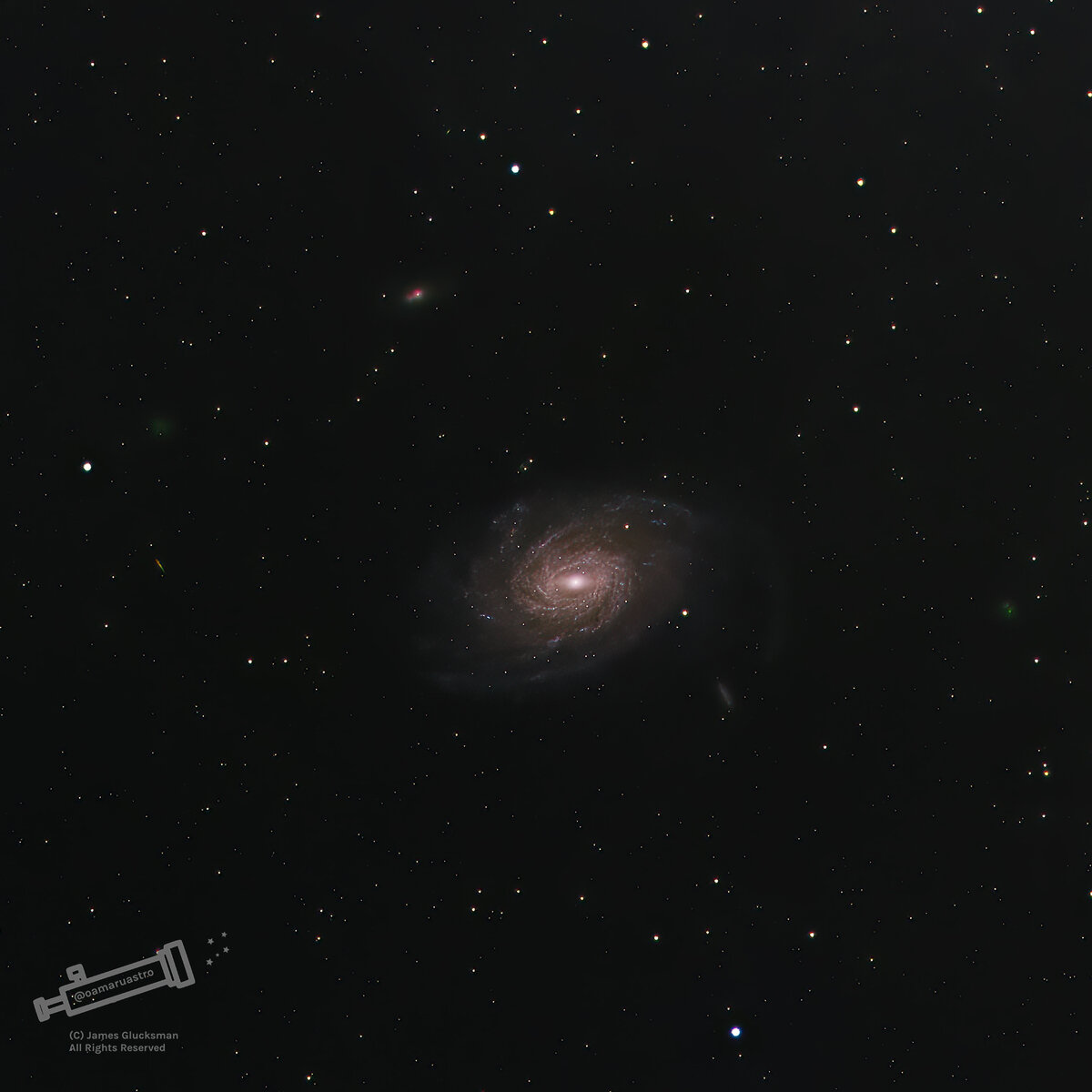
I was able to shoot a total of three targets over the course of the night, of which this is the first. It's NGC6744, a spiral galaxy that is considered a "big sister" to our Milky Way galaxy, located 30 million lightyears away in the constellation Pavo (so not visible to those of you north of the equator). In the image you can also see its smaller neighbouring galaxy, NGC6744A, to its lower right, and another lenticular galaxy to the upper left (it's that reddish-yellowish smudge). I still have a lot of work to do on processing these sorts of images, but I'm more-or-less happy with how this turned out. More to come!
On Sunday night just past, we had the promise of a long, clear night lasting nearly 10 hours. Unfortunately, I had made plans to go out to dinner with friends, which meant that the first two hours of the night were lost, since I would not be able to polar align my mount before we left for our appointment. (I do have one mount that is permanently set up, but I just got a new one, a ZWO AM5 that I wanted to use, and my partner has drawn the line at my having two tripods occupying space in our garden at the same time). So when I got home, I rushed to the patio, got the telescope quickly polar aligned (which is no longer something I dread, since the ASIAIR makes it so easy, even in the Southern Hemisphere) and set it up to go all night.
Up until now, I have not really shot any galaxies, preferring to focus on nebulae and other large subjects. One reason for that is that my imaging telescope only has a 443mm focal length with its reducer, so its reach is not that great. Another is that I am much more confident with narrowband imaging with a monochrome camera, so shooting in LRGB or with a one-shot colour camera is far less familiar, as is the subsequent processing of such images. But I decided to give it a try, using a ZWO ASI533MC-Pro camera (a colour camera with a square sensor) equipped with just a UV/IR cut filter to reduce any light pollution from the moon (and I'm not sure that even works for such a task).
I was able to shoot a total of three targets over the course of the night, of which this is the first. It's NGC6744, a spiral galaxy that is considered a "big sister" to our Milky Way galaxy, located 30 million lightyears away in the constellation Pavo (so not visible to those of you north of the equator). In the image you can also see its smaller neighbouring galaxy, NGC6744A, to its lower right, and another lenticular galaxy to the upper left (it's that reddish-yellowish smudge). I still have a lot of work to do on processing these sorts of images, but I'm more-or-less happy with how this turned out. More to come!


