North American Nebula - EOS R and 400mm lens

Andy Nowlen

Well-Known Member
Hi,

My archive hard drives are burning up during this rainy season!! This version of the North American Nebula NGC 7000 data acquisition goes back to my first few weeks of trying astrophotography - August 2020. Seems like a long time ago now. One thing is for sure, my post-processing skills have changed a lot from that time. That is a good thing for sure. They really needed to be improved!

August 2020
Canon EOS R - stock
Canon 100-400mm lens at 400mm
21 90 second subframes (back then I thought this was a lot!)
F 5.6
SkyWatcher Star Adventurer tracker
Some sort of shutter release timer
etc.

Jan 2022 processing
HOO style color palette
Astropixel processor
Pixinsight
Photoshop
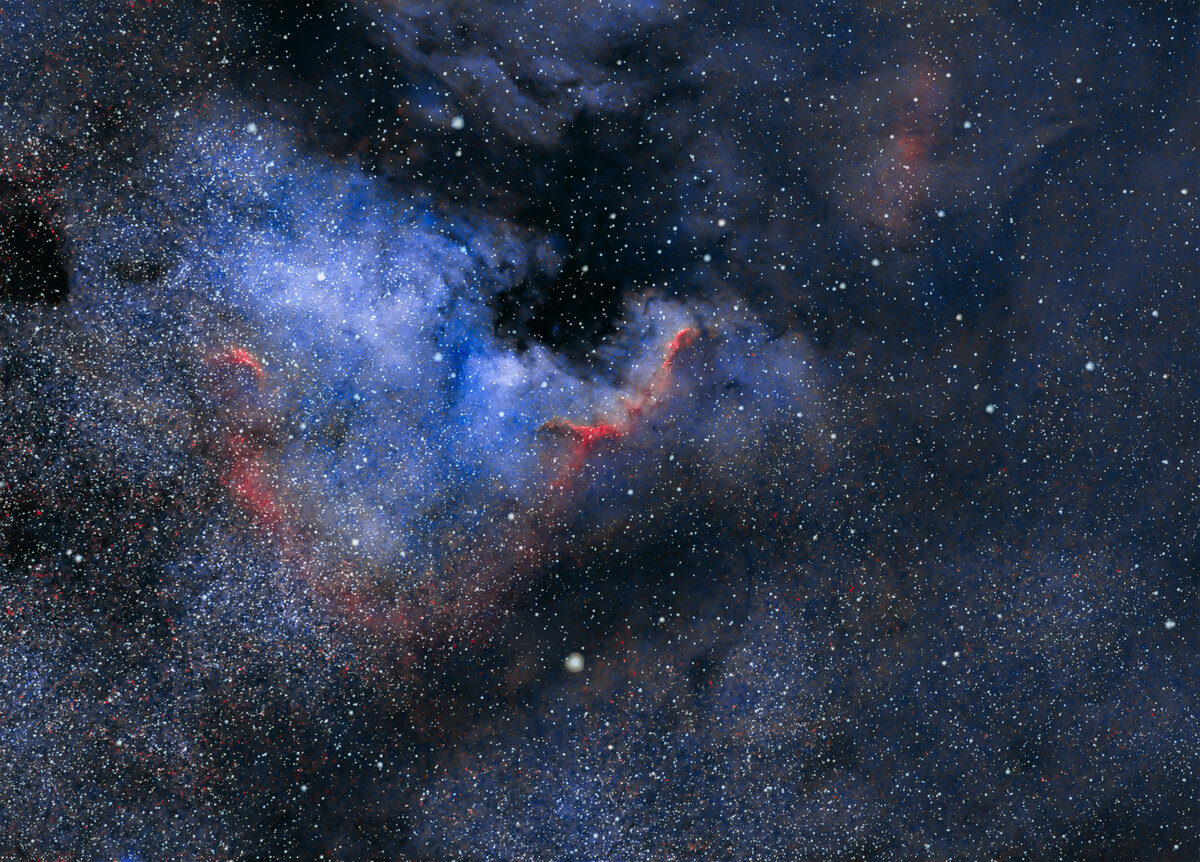

NGC 7000 North American Nebula HOO.jpg
 

JimFox

Moderator
Staff member
That's one good thing about the rains! :)

I sure like this! And I really like the color palette. I haven't tried that really with color images yet, though it's something I plan on doing this next year. This is a really cool representation of North American Nebula. I like how the red highlights the edges among the blue of the nebula. Have you thought about doing a slight star reduction? I know that can be a very personal choice. I have gone from full stars, to no stars (with Starnet++) and in general I use the Star Reduction Action in the Startools action set in Photoshop. I usually run it 3 or 4 times in a row. For me I like that look as the best of both worlds. There are still stars so it looks real, but less stars so the nebula pops out a little more. :)
 

Andy Nowlen

Well-Known Member
That's one good thing about the rains! :)

I sure like this! And I really like the color palette. I haven't tried that really with color images yet, though it's something I plan on doing this next year. This is a really cool representation of North American Nebula. I like how the red highlights the edges among the blue of the nebula. Have you thought about doing a slight star reduction? I know that can be a very personal choice. I have gone from full stars, to no stars (with Starnet++) and in general I use the Star Reduction Action in the Startools action set in Photoshop. I usually run it 3 or 4 times in a row. For me I like that look as the best of both worlds. There are still stars so it looks real, but less stars so the nebula pops out a little more. :)
I really like the starless / reduced star versions of images. For this one, I had challenges with that. I used starxterminator in PS. But due to the target location in the Milky Way, and the use of the lens and DSLR there were so many stars that the result left me wondering. So I added them back in for the earlier posting at about an 85% opacity 'lighten' layer. The starless version was not terrible but was a bit blotchy, so I decided with the stars would have to do. I have attached the starless version.

NGC 7000 HOO RGB 1 starless.jpg
 

Mike Lewis

Staff Member
Andy,

Fun to see what the EOS R can do for astroimaging. I have an R5 - do not plan to use it for astro,othjer than perhaps on a vacation to the Southern Hemisphere, if international travel should ever really be practical again. This is very nice. And like you say, usually most improved part of anyone's astro 'gear' is their post processing skills, if they stay in the hobby long enough :)


ML
 
Top Bottom