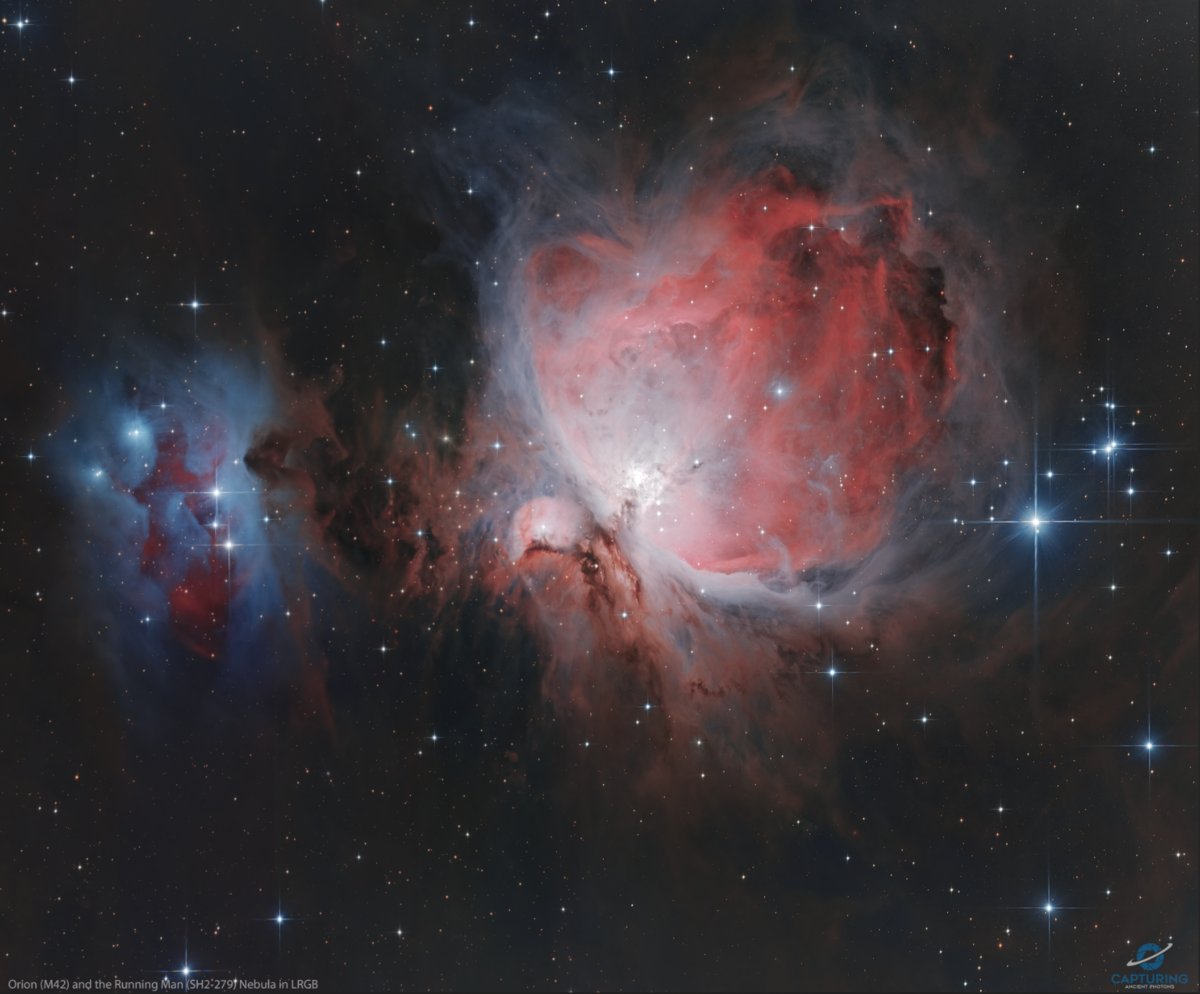
Orion (M42) and the Running Man (SH2-279) Nebula in LRGB

CRTAstro

Well-Known Member
Orion Nebula (M42) and the Running Man Nebula (Sh2-279) in a 2-panel mosaic shot in LRGB. Was still able to showcase the interstellar gas and dust clouds surrounding M42 and Sh2-279 without blowing out the core (trapezium) too much of M42. M42 is only 1,500 light-years away and about 30 to 40 light-years in diameter and is clearly visible in the constellation Orion on a clear night. The nebula is an enormous cloud of dust and gas where vast numbers of new stars are being forged. Sh2-279 is an HII region and bright nebula with an embedded reflection nebula that resembles a running man hence the name.

293 x 60s LRG subs shot @-10C spread across 2 nights for a total integration time of about 5hrs
For a higher resolution visit: https://www.astrobin.com/fr4e3f/
1669779572939.png
 

JimFox

Moderator
Staff member
Wow! Great job Carlos! Love the detail in this, the texture and coloring is so appealing. You have me looking forward to some new capturing and processing on my part of this.
 

Mike Lewis

Staff Member
Very nice, excellent job managing the dynamic range in this target. I am currently playing around with some new data on this as well; I will be very happy if I can get a result as nice as this.

ML
 

CRTAstro

Well-Known Member
Very nice, excellent job managing the dynamic range in this target. I am currently playing around with some new data on this as well; I will be very happy if I can get a result as nice as this.

ML
Thanks Mike ! Yes Orion is always tricky especially if you want a decent core and the outer cloud and dust lanes to display. PI's GHS again proved its worth by handling the stretch pretty decently. Also, 60s seemed a good enough long exposure for my gear to bring out the above. Can't wait to see what you come up with your data !

CS
Carlos
 

Mike Lewis

Staff Member
Thanks Mike ! Yes Orion is always tricky especially if you want a decent core and the outer cloud and dust lanes to display. PI's GHS again proved its worth by handling the stretch pretty decently. Also, 60s seemed a good enough long exposure for my gear to bring out the above. Can't wait to see what you come up with your data !

CS
Carlos

Carlos,

Very good. I have been in the NB realm for so long I think I have forgotten a little about good old LRGB collection and processing :) I shot a stack at 120 secs, and for sure that has blown out the core. I followed that up with a 30 sec stack - perhaps I can process both and then do a combine in some rational way to get a result that helps out the dynamic range problem at least a little bit.

On a related topic, I have tried to move over to using GHS for stretching, and I did use it on my recently posted Flaming Star Nebula image. That being said, even after watching some videos on it and blundering about with it I still feel like I am really not sure what I am doing with it. Perhaps we should exchange some info on your workflow using it, you are certainly getting impressive results.

ML
 

CRTAstro

Well-Known Member
Carlos,

Very good. I have been in the NB realm for so long I think I have forgotten a little about good old LRGB collection and processing :) I shot a stack at 120 secs, and for sure that has blown out the core. I followed that up with a 30 sec stack - perhaps I can process both and then do a combine in some rational way to get a result that helps out the dynamic range problem at least a little bit.

On a related topic, I have tried to move over to using GHS for stretching, and I did use it on my recently posted Flaming Star Nebula image. That being said, even after watching some videos on it and blundering about with it I still feel like I am really not sure what I am doing with it. Perhaps we should exchange some info on your workflow using it, you are certainly getting impressive results.

ML
Check this vid out for a simple way to use GHS, boils down to 3 stretches and he explains it really well:

My current workflow is DynamicCrop -> LinearFit -> ColourCombination -> Background Extraction (DBE/ABE) -> BackgroundNeutralization -> SCNR(Green) -> ColourCalibration (now using SPCC) -> NoiseReduction(StarXTerminator) -> Final stretch (Histogram/ArcsinhStretch/GHS) -> Magenta star correction -> Star Extraction -> Color Grading (ColorMasks) -> Process stars -> Star Addition -> RGB Convolution -> Add Luminosity (LRGBCombination where Lum/Ha layer has been pre-tone mapped and sharpened) -> LocalHistogramEqualization -> Add Ha (if needed) -> Color Grading -> Touch Up (Photoshop)

I use this both for broad and narrowband processing the only differences being in the color combination and luminosity steps.
 

Mike Lewis

Staff Member
Carlos,

Thanks for your prompt and detailed reply. Lots of similarities between our workflows. I do my star removal while still in the linear phase, to allow for stretching of nebulosity without regard for the effect on stars. I then add in a separately processed small stack of RGB stars back in later. Fun and instructive to see how you do it. I will definitely check out the video tutorial, hopefully some good GHS info in there.

Much appreciated!

ML
 

CRTAstro

Well-Known Member
I used to extract stars in the linear stage as well but since switching to the 3nm NB filters I find the stars are a lot smaller and they can handle a stretch without too much distortion

CS
Carlos
 
Top Bottom