Orion Nebula

JimFox

Moderator
Staff member
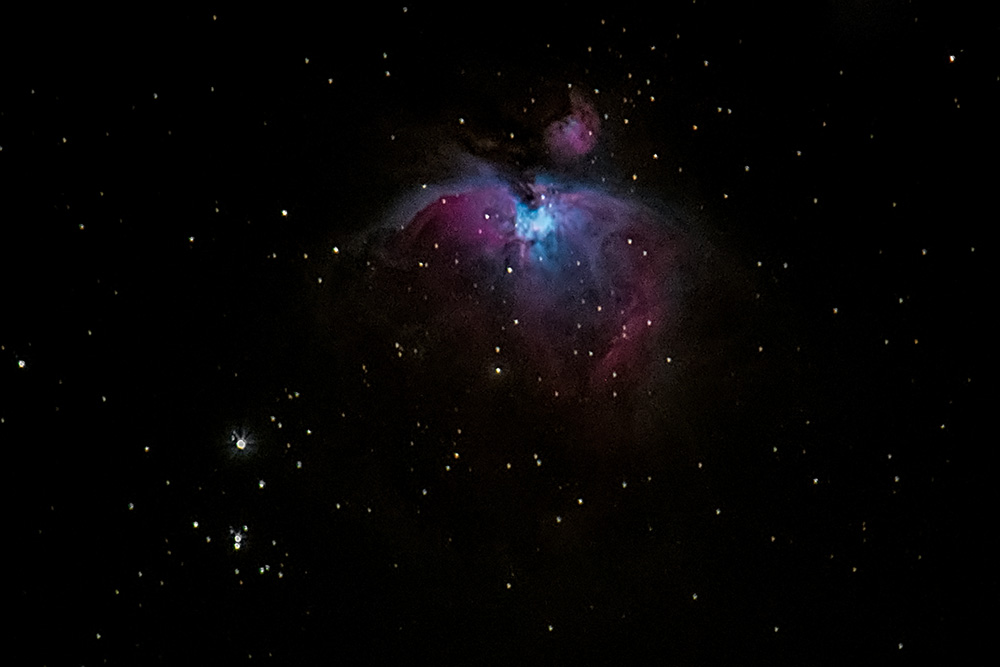
After shooting the Flame Nebula last week, I switched to Orion which is just next door to it. :)

When I did this one, I was able to shoot it at ISO 1600 instead of ISO 6400, not totally sure why, but it's what I was able to do so I went with it. :) This also is a single image as the stacked version of 20 shots actually made the stars too large when processed in DeepSkyStacker. I just started using that program so I am not sure why it made the stars so large, when it didn't with the Flame Nebula. I have a lot to learn. So when it dawned on me that I had shot this at ISO 1600, I just worked with a single image. Noise wasn't really an issue at that point.

Nikon D850
Tamron 150-600mm @ 600mm
ISO 1600
30 sec
f6.3
Single image

All comments are welcome,

Jim
_D850837_Orion_dw.jpg
 

AlanLichty

Moderator
Interesting to read along with your journey into astro photography. These aren't the results I would have expected by simply placing your camera on a tracker. Looking forward to where your journey takes you next :)
 

Colorado CJ

Well-Known Member
Nice! Looks like you are coming along great with your start in astrophotography!

WARNING!! It is all too easy to become addicted :p
 

JimFox

Moderator
Staff member
Interesting to read along with your journey into astro photography. These aren't the results I would have expected by simply placing your camera on a tracker. Looking forward to where your journey takes you next :)
Thanks Alan, it’s certainly amazing what the camera and a long lens can see in space. While I won’t be able to match the quality that Andrew or Mike can produce, so far I am really happy with what I have been able to capture. The next step will be to learn the locations of some other Galaxies and Nebulas that aren’t right at Orion. While the tracker I have is great, it doesn’t really have any really “fine” adjustments, so it’s harder to track down objects that aren’t right next to a super bright star. But that’s my next goal.
 

JimFox

Moderator
Staff member
Nice! Looks like you are coming along great with your start in astrophotography!

WARNING!! It is all too easy to become addicted :p
Hey Andrew, thanks so much! And thanks so much for all of your help in the background, you have been a really huge help.

Ha ha, I am trying not to think too far down the road!
 

Mike Lewis

Staff Member
Jim,

Great result, especially on a single frame! To answer your one question, you were able to dial down the ISO because of the much higher brightness of this object. In fact, M42 is often shot with mutiple image durations and then combined (basically a manual HDR treatment) becuase of the huge brightness difference between the core stars and the fainter wispy nebula regions. The bright core area, referred to as the Trapezium or Trapezium Cluster, can be imaged at expsosures of 4 or 8 seconds, which yield virtually no nebula. Conversely, when capturing the fainter nebula detail the Trapezium will be completely blown out. That is not necessarily a bad thing though, as too much of an HDR treatment can make blending challenging and start to make things look a bit overly processed. Like most things in astroimagaing processing, it is a bit up to one's personal taste. Your 30 second single image is a good compromise on detail, noise, and dynamic range optimization, so losing some definition of the central core stars is totally fine IMHO.

The bloating of stars with multiple frames might be a seeing, tracking, or registration in post processing issue. To figure that out you would have to examine the individual frames in more detail. it could be as simple as a couple of 'bad' frames that could be tossed out, or it could be more complex.

And as Andrew points out, watch out, you are flirting with a new, powerful, economic 'black-hole' that can easily pull your wallet in if you are not careful! :)

ML
 

JimFox

Moderator
Staff member
Jim,

Great result, especially on a single frame! To answer your one question, you were able to dial down the ISO because of the much higher brightness of this object. In fact, M42 is often shot with mutiple image durations and then combined (basically a manual HDR treatment) becuase of the huge brightness difference between the core stars and the fainter wispy nebula regions. The bright core area, referred to as the Trapezium or Trapezium Cluster, can be imaged at expsosures of 4 or 8 seconds, which yield virtually no nebula. Conversely, when capturing the fainter nebula detail the Trapezium will be completely blown out. That is not necessarily a bad thing though, as too much of an HDR treatment can make blending challenging and start to make things look a bit overly processed. Like most things in astroimagaing processing, it is a bit up to one's personal taste. Your 30 second single image is a good compromise on detail, noise, and dynamic range optimization, so losing some definition of the central core stars is totally fine IMHO.

The bloating of stars with multiple frames might be a seeing, tracking, or registration in post processing issue. To figure that out you would have to examine the individual frames in more detail. it could be as simple as a couple of 'bad' frames that could be tossed out, or it could be more complex.

And as Andrew points out, watch out, you are flirting with a new, powerful, economic 'black-hole' that can easily pull your wallet in if you are not careful! :)

ML
Thanks Mike for those thoughts and ideas. It gives me something to look for the next time I run into that issue.
 
After shooting the Flame Nebula last week, I switched to Orion which is just next door to it. :)

When I did this one, I was able to shoot it at ISO 1600 instead of ISO 6400, not totally sure why, but it's what I was able to do so I went with it. :) This also is a single image as the stacked version of 20 shots actually made the stars too large when processed in DeepSkyStacker. I just started using that program so I am not sure why it made the stars so large, when it didn't with the Flame Nebula. I have a lot to learn. So when it dawned on me that I had shot this at ISO 1600, I just worked with a single image. Noise wasn't really an issue at that point.

Nikon D850
Tamron 150-600mm @ 600mm
ISO 1600
30 sec
f6.3
Single image

All comments are welcome,

Jim

View attachment 24700
This looks good to me, Jim. But what I know about astrophotography I could write on a dime wth large block letters.
 
Top Bottom