Rosette Nebula

JimFox

Moderator
Staff member
A few days ago on my way back from Colorado to California along the I-40, it was the new moon just a few days ago and I wanted to be able to stop and set up my Deep Space Astro gear. The Petrified Forest National Park sadly closes it's gates at sunset, but the good news is there is a large parking area just outside the gate. So I got there just after sunset and then set up my Astro gear and prepared for a night of DSO shooting. I am not sure what the Bortle scale is there, but I do know it's very very dark! :)

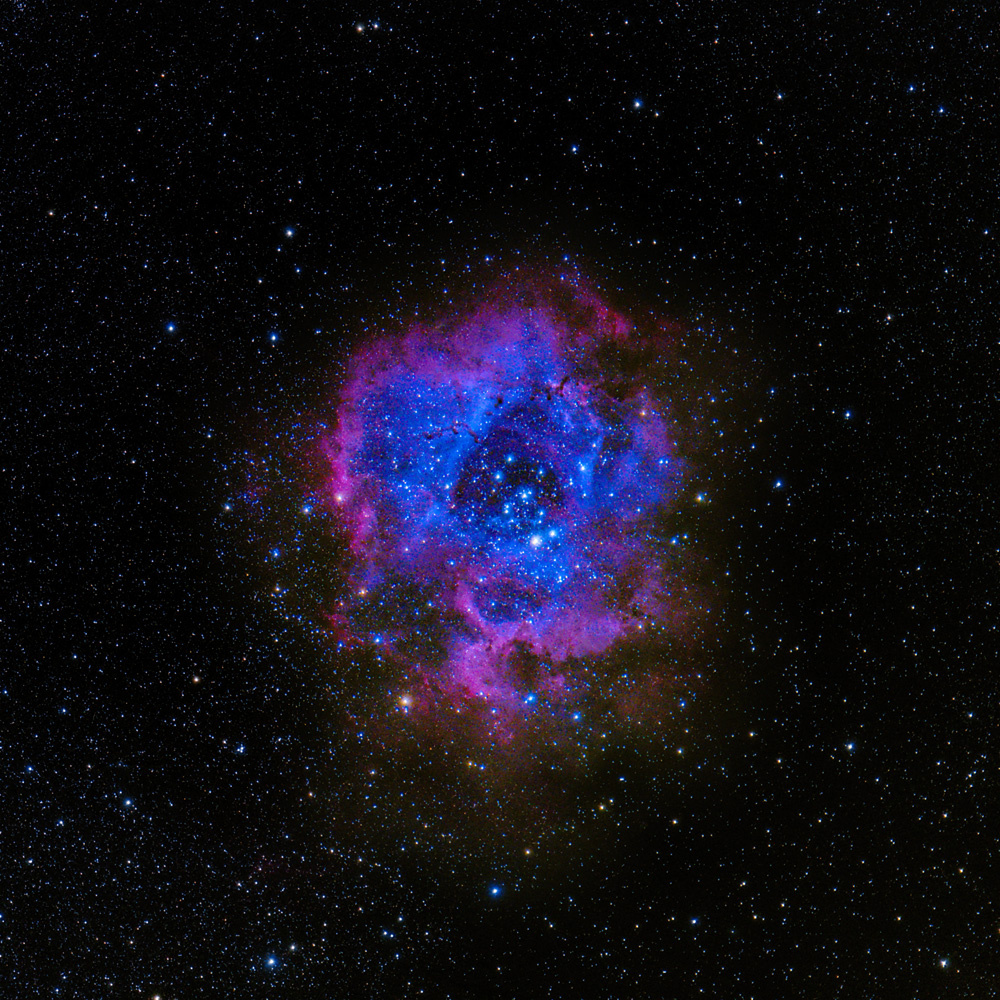
The Rosette Nebula (also known as Caldwell 49) is an H II region located near one end of a giant molecular cloud in the Monoceros region of the Milky Way Galaxy. The open cluster NGC 2244 (Caldwell 50) is closely associated with the nebulosity, the stars of the cluster having been formed from the nebula's matter.

Some of the detail inside the Nebular looking like ropes red nebula against the blue is maybe the finest amount of detail I have caught of that before. At least this time, it sure caught my eye.

70 Lights @ 90 secs, ISO 1600, f5.6
10 Darks
20 Flats
30 Bias
Combined in DeepSkyStacker
Processed in Photoshop

SkyGuider Pro - Tracking
Nikon D850 - unmodified
Tamron 150-600mm @ 300mm

All comments are welcome,

Jim
RosetteNebula_20211104_dw.jpg
 

AlanLichty

Moderator
Beautiful results with this image. For some reason I was always under the impression that you had to have incredibly long lenses to get shots of deep space objects like this. 300mm isn't all that long at all.
 

JimFox

Moderator
Staff member
Beautiful results with this image. For some reason I was always under the impression that you had to have incredibly long lenses to get shots of deep space objects like this. 300mm isn't all that long at all.
Thanks Alan!

Typically you do want or need longer, but there is a few objects out there that are larger.

This one is cropped a bit, but starting with a 42mp image, I still have pretty good resolution even after some cropping. I took this one at 300mm because I had started the even with my 150-600mm set at 300mm to take in the Andromeda Galaxy which is a really large object in the sky. So I decided since I had gotten it focused and balanced (balance is super important on a tracker) at 300mm, I would keep it at 300mm if I could.

You know how you have seen us also shoot and use what's called Darks, Flats and Bias frames that get stacked in to the image? The Flats are basically a solid white or blue image you take. I used to take mine with a white t-shirt stretched over the lens during the day after the night time shoot. They worked okay but with a zoom lens, if the lens gets moved at all then your Flats won't work very well. I started using a flat light panel at night that is a white light (my ipad set to Notepad) and it's an even white light, and I shoot 20 frames of that to end up with a white image that will show any vignetting from the lens. When it's stacked in with the rest of the frames, it in theory should remove the vignetting from your Deep Space image which can be pretty distinct.

Sometimes though, it doesn't work as well as you would like, so by shooting a bit wider, you can just crop out the vignetting. :)

But I will say, since I have switched from the daytime, tshirt created flats (which a lot of guys using the more low end gear like I do had recommended, to coming up with the idea for using my lightpad on a white screen as a Flats light source, vignetting isn't as much of any issue. And since it's so easy to do, I never forget to do it, like sometimes in the past I would end up forgetting to do the other type of flat.

Perhaps too much info for some, but I know you enjoy the background info.
 

JimFox

Moderator
Staff member
Nice shot Jim, do you think it is darker than where you go in Joshua Tree NP
Thanks so much Chuck!

Good question. I would say it was darker at the Petrified Forest. There are a few towns around there, but the closest is Holbrook about 25 miles away and it's not that big. Joshua Tree has a lot more towns both closer and of course much large towns that are further away. There isn't much light pollution along the horizon in the Petrified Forest, where Joshua Tree can have a lot depending on the angle.

There is a large level of comfort and feeling of safety at Joshua Tree though. I have been going there since I was 16, and at night there aren't many other vehicles going by, mostly locals I would guess. With the Petrified Forest, the parking area is literally right off the exit to the I-40 and there are thousands of vehicles passing by or getting off at that exit. In todays crazy world, you have no clue as to who those people are. So there was a level of concern being set up there at the Petrified Forest that I don't have when I am in Joshua Tree.
 
A few days ago on my way back from Colorado to California along the I-40, it was the new moon just a few days ago and I wanted to be able to stop and set up my Deep Space Astro gear. The Petrified Forest National Park sadly closes it's gates at sunset, but the good news is there is a large parking area just outside the gate. So I got there just after sunset and then set up my Astro gear and prepared for a night of DSO shooting. I am not sure what the Bortle scale is there, but I do know it's very very dark! :)

The Rosette Nebula (also known as Caldwell 49) is an H II region located near one end of a giant molecular cloud in the Monoceros region of the Milky Way Galaxy. The open cluster NGC 2244 (Caldwell 50) is closely associated with the nebulosity, the stars of the cluster having been formed from the nebula's matter.

Some of the detail inside the Nebular looking like ropes red nebula against the blue is maybe the finest amount of detail I have caught of that before. At least this time, it sure caught my eye.

70 Lights @ 90 secs, ISO 1600, f5.6
10 Darks
20 Flats
30 Bias
Combined in DeepSkyStacker
Processed in Photoshop

SkyGuider Pro - Tracking
Nikon D850 - unmodified
Tamron 150-600mm @ 300mm

All comments are welcome,

Jim

View attachment 44115
Jim, this is such a beautiful shot, the color really pops.

I have a quick question, do you use iPolar ? (the electronic polar alignment camera ) My eyesight is fading a bit, I have trouble looking at night, this little gadget seems a nice helping tool.

https://astrobackyard.com/ioptron-ipolar-skyguider-pro/

I don't mind pulling out the guts of iOptron guide pro, just wonder how this compares to a dedicated guiding camera?


Thanks

Oliver
 

Attachments

Mike Lewis

Staff Member
Jim,

Very nice result you did resolve some of the inner detail and have some very good colors on this too. Would love to see the black level pulled up a bit but we have already had that discussion :) A very impressive result on this wonderful object!

ML
 

JimFox

Moderator
Staff member
Jim, this is such a beautiful shot, the color really pops.

I have a quick question, do you use iPolar ? (the electronic polar alignment camera ) My eyesight is fading a bit, I have trouble looking at night, this little gadget seems a nice helping tool.

https://astrobackyard.com/ioptron-ipolar-skyguider-pro/

I don't mind pulling out the guts of iOptron guide pro, just wonder how this compares to a dedicated guiding camera?


Thanks

Oliver
Thanks so much Oliver!

The iPolar only does polar alignment. Unless I missed something it doesn’t do guiding, just the polar alignment.

I am going to be ordering the ioptron GEM28 for Christmas, and I will be getting it with the ipolar. :)

I have heard that the iPolar can polar align by using the iPolar along with the hand controller. But you will need to connect the iPolar to a computer or the ASIAir Pro or Plus (which I will do)

Is Polar Aligning the issue or do you want the guide camera so you can take longer images?

As a note, I have always been able to polar align really well with the optical polar alignment on my Sky Guider Pro. That is along as I could do it during twilight. But once the sky got dark, like if I got to an area late at night and set up, I could not optically polar align. I could never pick out Polaris in the little scope when at that view all the stars look about the same. I ended up getting a green laser light, and with that I can polar align no matter how dark it is.
 
Top Bottom