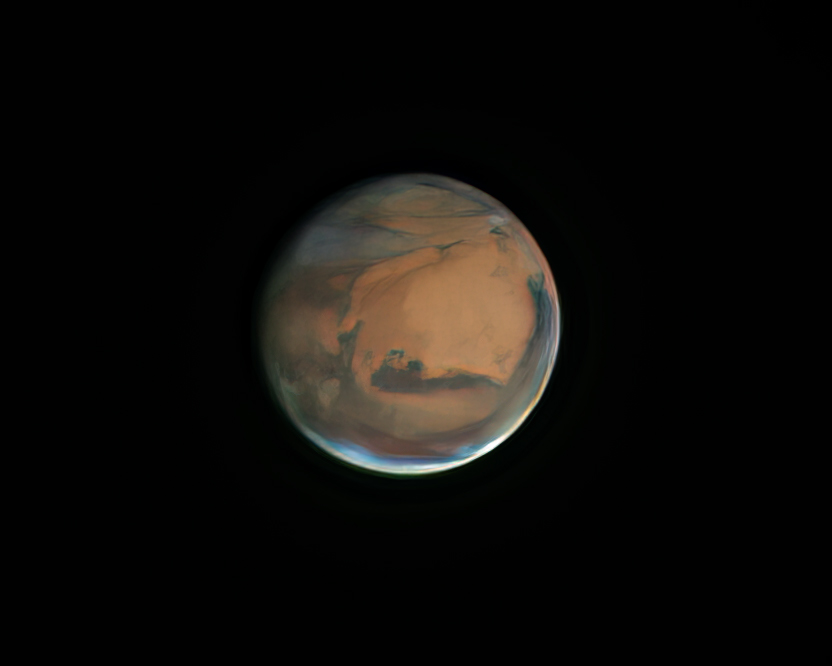
Since Mars is in the spotlight

chuckp

Well-Known Member
Since Mars has been in the spotlight lately I went back and reprocessed my images of Mars from 2016. This was the best time of the year for imaging the planets because of the seeing conditions. This 2020 Mars opposition was good but the weather did not cooperate and the heat of summer played havoc with heat radiating from neighbors roof's and from the pavement. The 2018 opposition was bad because of dust storms on Mars blocking out surface detail. These shots were taken with the Celestron 9.25 Edge with a 2x barlow. I used a DMK21au618 mono camera with Orion rgb filters and a 2x barlow. Resolution on the camera is only 640x480 max. Seeing was excellent! The Celestron 9.25 that I own is a really good scope. I check collimation most of the time before I shoot the planets.
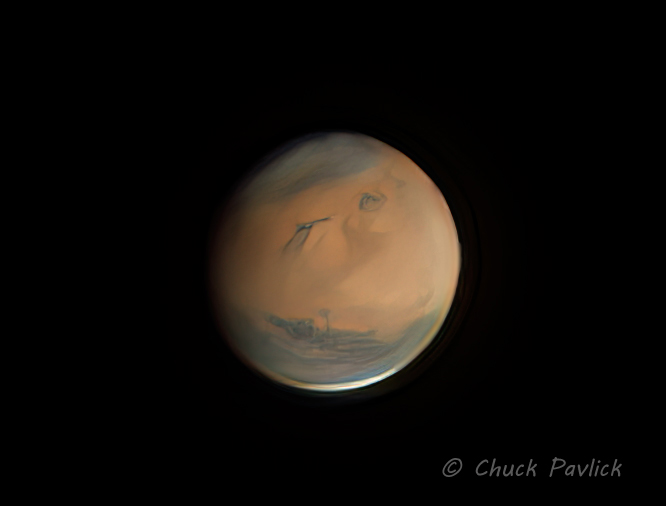
marsr16-06-28dngi.jpg
marsr0004-16-07dngi.jpg
mars16-06-14dngi.jpg
 

Ben Egbert

Forum Helper
Staff member
Great detail here I don't recall ever seeing images of Mars this good from any source.
 
Last edited:

chuckp

Well-Known Member
Beautiful imagery. Thanks for describing what it takes to get shots like these.
Thanks Alan, Excellent seeing with a steady atmosphere is what counts the most. There are many shots I take that a not good at all, I don't even bother to process then totally.
 

chuckp

Well-Known Member
Great detail here O don't recall ever seeing images of Mars this good from any source.
Thanks Ben, there are many excellent shots taken with scopes 8" and above. Like I said before I'm fortunate to live in an area that has a steady atmosphere, light pollution is bad but for the planets that does not matter.
 

Mike Lewis

Staff Member
Chuck,

Those are phenomenal - some of the best stuff I have seen. The seeing must be very special for you, although one still has to know what to do with the data afterwards to get such excellent results as these. If I eventually get set up with my Edge 8 again I will be pinging you for a few tips on how best to approach planetary imaging again, as I have forgotten a lot of the details. What was the FPS you were running on that camera at 640 x 480? How many frames did you run each filter for? About what percentage of frames were you able to keep in the stack for further processing?

ML
 

JimFox

Moderator
Staff member
These are really sweet Chuck! I enjoy the varied detail between all 3. Is the difference in detail because Mars rotates so each image is a different side of it? And I have been wondering for a while, why is the bottom of Mars always so bright? Is it reflecting light from the sun down there?

I have tried to pick a favorite of the 3, but since they each are different I can’t pick just 1. :)
 

chuckp

Well-Known Member
Chuck,

Those are phenomenal - some of the best stuff I have seen. The seeing must be very special for you, although one still has to know what to do with the data afterwards to get such excellent results as these. If I eventually get set up with my Edge 8 again I will be pinging you for a few tips on how best to approach planetary imaging again, as I have forgotten a lot of the details. What was the FPS you were running on that camera at 640 x 480? How many frames did you run each filter for? About what percentage of frames were you able to keep in the stack for further processing?

ML
Thank you Mike! The seeing is good to excellent here 90% of time. In the summer the seeing is better but I get my best shots after 1am because everything cools down little. When I used the DMK camera I could only get 30fps at the most on the planets. I usually stack at different percentages 30% to 80%, it all depends on how the video looks and process all and pick the best one. The DMK doesn't work that good with usb3.0 even when using the usb2 port so I started to use the ASI 1600. It is easier to use because I can use the whole sensor to find the target. That could be a problem at times when imaging at over 5000mm and use a 1/4" sensor. The ASI 1600 is working out good. Winjupos or Photoshop for channel combination, using what produces the best image. Topaz stuff has been a game changer but only on the good shots doesn't help the poor quality ones.
 

chuckp

Well-Known Member
These are really sweet Chuck! I enjoy the varied detail between all 3. Is the difference in detail because Mars rotates so each image is a different side of it? And I have been wondering for a while, why is the bottom of Mars always so bright? Is it reflecting light from the sun down there?

I have tried to pick a favorite of the 3, but since they each are different I can’t pick just 1. :)
Thanks Jim, and yes that is almost the whole surface, I think I have a few more to reprocess. Those are the polar cap and you can also see the clouds.
 

Yervant

Well-Known Member
Since Mars has been in the spotlight lately I went back and reprocessed my images of Mars from 2016. This was the best time of the year for imaging the planets because of the seeing conditions. This 2020 Mars opposition was good but the weather did not cooperate and the heat of summer played havoc with heat radiating from neighbors roof's and from the pavement. The 2018 opposition was bad because of dust storms on Mars blocking out surface detail. These shots were taken with the Celestron 9.25 Edge with a 2x barlow. I used a DMK21au618 mono camera with Orion rgb filters and a 2x barlow. Resolution on the camera is only 640x480 max. Seeing was excellent! The Celestron 9.25 that I own is a really good scope. I check collimation most of the time before I shoot the planets.
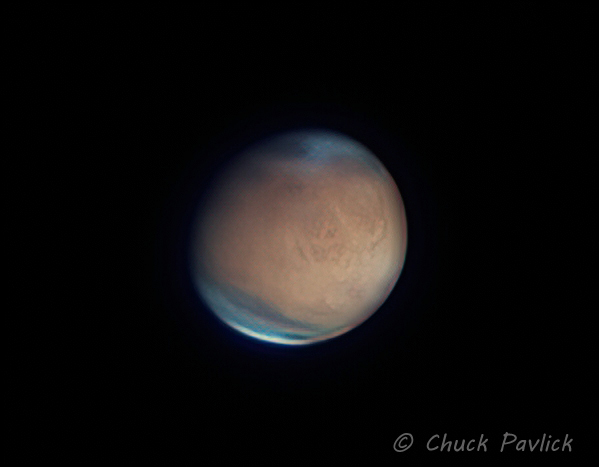
View attachment 36584View attachment 36585View attachment 36587
Outstanding
 

Mike Lewis

Staff Member
Thank you Mike! The seeing is good to excellent here 90% of time. In the summer the seeing is better but I get my best shots after 1am because everything cools down little. When I used the DMK camera I could only get 30fps at the most on the planets. I usually stack at different percentages 30% to 80%, it all depends on how the video looks and process all and pick the best one. The DMK doesn't work that good with usb3.0 even when using the usb2 port so I started to use the ASI 1600. It is easier to use because I can use the whole sensor to find the target. That could be a problem at times when imaging at over 5000mm and use a 1/4" sensor. The ASI 1600 is working out good. Winjupos or Photoshop for channel combination, using what produces the best image. Topaz stuff has been a game changer but only on the good shots doesn't help the poor quality ones.

Well it is nice to hear you are getting good results with the 1600, as I of course have that camera too. Are you in FL? I forget, but wow, that seeing is special. Here right next to the Rocky Mountains it is comically bad most of the time, like being just a few feet downstream from some rapids. I think the area I remotely image from in Southern AZ is noticeably better, although I am guessing not at the level you are displaying with these images.

ML
 

chuckp

Well-Known Member
Well it is nice to hear you are getting good results with the 1600, as I of course have that camera too. Are you in FL? I forget, but wow, that seeing is special. Here right next to the Rocky Mountains it is comically bad most of the time, like being just a few feet downstream from some rapids. I think the area I remotely image from in Southern AZ is noticeably better, although I am guessing not at the level you are displaying with these images.

ML
Yes in SW Fl. My best view of Saturn was through a 20" Obsession with binoviewers on an excellent seeing night. Enke division was clearly visible. I took a shot of it with with the first Orion Starshoot deep sky imager but nowhere near the quality with the newer cameras and software. I wish I could have used the camera I have now. Southern Az might be good.
 
Top Bottom