
Keith Grice
Active Member
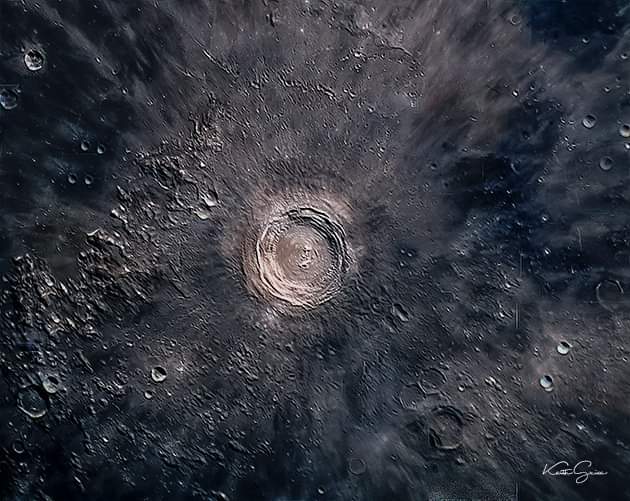
Copernicus Crater from the backyard.
One of the most prominent craters on the Moon. It constitutes a classic example of a relatively young, well-preserved lunar impact crater. Located near the southern rim of the Imbrium Basin (Mare Imbrium), Copernicus measures 93 km (58 miles) in diameter and is a source of radial bright rays, light-coloured streaks on the lunar surface formed of material ejected by the impact. Photographs of the crater taken from spacecraft above the Moon show terraced slumps on the crater walls that resemble giant stairs leading to the floor, 3.8 km (2.4 miles) below the rim crest. Peaked mountains rise from the centre of the crater to a height of 800 metres (2,600 feet); they probably were formed as a result of a rebound of deep-seated rocks at the site of impact. Lunar scientists estimated that Copernicus was created less than one billion years ago.
Skywatcher Mak 180 @ F/15.
ZWO ASI224MC camera.
EQ6 Pro Mount.
Captured in Sharpcap
Stacking in Autostakkert
Processing in Photoshop CC 2019
One of the most prominent craters on the Moon. It constitutes a classic example of a relatively young, well-preserved lunar impact crater. Located near the southern rim of the Imbrium Basin (Mare Imbrium), Copernicus measures 93 km (58 miles) in diameter and is a source of radial bright rays, light-coloured streaks on the lunar surface formed of material ejected by the impact. Photographs of the crater taken from spacecraft above the Moon show terraced slumps on the crater walls that resemble giant stairs leading to the floor, 3.8 km (2.4 miles) below the rim crest. Peaked mountains rise from the centre of the crater to a height of 800 metres (2,600 feet); they probably were formed as a result of a rebound of deep-seated rocks at the site of impact. Lunar scientists estimated that Copernicus was created less than one billion years ago.
Skywatcher Mak 180 @ F/15.
ZWO ASI224MC camera.
EQ6 Pro Mount.
Captured in Sharpcap
Stacking in Autostakkert
Processing in Photoshop CC 2019


