The Pinwheel Galaxy (M101)

Mike Lewis

Staff Member
Here is an image of The Pinwheel Galaxy (M101), a dramatic face-on spiral galaxy located at an approximate distance of 21 million light years from us, that never sets when observed from up here at 40 degrees North Latitude, and is well positioned for many observers in the Northern Hemisphere. This was imaged from dark skies at the Arizona Sky Village, near Portal, AZ in 2017. This is a natural color image using a dedicated astro camera, that allows the capture of some of the star forming regions (that show up as red or purple colored here) that are emitting very heavily in the Hydrogen-alpha wavelength. This was my first 'keeper' image from my 8" Celestron EdgeHD 800 scope.

Equipment:
ZWO ASI1600MM-C Camera @ -15C and
gain:139 Offset:21
Software Bisque MyT Mount, unguided
Celestron EdgeHD 800 8", with 0.62x reducer, 1260mm @ f/6.2

Software:
Pixinsight Commercial Version 1.8
Lightroom CC
Photoshop CC

Light Frames:
Luminance: 55 x 90 secs (82.5 mins)
Red: 6 x 150 secs (15 mins)
Green: 6 x 150 secs (15 mins)
Blue: 6 x 150 secs (15 mins)


Dark Frames:
20 x 90 secs (30 mins)
20 x 150 secs (50 mins)

Comments and critiques welcome!
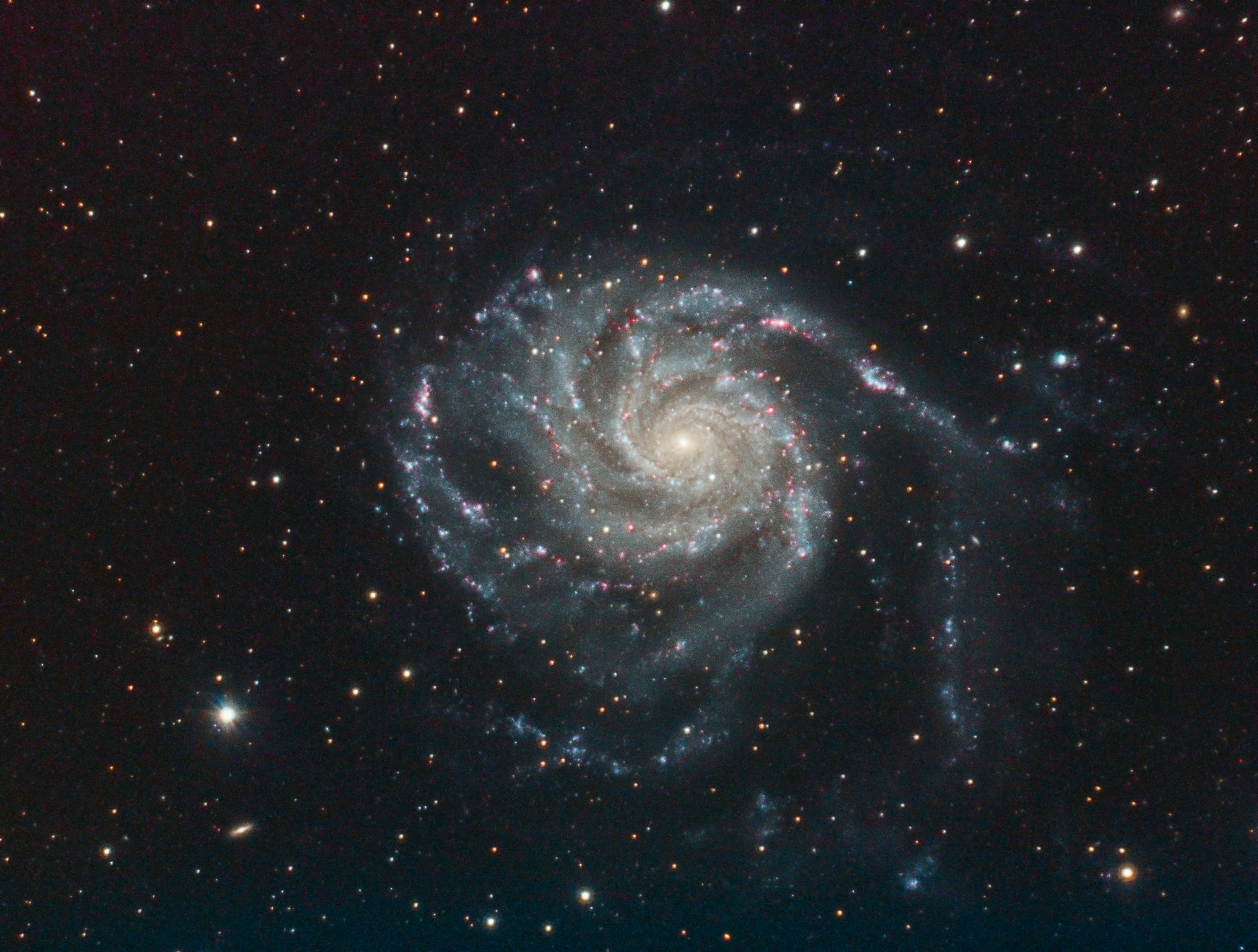

ML
 

AlanLichty

Moderator
Whoa - I am impressed. I thought images like these only came from large scale observatories. Beautiful image.

I would be hard pressed to keep track of all of the frames that go into such an image. How long does it take your computer to process something like this? If I am reading your technical info correctly you used 113 individual exposures to make the final image?
 

Mike Lewis

Staff Member
Thanks Ben and Alan!

Alan,

Yes, it is a lot of frames. But using dedicated software, the tedium of alignment and stacking can be greatly lessened. But even then, speaking for myself anyway, an image like this, by the time it has been pre-processed (dark and bias subtracted, aligned and stacked) and then gone through all the other processing steps, even a straightforward image takes at least 3 to 4 hours to complete. And that assumes there is not anything that requires extra fiddling. This was shot with a one shot color camera, so less data than shooting with filters using a monochrome camera, but also less actual resolution too. In my case, I get pretty wrapped up in the post processing part (I fortunately DO enjoy it) and often don't 'finish' an image as much as finally get sick of working on it :) For a number of technical reasons, most serious astroimagers end up using a dedicated monochrome camera designed for astro, although, lots of GREAT stuff is till shot with DSLRs too.

ML
 

JimFox

Moderator
Staff member
This is really awesome Mike! What a cool structure being a pinwheel like this!

Maybe by this time next year I can be taking images like this too.
 

Tom Narwid

Well-Known Member
Here is an image of The Pinwheel Galaxy (M101), a dramatic face-on spiral galaxy located at an approximate distance of 21 million light years from us, that never sets when observed from up here at 40 degrees North Latitude, and is well positioned for many observers in the Northern Hemisphere. This was imaged from dark skies at the Arizona Sky Village, near Portal, AZ in 2017. This is a natural color image using a dedicated astro camera, that allows the capture of some of the star forming regions (that show up as red or purple colored here) that are emitting very heavily in the Hydrogen-alpha wavelength. This was my first 'keeper' image from my 8" Celestron EdgeHD 800 scope.

Equipment:
ZWO ASI1600MM-C Camera @ -15C and
gain:139 Offset:21
Software Bisque MyT Mount, unguided
Celestron EdgeHD 800 8", with 0.62x reducer, 1260mm @ f/6.2

Software:
Pixinsight Commercial Version 1.8
Lightroom CC
Photoshop CC

Light Frames:
Luminance: 55 x 90 secs (82.5 mins)
Red: 6 x 150 secs (15 mins)
Green: 6 x 150 secs (15 mins)
Blue: 6 x 150 secs (15 mins)


Dark Frames:
20 x 90 secs (30 mins)
20 x 150 secs (50 mins)

Comments and critiques welcome!


ML
Nice detail.
 

Mike Lewis

Staff Member
WOW! Someday I hope to get something close to this. Very nice.

CJ,

Thanks! You are well on your way to images like this. I used a longer focal length scope, but I have also shot this with a 300mm lens and gotten a nice result. I would turn that new 80mm on it - you might be surprised at what you can pull out!@

ML
 
Top Bottom