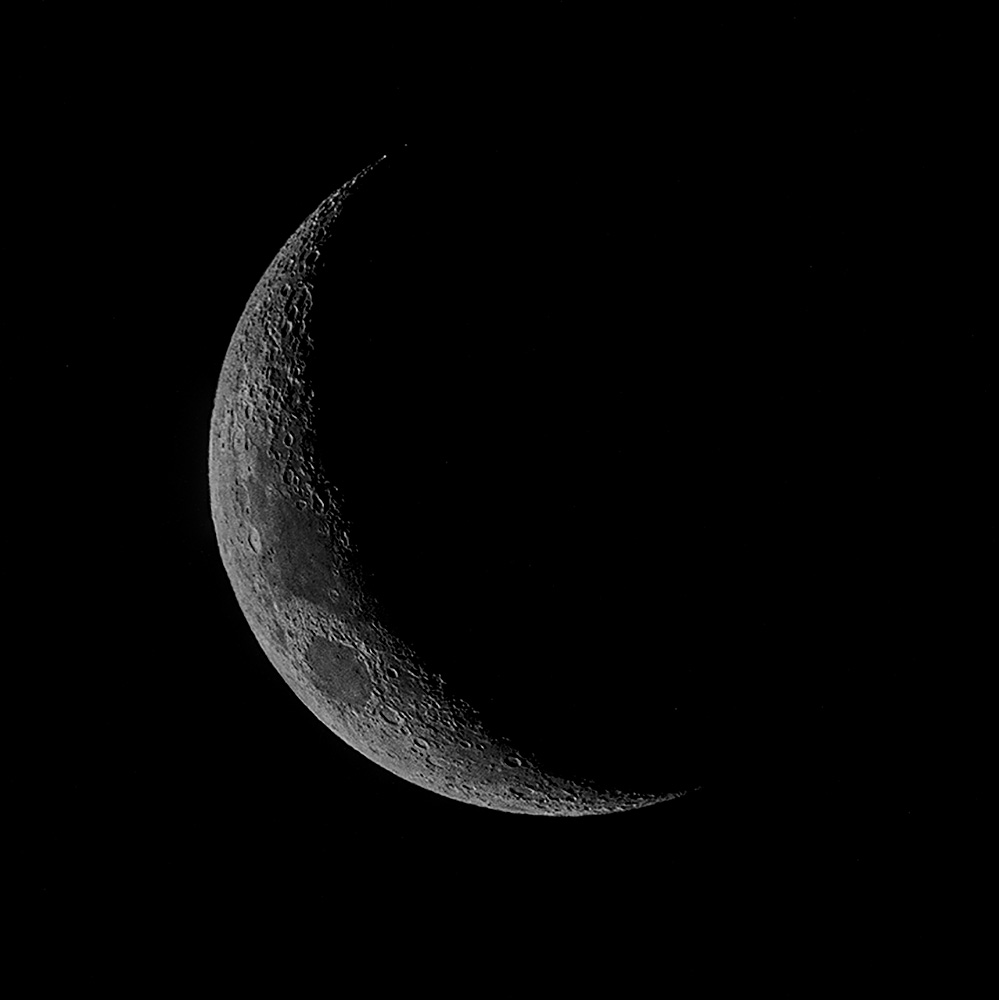
Waxing Crescent Moon - 2021/03/17

JimFox

Moderator
Staff member
It was a St Patty's moon, but it wasn't green! :)

The blizzard in Colorado messed up any chance of me doing any Deep Space Astro with the new moon this last weekend, we finally had some clearing skies tonight so I did the next best thing, and went out and photographed the moon. :)

Now I am hoping to drive an hour to the east by Ft Morgan Colorado and get some dark skies to try and get in a little Deep Space Astro on Thursday night. Hopefully that all works out while juggling 6 grandkids. :)

This was just a single image, I will work on a multi-stacked image later.

All comments are welcome,

Jim
_D855587_dw.jpg
 

JimFox

Moderator
Staff member
Very impressive single shot. Was there any earthshine visible in the shadow ?
I appreciate that Graeme.

Now my ignorance will show, what’s the earth shine? Is that where it picks up some colors reflecting off the earth?
 

Mike Lewis

Staff Member
JIm,

Nice image, captured at one of the best times to get good detail. I will look forward to your stack from this as well!

ML
 

Ken Rennie

Well-Known Member
Nice image. I am going to show my ignorance. Why would you need to stack a moon image? I know about the advantages of stacking astro images but can't work out why you would stack an object that is in full sunshine. Ken
 

JimFox

Moderator
Staff member
Nice image. I am going to show my ignorance. Why would you need to stack a moon image? I know about the advantages of stacking astro images but can't work out why you would stack an object that is in full sunshine. Ken
Hey Ken, I am answering this as a total novice mind you, but the advantages of stacking are several.

1. due to atmospheric disturbances the whole moon in the shot usually parts that end up not being sharp. So the stacking with the moon takes the sharpest parts of each image in the stack and combines them to end up with 1 image that is completely sharp.

2. Noise reduction.

3. I don’t totally understand this one, and maybe it’s tied into overall sharpness, but stacked images have better crater detail and definition.

I think that’s the reason we stack. Maybe @chuckp can jump in and correct or add to my list?
 

Ken Rennie

Well-Known Member
Hey Ken, I am answering this as a total novice mind you, but the advantages of stacking are several.

1. due to atmospheric disturbances the whole moon in the shot usually parts that end up not being sharp. So the stacking with the moon takes the sharpest parts of each image in the stack and combines them to end up with 1 image that is completely sharp.

2. Noise reduction.

3. I don’t totally understand this one, and maybe it’s tied into overall sharpness, but stacked images have better crater detail and definition.

I think that’s the reason we stack. Maybe @chuckp can jump in and correct or add to my list?
Thank you Jim. I have now read a few articles on this and can see the noise benefits and the ability to nullify the effects of atmospheric disturbances ( cancelling out the twinkle). I am still reading about the sharpening used and have tiny alarm bells going off in my head as the authors use sharpening techniques to enhance detail at a level that would never be used in a terrestial situation. Alternatively if we did use stacking and sharpening like this we might be able to produce super sharp terrestial images well beyond the normal, a bit like the computational techniques now being used in the latest smartphones. I think that I need to read more and perhaps resurrect my now, mostly forgotten, maths skills. Ken
 

chuckp

Well-Known Member
Hey Ken, I am answering this as a total novice mind you, but the advantages of stacking are several.

1. due to atmospheric disturbances the whole moon in the shot usually parts that end up not being sharp. So the stacking with the moon takes the sharpest parts of each image in the stack and combines them to end up with 1 image that is completely sharp.

2. Noise reduction.

3. I don’t totally understand this one, and maybe it’s tied into overall sharpness, but stacked images have better crater detail and definition.

I think that’s the reason we stack. Maybe @chuckp can jump in and correct or add to my list?
You pretty much said it like it is but the final image is only as good as the atmosphere will allow it. You can't make bad data look good, you can help it out a little but steady atmosphere is what make the solar system image. They do sell atmospheric dispersion correctors which do help out especially if you want to image the planets that are low in the sky.
 
Top Bottom