More Christmas Meadows. (+ edit)

Ben Egbert

Forum Helper
Staff member
I left home Sunday planning to explore Murdock Basin and camp at Little Deer Creek falls and then hike the Cataract Gorge near the start of the Duschsne tunnel. This is in the Uintas near Mirror Lake. But they had the road to the tunnel closed because of a fire. I did not wish to turn back so I went on up to Christmas Meadows. clouds were forecast but it was crystal clear.

I did a check and found that the Milky Way would be in good alignment around 10:00 Pm, so I took went back to camp and waited until then. The moonrise was not until around midnight and the MW would no longer be in a good position so I knew I was going to get a silhouette. But I have never seen the MW so easily with the naked eye as here at 8700 feet., clear sky's and no light pollution.

The first was before full dark so I did get some foreground detail, the last two were full dark and I mean dark. I either need a camera with better high ISO noise performance or a faster lens or both. I used both my 24-70 f2.8 and 11-24 F4 for these images. ISO3200 is just tolerable with a lot of nr and cropping of the banded areas.

These are not high quality compared to other Milky Way folks here, especially Jim and Kyle, so give it too me.

Before full dark, 24-70 at ISO1600
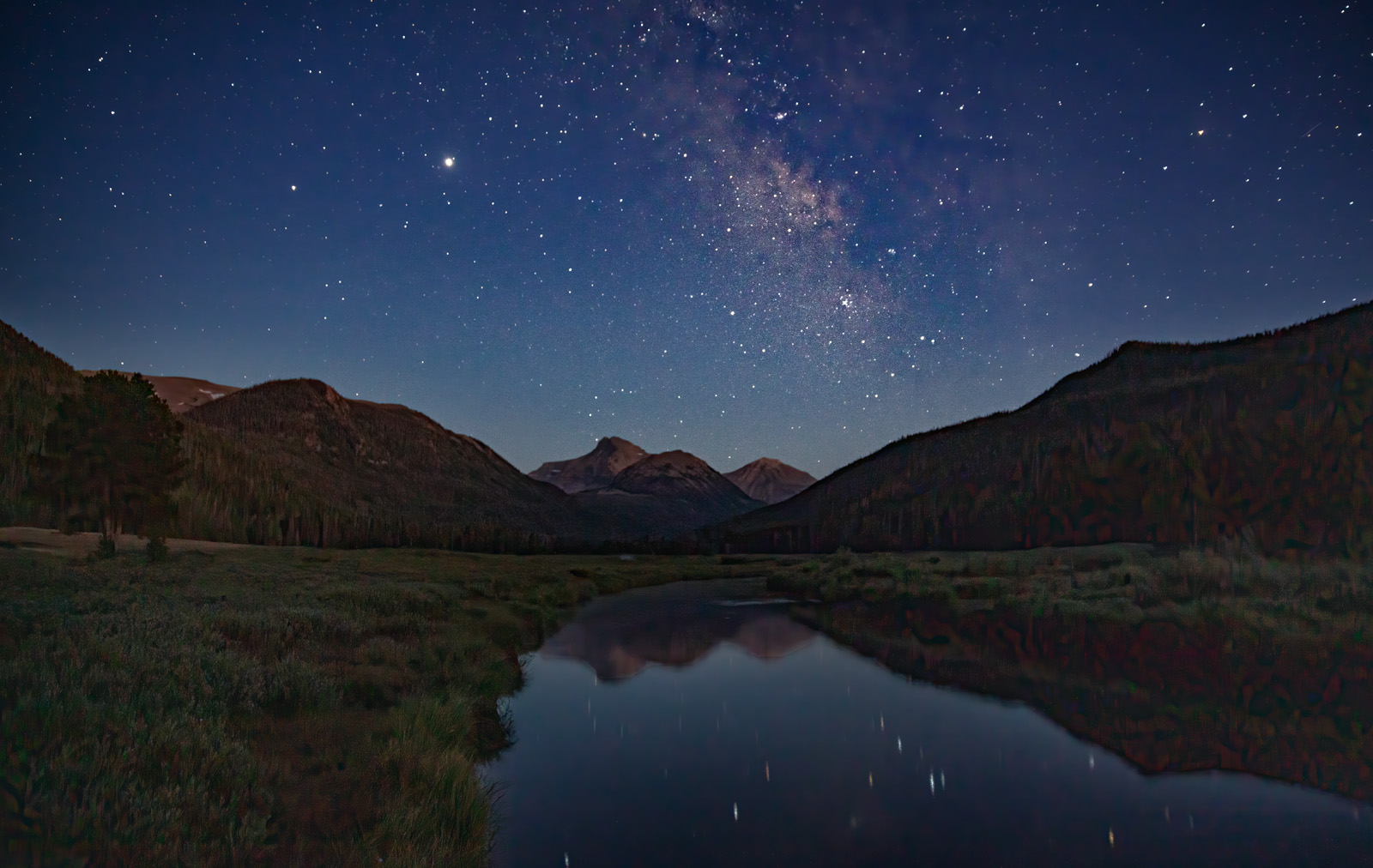
200809-14073-5DS R.jpg


Add a darker sky version of the above image
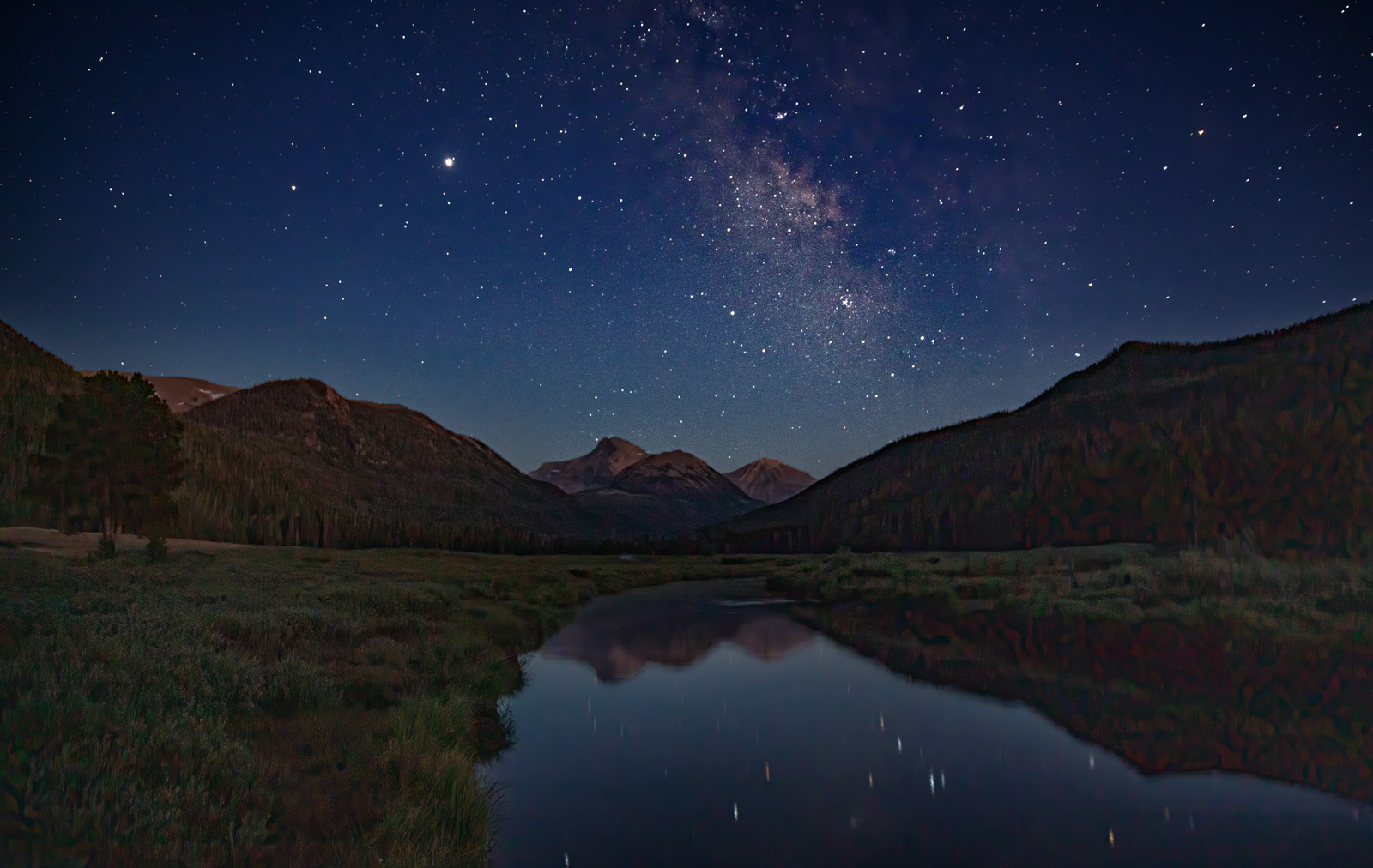
200809-14073-5DS R A.jpg


Next 2 are 11-24 and different processing.

200809-14089-5DS R.jpg


200809-14078-5DS R.jpg
 
Last edited:

Kyle Jones

Moderator
I think the first one is great. I'd probably darken the sky a little (maybe a levels layer masked to the sky and pull down the mids) and call that good.

You are right that it is really tough to get a good landscape in pure darkness - especially when limited to ISO 3200 and f/4. My best results in that situation are to do a really really long exposure at a lower ISO (maybe 800) to get some light from the stars on the ground and blend that with the sky image. I like the second one as a silhouette but the third doesn't do anything for me. I'd probably go a little more blue on the WB in the second but that's a matter of choice.
 

Kyle Jones

Moderator
The other option is to take a deep twilight image to get the ground and then wait for darkness to capture the sky and then blend. That requires the very challenging activity of not touching your camera between shots :)
 

Ben Egbert

Forum Helper
Staff member
I think the first one is great. I'd probably darken the sky a little (maybe a levels layer masked to the sky and pull down the mids) and call that good.

You are right that it is really tough to get a good landscape in pure darkness - especially when limited to ISO 3200 and f/4. My best results in that situation are to do a really really long exposure at a lower ISO (maybe 800) to get some light from the stars on the ground and blend that with the sky image. I like the second one as a silhouette but the third doesn't do anything for me. I'd probably go a little more blue on the WB in the second but that's a matter of choice.
Thanks Kyle, the moon was really bright last night, had it come up early enough to allow a good MW alignment it would have been super. The moon was at a 90 degree angle to the MW. That worked good for me at the Temple of the moon.

I will try darkening the sky.

The silhouette shots were sort of practice. There is a lot to learn in both capture and post processing. I shot all the way from ISO 1600 to 6400. The first was a low iso, but had to be brightened up so much it still have noise and banding issue.

Also note, I am not getting MW in the reflection, wonder why? I treated the reflection the same as the sky in processing.

I kind of like the first one with Kyle's suggestions for the sky.
Thanks Alan, I will give that a shot.
 

Ben Egbert

Forum Helper
Staff member
I saw it on the in camera review which provides a much brighter image than the actual raw. But it was gone most times when I processed it.
 

Jameel Hyder

Moderator
Staff member
Nice work on the edit Ben.

With respect to reflection, realize that the reflection is atleast a stop darker than the source.
 
Last edited:

Timmeh

Well-Known Member
I like the darker sky as well. You should try taking multiple exposures at high ISO so you have the files for processing if you decide to use a stacking program. I started doing it before I knew how to use the program, but now I have images I like with the equivalent of a 400 ISO sky. The rough conversion given to me is that the effective ISO is improved

one stop by stacking two images
two stops by stacking four images
three stops by stacking eight images
four stops by stacking sixteen images
etc.

I've been shooting 16 short 6400 ISO exposures and my skies are very clean. (I do need to shoot an exposure for the ground layer for blending though).

Tim
 

Ben Egbert

Forum Helper
Staff member
Thanks Tim, how on earth do you stack images with such great movement as the stars have in long exposures? I also have trouble blending a light ground layer. In this case I did not even try because of the river element. The river has a lot of grass around the bank so it presents a tough mask job.

I know how to use align layers, but if it uses the stars as the base the horizon will get skewed as each layer will need to be rotated.
 

Vieri

Well-Known Member
Love the first two, Ben :) Of the last two, I much prefer the last one, both as far as colour and composition - if I might add a suggestion, perhaps I would change image ratio to 4:3 to crop out the bottom (the fully black part of it). Just my .02, of course - hope this helps! Best regards,

Vieri
 

Ben Egbert

Forum Helper
Staff member
Love the first two, Ben :) Of the last two, I much prefer the last one, both as far as colour and composition - if I might add a suggestion, perhaps I would change image ratio to 4:3 to crop out the bottom (the fully black part of it). Just my .02, of course - hope this helps! Best regards,

Vieri
Thanks for the comments Vieri, good suggestion here, I will do it.
 

Kyle Jones

Moderator
Here is a cropped version of the last image per Vieri's suggestion
That works much better for me - I think the darkness at the bottom was part of my problem with it. I think this is much better balanced. I'd probably try adding a little more exposure to it at this point to brighten it a little - not because I want to show any more detail, just because it is still pretty dark.
 
Top Bottom