

I caught this down on Molas Pass south of Silverton in SW CO. I have not shot Deep Space Astro from there before, but knowing that area (It's one of my favorites) and knowing how dark it gets at night, I figured it would be a really good dark sky to shoot deep space in. The problem was the moon. Due to the grandkids week of rehersals and recitals the previous week, I was prevented from going out that week when the moon was not up at all. Now I had to shoot with rather large moon that wasn't setting until about 12:30am or so. Which only left me about 4 hours to image.
I got the Deep Space rig set up at twilight, right after I had gotten 2 cameras going for Milky Way timelapses. Once I was polar aligned and tested, I let it sit there for a few hours until closer to midnight. This isn't perfect by any means, but each time out is a learning experience and a building experience of practicing Deep Space Astro techniques.
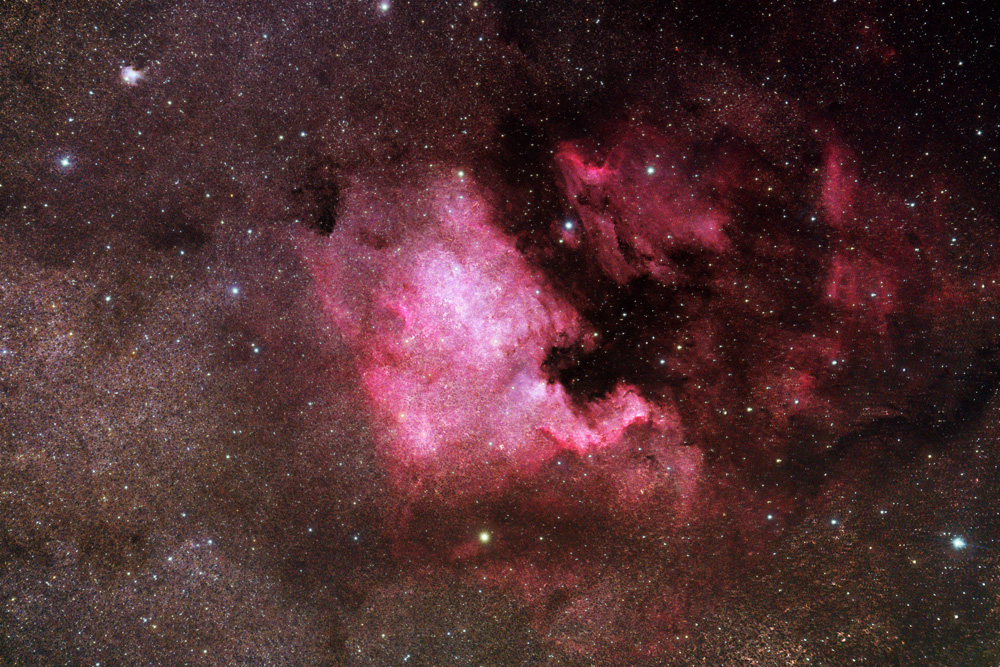
You can see the Milky Way dust in the bottom and left sides. You can see the Pelican Nebula to the upper right of the North America nebula. I stacked and stretched this a bit in DeepSkyStacker and Photoshop. Then ran it in Starnet++ to remove the stars. I then stretched and massaged that without the stars (So the stars dont get too bloated). When done with that, I then used the Light Mode overlay in Photoshop to blend the stars back in from the older layer.
All comments are welcome,
Jim
SkyGuider Pro
Nikon D850 - Not Modified
Tamron 150-600mm
70 - 120 sec, ISO 800, f6.3 @ 300mm
Darks - 15
Flats - 20
Bias - 20
I got the Deep Space rig set up at twilight, right after I had gotten 2 cameras going for Milky Way timelapses. Once I was polar aligned and tested, I let it sit there for a few hours until closer to midnight. This isn't perfect by any means, but each time out is a learning experience and a building experience of practicing Deep Space Astro techniques.
You can see the Milky Way dust in the bottom and left sides. You can see the Pelican Nebula to the upper right of the North America nebula. I stacked and stretched this a bit in DeepSkyStacker and Photoshop. Then ran it in Starnet++ to remove the stars. I then stretched and massaged that without the stars (So the stars dont get too bloated). When done with that, I then used the Light Mode overlay in Photoshop to blend the stars back in from the older layer.
All comments are welcome,
Jim
SkyGuider Pro
Nikon D850 - Not Modified
Tamron 150-600mm
70 - 120 sec, ISO 800, f6.3 @ 300mm
Darks - 15
Flats - 20
Bias - 20
Last edited:


