Rosette Nebula 2020, Feb 18 & 25 Combined

JimFox

Moderator
Staff member
For this one I combined the data from 2 different nights a week a part. I shoot primarily with the Tamron 150-600mm G2 lens, and after my first night out I started taking notes and also making an effort to shoot any of my DSO targets at the same Focal length each time, just so I can stack data from multiple nights. Now in this case though they were not shot at the same ISO or shutter speed, which will be the next thing I will work towards to have more consistency with my exposure settings.

In this case, the first time I shot Rosette I was shooting at ISO 6400, the second time I was at ISO 800, with the difference being 60 secs of exposure vs 180 secs. Anyway, I used my original stacked Tiffs out of DeepSkyStacker and then stacked those 2 images into a Smart Object in Photoshop and then used a Median Blend with them. It seemed to work well and it processed nicely.

No Starnet++ this time for removing the stars. I did use some Star Reduction techniques to help dim the stars a bit if you will so that they didn't over shadow the Nebula.

All in all, I liked how this turned out.

Nikon D850
Tamron 150-600mm G2 @ 300mm
SkyGuider Pro - Tracking Mount

21 x ISO 6400, 60 secs f6
20 x ISO 800, 180 secs f6
10 x Dark for each


All comments are welcome,

Jim
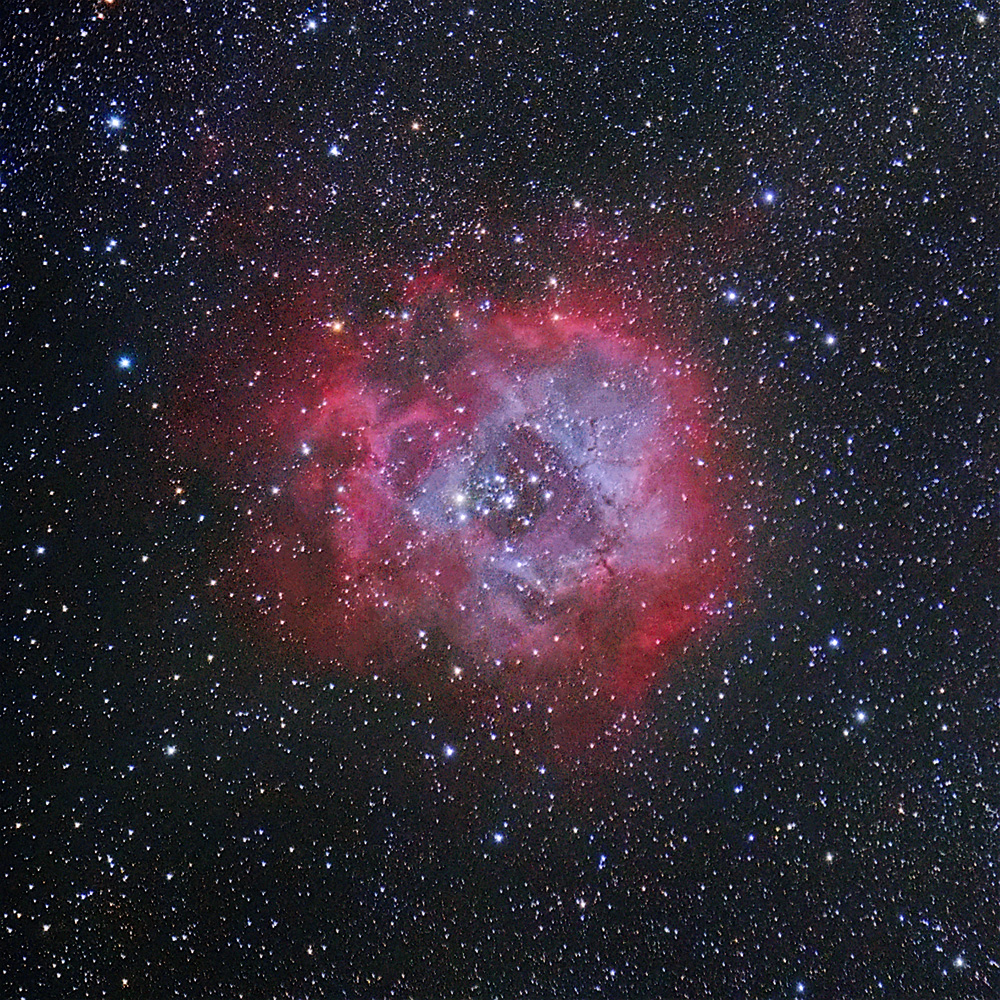
Rosette_Nebula_Combined_202002xx_dw.jpg
 

AlanLichty

Moderator
Looks pretty cool to my untrained eyes.

It still seems like magic that you can stack things like this and get coherent results.
 

Colorado CJ

Well-Known Member
You are pulling good nebulosity out of your shots.

That is a pretty dim target for a DSLR. Man I wish I had that kind of dark sky to shoot from!
 

JimFox

Moderator
Staff member
You are pulling good nebulosity out of your shots.

That is a pretty dim target for a DSLR. Man I wish I had that kind of dark sky to shoot from!
Thanks so much Andrew!

Are you familiar with the Clip-in Filters made by Astronomik? They make 2 CLS filters for full frame Nikon cameras. They are supposed to also enhance the Nebula's by allowing more red in. I am looking at those right now and doing some research. As you noted some of these targets are very faint, so if a filter helps me pick up a bit more Nebula data that would be great.
 

Mike Lewis

Staff Member
Very nice! Getting some nice detail and the colors look very good. A super object that you have really started to optimize at your focal length. I think your capture skills are good, and now your post processing skills are starting to catch up! :)

ML
 

Colorado CJ

Well-Known Member
Thanks so much Andrew!

Are you familiar with the Clip-in Filters made by Astronomik? They make 2 CLS filters for full frame Nikon cameras. They are supposed to also enhance the Nebula's by allowing more red in. I am looking at those right now and doing some research. As you noted some of these targets are very faint, so if a filter helps me pick up a bit more Nebula data that would be great.

I've never used them, but Trevor from AstroBackyard has used them extensively. He seems to like them, but I am not sure if he took the hot mirror out of his DSLR. He uses Canon DSLR's, which have pretty easy hot mirror removal.

Here is his review on the Ha version of that filter. He has others on his YouTube channel for the CLS filters.


JimFox

Moderator
Staff member
I've never used them, but Trevor from AstroBackyard has used them extensively. He seems to like them, but I am not sure if he took the hot mirror out of his DSLR. He uses Canon DSLR's, which have pretty easy hot mirror removal.

Here is his review on the Ha version of that filter. He has others on his YouTube channel for the CLS filters.

Thanks Andrew! I will have to look at more of his video's. I think I had seen him mention them one time so that's what got me thinking.

For some reason there are tons of those filters out for Canon, unfortunately only a couple to choose from for Nikon. I am toying with getting a Williams Optics Redcat 51 because I think it will allow me to use the 2" filters which are in ready supply and variety.
 

JimFox

Moderator
Staff member
Very nice! Getting some nice detail and the colors look very good. A super object that you have really started to optimize at your focal length. I think your capture skills are good, and now your post processing skills are starting to catch up! :)

ML
Thank you Mike! Yep, the post processing is coming along slowly but surely. It is one of those cases where it's all about the journey. :)
 

Mike Lewis

Staff Member
As Andrew says, the stock filter in your Nikon will limit the efficiency of H-a collection, as well as the Bayer filter already on the sensor. But your camera has shown itself to be a little more sensitive to H-a than I would have thought, and I have seen some interesting results with these type of filters on DSLRs. How much are these filters going for these days? Always possible to find one used for a discount too on Astromart or Cloudy Nights.

ML
 

JimFox

Moderator
Staff member
As Andrew says, the stock filter in your Nikon will limit the efficiency of H-a collection, as well as the Bayer filter already on the sensor. But your camera has shown itself to be a little more sensitive to H-a than I would have thought, and I have seen some interesting results with these type of filters on DSLRs. How much are these filters going for these days? Always possible to find one used for a discount too on Astromart or Cloudy Nights.

ML
Thanks Mike!

I am not much for buying used, I prefer to buy new. The big caveat with the clip in filters for Nikon is you also then have to tape up the contacts on the AF Lens. I would really prefer not to be taping over contacts and having to deal with adhesive residue as I only have AF lenses to work with at this point.
 
Top Bottom