

Jim did a time lapse of stars circling Polaris while at Joshua tree a week or so back. I thought it was so cool I tried one of my own Saturday night while down at the south west end of Utah Lake. Too much light pollution, but the best I could do in winter.
I started with time lapse, but my Canon R5 has a 1/8 second max exposure length for in camera time lapse. So I switched to time interval which has no such limits. I used the Rokonon 14 f2.0 which reports f2.8 in the camera. 20 second exposures ISO 1600. I had my intervals set for 22 seconds, but they were more like 28 or so. You need to turn off image review to fix this issue.
I had a short time period when it was dark enough to shoot and before a near full moon rose above the mountains at about 8:15 so this is a very short TL.
I had lots of light pollution and some flare caused by stray light so I deleted a few frames causing some jumps. Also lots of aircraft. I left that in because I wanted to show what I was able to do and get some feedback.
I located Polaris using Sky Guide, but was only able to get close with aiming, a skill I need to master. I was not even sure which star in that general direction was Polaris. Looks like I was not too far off.
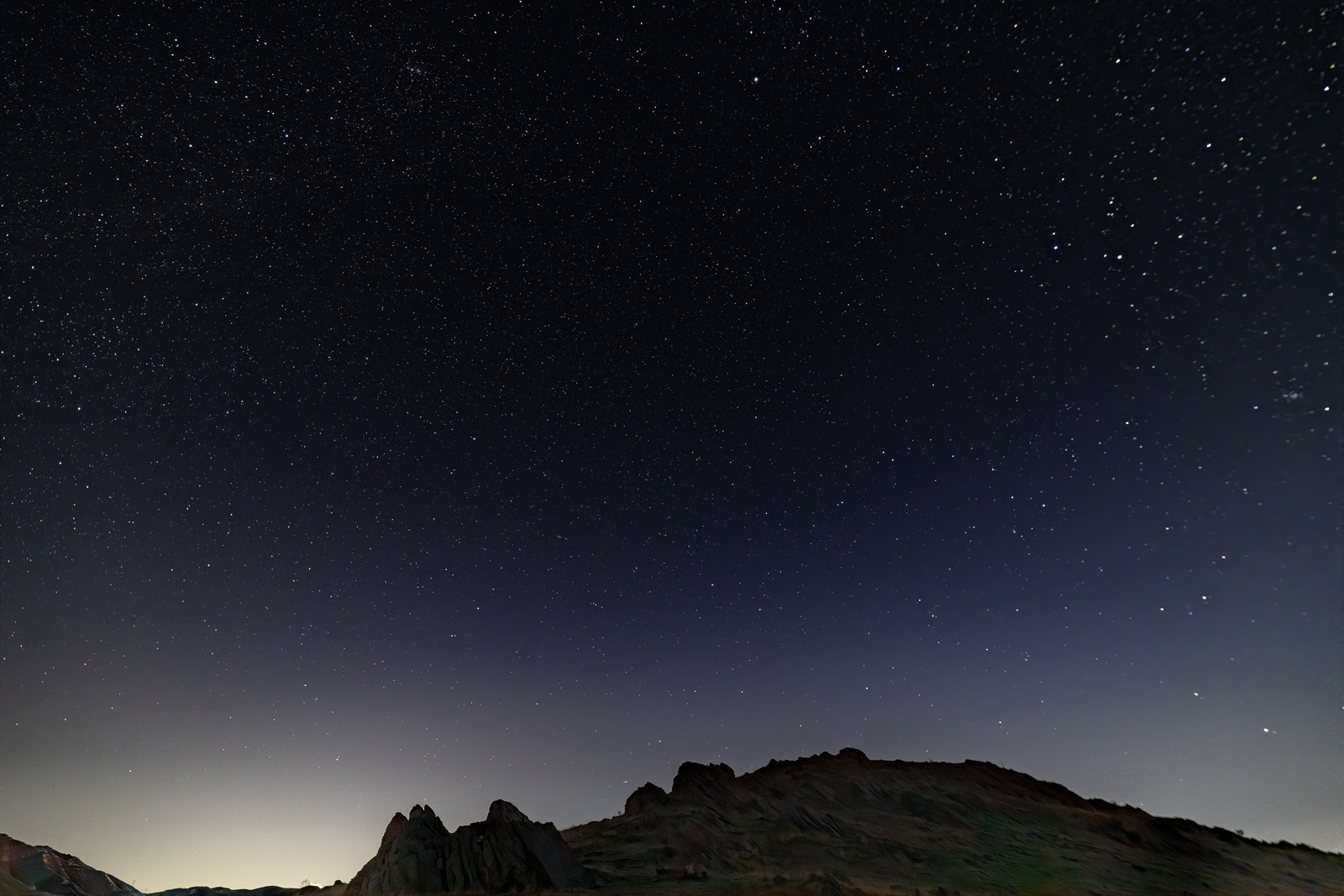
Here is a single shot I picked to process in the normal manner. I was pleased with the way the R5 and Rokonon 14 f2.0 handled star shots. Minimal NR was required. The focus was great but the corners are a bit soft, I might try f2.8 next time.
Not many stars show up in you tube std resolution, so I waited almost a full day for the 4k version.
I started with time lapse, but my Canon R5 has a 1/8 second max exposure length for in camera time lapse. So I switched to time interval which has no such limits. I used the Rokonon 14 f2.0 which reports f2.8 in the camera. 20 second exposures ISO 1600. I had my intervals set for 22 seconds, but they were more like 28 or so. You need to turn off image review to fix this issue.
I had a short time period when it was dark enough to shoot and before a near full moon rose above the mountains at about 8:15 so this is a very short TL.
I had lots of light pollution and some flare caused by stray light so I deleted a few frames causing some jumps. Also lots of aircraft. I left that in because I wanted to show what I was able to do and get some feedback.
I located Polaris using Sky Guide, but was only able to get close with aiming, a skill I need to master. I was not even sure which star in that general direction was Polaris. Looks like I was not too far off.
Here is a single shot I picked to process in the normal manner. I was pleased with the way the R5 and Rokonon 14 f2.0 handled star shots. Minimal NR was required. The focus was great but the corners are a bit soft, I might try f2.8 next time.
Not many stars show up in you tube std resolution, so I waited almost a full day for the 4k version.


